Showing posts with label social business. Show all posts

Tuesday, 5 July 2016

Riverstone and Interpret the Future team up again with OpenKnowledge at the Social Business forum 2016


Now in its ninth year, the Social Business Forum, Europe’s premier speaker and networking event dedicated to social business, will take place in Milan on the 6-7 July 2016. Held once again at the Marriott Hotel in the capital city of fashion and design, SBF16 features a unique offer of visionary keynote speeches, success stories and discussion panels organized in a Free and Premium Conference. The Free Conference includes the keynote speeches in the mornings of July 6th and 7th delivered by outstanding and internationally-known experts.
The theme of this year’s Social Business Forum is the Platfirm Age: Plug your Business – Play your Future. The focus of many of the keynote presentations will be on how platform-companies, such as Airbnb, Facebook and LinkedIn, have revolutionised traditional business models and developed continuously-evolving structures where value is co-created with users / customers.
All the keynotes will be simultaneously translated by Interpret the Future, the Social Business Forum’s longstanding specialist interpreting partners. This year, the team includes ItF founder members Loredana Nano and Alice Bertinotti. Daniela Negru will also be in the booths helping the team to provide a highly professional conference interpreting service. The project is managed by Robert Dennis, director of Riverstone Language & Communications.
Find out more...

Written by Robert Dennis
Robert has published an online business English course. Sign up for the free edition here.

Friday, 6 September 2013

Yes, the cold winds of recession are still blowing; but here in Milan things are hotting up for smart, creative firms...

I’ve just realised it’s been almost a year since I posted in this blog. That’s mainly because my focus has been elsewhere recently – in particular on Riverstone Language & Communications, the Social Business Forum, Interpret the Future and a number of other cool projects I have been working on. Right – so it’s time to bring you up to speed with what’s been happening here in Milan.

Well, the summer is over and here in this city that means that everything is really getting going again. Despite concerns about the economic situation (not to mention the political one) the business capital of Italy is revving up – and although confidence is not what it once was, these days there is a surge of interest and business activity being generated by Milan’s vibrant startup scene. It’s true that Italy’s traditional manufacturing sectors are facing huge challenges in the form of cheaper competition from abroad, depressed global markets for consumer goods and the cumbersome bureaucracy that tends to characterise the Italian business context; but on the plus side, Italy has a vast reservoir of talent, inventiveness and intelligence that it can put to good use. It is this country’s wealth of human capital that drives it – in conjunction, of course, with its legacy of beautiful landscapes and great food.

Milan is a post-industrial city
 that has reinvented itself as
a powerhouse of creative energy
Image: Wikimedia Commons
In the last few years Milan has seen something of a renaissance in the form of new kinds of knowledge-based businesses as well as more dynamic – if smaller – companies that are tapping into the country’s wells of brainpower and creativity. They are also attracting more international talent – and, indeed, one of the key strengths of this city is its relative diversity compared to other cities in Italy. I have been lucky enough to work with several of these firms (see below for some examples).

I am proud to live in Milan and to have met a large number of highly-motivated and creative people from many different sectors: I have taught and worked as a communications consultant alongside finance executives, marketers, designers, lawyers, doctors, academics, technology specialists and professionals from many disciplines - as well as entrepreneurs in the city’s growing startup scene.

I have also been able to develop contacts and find new business opportunities via social networking, which has also meant getting to grips with an ever-changing array of new social media tools and platforms (as well good old-fashioned face-to-face conversation!). During this time, the Milan Business English Network, which I founded three years ago, has been a great way of meeting people and getting in touch with companies that are doing fascinating and ground-breaking projects.

Riverstone Language and Communications is an innovative and highly flexible training and development and organisation, which I established with Helen Fish, an entrepreneur from the UK who is now working on her own exciting project. Riverstone also provides bespoke language services and informal networking events that bring people together who are interested in English and business communication. The Riverstone Network is a growing resource that is helping its members – mainly freelancers – to develop their careers.

Currently, I am involved with a number of companies as a communications consultant. I’d just like to highlight two of these here, both of which are typical of the kind of small, highly able and passionate businesses that fuel this city's success:

Firstly, there is OpenKnowledge, which I believe is an example of all that’s best about Milan (including the company's international outlook - it has offices in London, Shanghai and Sydney). It’s basically a small but growing corps of highly focused and experienced consultants as well as recent graduates from top universities. The company's mission is to help mainly large corporations adopt the social business paradigm. OpenKnowledge has been a pioneer in bringing the social business message to the corporate world and for the last six years it has organised the hugely successful Social Business Forum – Europe’s leading event in this field, which attracts high-profile keynote speakers such as IBM Vice President Sandy Carter and has welcomed over three and a half thousand visitors in its short history (so far!). This year Riverstone became a Marketing Service Partner of the SBF and was responsible for managing a team of brilliant, young interpreters as part of the Interpret the Future project.

Another company I collaborate with on a regular basis is the award-winning Reverse Innovation. They are a young, dynamic design agency which provides amazingly creative designs for structural packaging and communications for major corporate clients as well as some smaller firms. I work closely with Reverse and their highly-effective press manager to make sure everything they say to the world in English is crystal clear and hits just the right note.

So, what's on the horizon this autumn, then? In addition to our sparkling aperitivos, the Milan Business English Network will be presenting a series of informal business discussions and networking sessions. These will be by invitation-only and will address some key Milan themes: social media (and social business); technology and innovation; fashion and design; marketing and communications; as well as medical / pharmaceutical and legal topics.

If you aren’t already a member of the Milan Business English Network, please join our group and find out about all the activities we are organising and how you can develop your professional network – as well as improve your communication skills in English.

I would also like to invite everyone to read NetworkMilan.com – the online news magazine of the MBEN. (Check out our special feature on "People and Wine" from earlier this year.)

If you need English for your work or travel – or you’re just interested in learning the world’s “lingua franca” – please get in touch with me. (See the contacts section of the Riverstone website for details.) You can also find me on LinkedIn – or just google the words “Milan”, “business” and “English” and you’ll find most of my groups.

I wish everyone a great autumn (if you’re in the northern hemisphere) – and if you’re in Milan, please drop into one of our events or give me a shout. I’m nearly always somewhere in the centre – usually with my laptop and an “Americano” coffee.

Between now and Christmas it will get much colder - winters in northern Italy can be bitter - but I will be kept warm by the energy coming off this most vibrant, resourceful and stylish of all European cities.

Viva Milano!

Robert Dennis 
CEO and Head of Innovation, Riverstone Language and Communications

Milan brains at work: Designers and problem solvers at UX Bootcamp Milano,
an event realised by Sketchin in collaboration with Frontiers of Interaction 2013,
Italy's leading international technology and innovation conference at Talent Garden Milano.
(I wasn't involved in this event. I just think this picture sums up what makes Milan great!)
Photo: Luca Mascaro


Wednesday, 18 July 2012

Team Writing: a new project for people who want to write well in English... together!

Would you like to improve your writing skills in English, connect with other professionals and raise your profile? Freelancers, bloggers, students and teachers, welcome!

Team Writing: Join us!
Good writing is a both an art and a science. It’s an ability you can be born with – but it’s also a set of techniques that you can learn. Anyone can write: it’s not always easy to say exactly what you mean, but with practice you can get better. It’s also more fun when you do it with other people.

I am starting a project, called Team Writing, which is for people who want to write collaboratively and produce interesting material other people want to read. This is a not-for-profit exercise – you won’t receive any money, but you won’t have to pay anything either. It’s just a group of people who like writing.

Team Writing will take place online and will make use of various different tools for collaboration. The most important part of writing is what you actually do BEFORE you start: organising your ideas and material, finding sources, links and images, etc. We will use collaborative platforms such as Google Docs to share our ideas and resources.

For the actual writing itself I would like people in Team Writing to experiment with different collaborative writing tools. These will allow us to work together on the same text, but they also have several advantages, such as the ability to comment, edit other people’s work, rank or rate material and generally provide an overview of the project and its development over time.

One of the main things about this project is the ongoing discussions that take place around the writing itself and the comments generated by working together. These can sometimes be more instructive and entertaining than the text itself! This will also be a great opportunity to discuss problems and share ideas about writing and expressing yourself clearly.

Finally, we will publish the material we have created collaboratively. The easiest way to do this is by using blogs, which also allow other people to comment on the article or post and share it as well. (We can also use self-publishing platforms such as Slideshare.)

Why should you get involved with Team Writing?


There are a number of reasons why you might want to be part of this project:

·         Improve your English: this will be of interest mainly to learners of English as a foreign language and non-native speakers, but many of the discussions will also be useful for native speakers who need to sharpen their knowledge of how to use English grammar and vocabulary accurately.
·         Develop your skills as a writer: this applies to both native and non-native speakers of English. You are not automatically a better writer because you’re a native speaker. Some of the greatest writers in the English language (e.g. Joseph Conrad and Vladimir Nabokov) learnt English as a foreign language but went on to become literary titans. You can always pick up some tips and techniques as a writer. And even professional writers and journalists have editors.
·         Gain experience of working on a collaborative creative project: while most people will just visit the group and stay for a short while, there will eventually be a “core” team of people who spend quite a lot of time and effort working on the material produced by Team Writing. These writers will benefit most from learning to collaborate online and use a wide range of digital tools. The skills and knowledge you gain from working with Team Writing will impact directly on your ability to find paid work outside of the group – e.g. as a copywriter, editor or other job that requires strong writing and editing ability.
·         Networking opportunities: Team Writing will attract people who are interested in developing their network of collaborators and professional contacts. If you work in (or would to like to work in) social media, marketing or any field that requires the ability to co-operate effectively with other creative people, Team Writing will enable you to get to know the other members of the team and to share useful contacts and job opportunities. Team Writing will also make use of business social networking sites such as LinkedIn.
·         Promote yourself as a writer: The best way to show people your ability as a writer is to write for blogs and websites where people can find your work. You may already have your own blog. (If you don’t, start one now – it’s easy!) The members of Team Writing will be able to share and link to the material they have worked on.  Having a series of co-authored articles in your portfolio (and on your blog) will demonstrate to potential employers and clients that you are a serious professional with the ability to collaborate in a team and produce high-quality written material.

Organisation


Team Writing is not a company or association: it’s just a group of people who like writing. There are no real rules about what you can and can’t do, but as with any group there will tend to be people with more experience and knowledge and others who need to learn and acquire greater skills. The main direction and focus of Team writing will be determined by the people who spend more time and energy on writing the material (as well as supporting, editing and commenting). I imagine that eventually some fairly distinct groups will emerge in Team Writing. These groups will be determined by the interests and ambitions of the people in them. However, I have already thought about some of the topics and themes that writers for Team writing will be interested in. These include:

·         Social media: a group dedicated to writing about social media topics. This will include bloggers and people who are either working in social media or an area that involves using social media tools (e.g. online marketing, public relations, etc)
·         New technology and startups: this group will overlap with social media and the type of material written here will be mainly focused on using technology to improve the way people live and work. We will also look at new and creative ways that people are starting their own companies and funding them (e.g. venture capital).
·         English language learning: mainly for students and teachers. Subjects will include: online learning; new, social approaches to learning English; business English; global culture and the impact of English.
·         National and local interest: I am based in Milan, Italy. I tend to write about things that have some connection to either Milan or Italy in general. I am also collaborating with Danielle Dalkie, who is organising Network Roma. As a web-based project, however, Team Writing is open to people based anywhere in the world. However, if you are a freelancer, social media professional, language teacher or learner, you will probably want to find people in your location so that you can use your writing to make contact with partners and clients mainly where you are based. It will be interesting to see how this develops. I can see a network of groups springing up, all drawing on and feeding into the main Team Writing “cluster”.

We can also write about social and cultural topics, science, music, history, food, fashion... anything, really. But I suspect that the main value of this group will be topics that are quite closely related to people's activities as freelancers and social media practitioners.

Copyright and intellectual property


Of course, a group of people writing together raises the question of who owns the material produced. Since we are not a commercial organisation and we do not intend to sell our writing,  I think the best solution is to make whatever we write available under a Creative Commons Share-alike licence. (You can find more information about Creative Commons here.)

There are lots of issues about intellectual property and blogging (e.g. the sometimes controversial use of copyright images used to illustrate a post). This will be part of our discussion and could also be the theme of a series of posts itself.

Team Writing and English Revolution! / Open Source English


I am developing a parallel project (currently with the working title of Open Source English). I have also created a blog: English Revolution! The main idea of this project is to create a set of free, high-quality materials for English learners and language teachers. These will be available under a Creative Commons licence and will be the main tools for “Open Source English” teaching, a professional movement modelled on the Open Source community in the world of computer programming.

OK, you’re interested. How do you get involved?


All you need to do is contact me, Robert Dennis, and tell me a bit about yourself: who you are, what you want to achieve and what sort of things you are interested in. I will then give you access to the collaborative tools and platforms used by Team Writing. This is not a completely open group: there will be some selection based on what you want to do. You will also need a fairly good level of English. (Unfortunately, this is not a language training course, although you will be able to improve your English by taking part.) I envisage a sort of floating community of writers with people joining and drifting away, coming back, introducing friends and colleagues, etc. Over time, the core Team will emerge and other members of the group will take over some of the administrative roles (e.g. setting up blogs, groups, wikis, etc).

Contact me now! Send an email to Robert.dennis@gmail.com or join any of my groups on LinkedIn or Facebook. I don’t need your CV, but it would help if you can provide some background information about yourself and links to your blog or website, if you have one.


Thursday, 14 June 2012

CircleMe: Some suggestions for making the user experience of "the social network from Milan" more social

I recently wrote a review of CircleMe, the fast-growing “Made in Italy” social network where you can share your passions and interact with other people who like the same things as you. I have been thinking about how this experience could be deepened and enriched socially and in this article I discuss some of the key factors that need to be taken into account.

CircleMe is a social network for sharing the things you like
I like something; so do you – so what?

The first thing to consider is what is the significance of people liking things - and more importantly telling other people they like them? I suppose this is a basic, human thing that we do all the time. We show other people what we like – e.g. allegiance to a particular football team, the choice of brands we make (what we wear, the car we drive round in) as well as more subtle, less articulated passions and values – e.g. our desire to be taken seriously and to be considered interesting or cool. In fact, if you look at most of the decisions we make regarding the things we buy, use, etc – as well as where we live, the places we visit, the people we know – all of these are really “likes”: we are telling the world “this is me, these things are important to me” – and we tend to feel positive and generally well-disposed to people who share our likes and passions. (Conversely, we can feel quite negative towards those who have a completely different set of likes – and, hence, passions, values or even an opposing world-view.)

More than just a directory?

How is CircleMe different from a (good-looking) list or database?
Now, from the perspective of sites and services such as CircleMe, how does the data they accumulate help them to deliver a better experience? Assuming that CircleMe is not just a huge survey or questionnaire designed to garner information that is useful to marketers and brand-owners (which I’m sure it is, but there must be more to it than that), how does the relationship between what people like and the way they interact with each other through CircleMe become significant or achieve something meaningful enough for people to stick with the site and keep returning to it? (And how will it differentiate itself from other "recommendation" sites which offer a similar service?)

I believe the answer is: communities. By initially declaring what you like and finding other “like-minded” individuals, you start to develop a kind of footprint or to map out an area / territory that defines you (or the part of you that you want to show publicly). If enough people start to cluster or congregate around a particular topic, that topic will start to take on a life of its own. It may also draw in existing goodwill and energy (e.g. fans of a singer or film director who already belong to other sites and communities relating to that topic or “hero”). Eventually, the community establishes itself as a permanent presence on the web (perhaps clustered around certain sites or networks) – and, indeed, spilling out into the offline world as well. (I have noticed, by the way, that CircleMe has been using the word "community" in some of its likes – but perhaps this is more wishful thinking at present than an accurate description of what is happening. More on this topic coming up...)

The network is the message

Sharing interests can bring people together
These online communities are often associated with a particular social networking site or or other virtual location (e.g. forum, blog, etc). Groups dedicated to certain topics may favour one platform over another. MySpace, for example, tends to attract music fans, while Google+ has a large number of (mainly male) tech aficionados. Pinterest (which I touched on in my earlier article about CircleMe) attracts mainly female “pinners” who are particularly interested in fashion, interior design – and, of course, cupcakes. It isn’t exactly clear yet what the main focus is for people who CircleMe attracts: it’s still early days for this feisty all-Italian startup. Obviously, there is a bias towards leisure and entertainment. However, I have attempted to identify some trends which may point towards its eventual focus or “centre of gravity” (or "centre of levity", even).

As I said before, CircleMe is good-looking and offers an intensely pleasurable aesthetic experience. Its interface is a delight. (I have compared it to an expertly-produced – and up-market – glossy magazine - or perhaps just the Contents page in such a periodcal.) This analogy with high-end magazines could be significant. It is very much oriented towards cultural consumption: books, films, music, food and drink, etc. Looking at the mainly offline publications that tend to attract a devoted following (as opposed to casual passers-by who are probably looking for immediate gratification: clips, downloads, etc), it is clear that the people who buy music magazines, for example Q, Mojo, Rolling Stone, etc tend to be slightly older and to belong to a comparatively “higher” social demographic. If someone is interested in the background, discography and forthcoming gigs for a band, they are more likely a) to actually buy the music and b) have a greater stake in the band’s “social” context or community. This is also true for films (again – the analogy with magazines such as Empire or even the more serious Sight and Sound is telling: a person who identifies strongly enough with a particular director or performer to be active in the community surrounding that individual probably also goes to the cinema and buys DVDs / other (physical) formats, e.g. BluRay) – or actually spends money on downloading and streaming services. (In my last article I used the phrase “Facebook for grown ups”. I would refine that here, perhaps, to “Facebook for predominantly metropolitan, style-conscious grown ups who are still into old media and visit restaurants with friends” – i.e. a pretty significant group of people when it comes to spending their disposable income and influencing others.)

Consuming passions
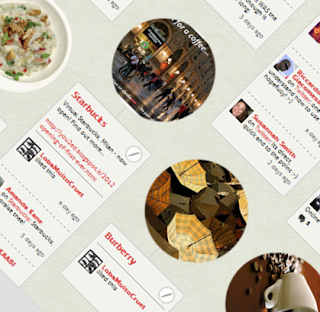
Food and drink, goods, films, book and music: they're all social!
Looking at the trends on CircleMe, there is a definite tendency for people to like what may be termed “lifestyle” topics – food, places to visit, cultural events and phenomena, as well as media such as books, films and music. Another important group of likes is “Heroes” – people, many of whom, naturally, are artists, musicians and writers, etc – but also “celebrities” (a term which can be slightly pejorative or dismissive): perhaps the more neutral “famous people” is better – figures from public life, campaigners and “movers and shakers” of all kinds. (Interestingly, while these people may not associated with an obvious product to sell, such as a biography or tee-shirt, the fact that someone likes a topic that is not just an item to be consumed (e.g. Aung San Suu Kyi or Artificial Intelligence) is significant. This kind of “soft” or nebulous information fills in the gaps between a person’s consumption patterns across different product categories and their aspirations and ideals: it tells you about people’s values, what makes them tick – not just what they have already bought.)

Now, one of the things I really like about CircleMe is the way that when you add a topic it produces a neat-looking “card” on your wall. All of these cards together make an attractive collage or overview of your tastes. (This is definitely the main motivation behind Pinterest – and, to tell the truth, if you want to produce a “mood board” of images, Pinterest is what you need.) While this collection of likes within CircleMe is appealing, within an individual topic, however, the experience is less satisfactory. Comments can be added in a scrolling list to a topic page; there are areas to add stories (really just links) and you can see other people who like the same topic or have planted it on the map. To Do's are also visible, but these offer little extra info and are not easy to access. So, a topic quickly becomes little more than a list of comments and links. You can add a picture, but again, these are just in the form of a slideshow with thumbnails. One picture (generally the last one added) forms the main picture for the page. The overall feel within a topic page is that of a more-stylish Facebook wall or bulletin board with limited functionality.

My 7 "To Do's" for CircleMe

Ideas for making CircleMe more social
Now, I am not sure what CircleMe plans to develop as regards their site – and I am just floating some ideas here. (As I mentioned in my last piece about them, they have deployed Get Satisfaction, a social engagement platform, which has some interesting user feedback. The CircleMe team are also quite happy to respond to individual comments and suggestions you send them.) So, here are my suggestions for how they could improve the experience of their site for users and develop the communities concept further:
1.  Give users more tools to do stuff with the content in each page – e.g. it would be quite cool if you could add links to other likes within comments or tag individual comments. (Also, the ability to automatically generate a preview thumbnail and intro text when you add a link – as on Facebook and LinkedIn – would add value.)
2.  Layout and design: One of the main benefits of CircleMe is its aesthetic appeal and textured, tactile design that arranges pages automatically and generally tidies them up so that whenever you look at a page it doesn’t seem cluttered or crowded (on both the PC/Mac and mobile platforms). Extend this principle to individual topic pages by allowing users to add content – but silently manage the design that you (CircleMe) do so well. (In this regard, I have been looking at some automatic page and template generators that you can use to create “fake” newspaper stories or magazine layouts.) The key thing here is that the content and design can be separated: everyone could become a Condé Nast editor and immediately see their comments and pictures beautifully formatted on glossy, “handmade” pages. (Magazines actually use a lot of automated design features in terms of borders, dividers and placeholders for text.)
3.   Make it more social: allow collaborative editing of articles, but let the people who are contributing show what they have done. Don’t make the process invisible (as it is, at the moment, e.g. if you add a picture or edit tags (although these do show up in your Activity)). Give contributors a byline (and pic) - it doesn't have to be Wikipedia.
4.   Let people vote and decide on which content gets used. Add polls, sticky notes, etc. (These could be in a “design” panel or dashboard (complete with coffee stains and pencil marks – they already have Get Satisfaction on a fly-out menu button at the side which opens up the GS interface.) The key thing is that every time you hit "Refresh" you would see a beautiful,“print-ready” page or layout that incorporates all the material that has been added. (You could also print off hard copies of the lovely pages you have worked on - complete with crop marks and CMYK registration.)
5.   Allow users to publish the content from the topic page to their social media sites, profiles and blogs, etc. If a group of people decide to start curating the page on a topic, e.g. Bob Dylan, then give them (full) credit for their work. Make each page a mini-magazine and generate a kind of magazine-style credit list of contributors. Allow people to comment on the work and link back to their main CircleMe profile so you can see everything they like and the other content they have added. (Not everyone will be a designer – there will be writers, researchers, picture editors, fact-checkers, etc.)
6.   Be iconic! Compared to the usual experience of Facebook, forums of various kinds – and even the more “serious” collaborative content sites, such as Wikipedia – CircleMe could become known for being distinctive and design-conscious (which are important Italian values too!). Make it virtual Moleskin and Montblanc.
7.   Let CircleMe become “the glossy lifestyle magazine you can edit yourself” – Vanity Fair or Rolling Stone with a million guest editors, beautiful black and white photography (sign up professional photographers and picture libraries to showcase their work) and cutting-edge graphics you can load from a simple push-button template.

A few other ideas regarding the communities clustered around each like:
·       Allow communities to like other communities. Create a network of “cross-likes” and associations. (e.g. people who are into Deep Purple could hook up with lovers of classic motorbikes; bebop fans could reach out to readers of the Beats and Jack Kerouac). Make it easy to aggregate topics and curated content based on tags and categories – see Last.fm in this regard, which allows users to create their own radio stations and listen to other user’s playlists.
·       Develop community activities in the real world as well as on CircleMe. E.g. if you know that a large number of people are into a topic in a particular location, use the site to direct people towards each other. (e.g. if there’s a film or festival that has been planted by users, let them save the map – include locations of restaurants or bars nearby – and add reviews from other likes. Allow people to print out or download the whole thing as a mini-programme, tailored to their individual style and tastes – and also to send / share this with others. Local vendors could include Groupon-style vouchers for discounts and there could even be a “print a flier or poster” option for someone organising an event to produce publicity material  perfect for a band or performance artist who want to connect with their local fan base. (This is significant as CircleMe differentiates itself from other similar sites by making planting” (or geo-tagging) central to its experience. At present, this feature of the site is under-exploited.)

I will be visiting CircleMe.com over the next few weeks and months and I’ll be interested to see if they take up any of these ideas!

My vision of a "collaborative" article created by contributors within a community.
(I'm sure CircleMe's designers could do a better job and make it more "bello"!)


Thursday, 7 June 2012

Unsquaring the circle: a very different (and good looking) social network


CircleMe: a different kind of social network
I have been exploring CircleMe – a new type of social network that lets you build connections with other people based on shared likes and passions – rather than just who you already know.

There has been a flurry of start-up activity in the social networking sector recently – driven mainly by the flotations of LinkedIn and Facebook, the meteoric rise of Pinterest (and the less meteoric but still significant rise of Google+) as well as the high-profile acquisitions of Instagram by Facebook for $1bn and the imminent purchase of Meebo by Google. And this is without mentioning a vast swarm of smaller, optimistic start-ups – of which CircleMe is one.

I can’t quite remember how CircleMe came to my attention – but over the last few days it has gradually taken hold of me and I am experiencing the same kind of obsessive “I’ll just check and see what’s happening” sensation that I had when I first joined Facebook – and, to a certain extent, LinkedIn. Looking back now though, I’m sure the main motivation of this desire to log in and check on these networks was simply to see who out of the people I already knew had joined my network. It’s a kind of feedback of how popular you (really) are.

Appetising design and ease of use combine to give a great experience
But with CircleMe it’s quite a different feeling altogether. I am really curious to find out which of the topics or people I have “liked” have been shared – and also to see the expanding network of collections that other people have curated. (I’m trying not use the words “pin” or “board” – although, of course, CircleMe bears more than a passing resemblance to Pinterest.) It may be the case that because CircleMe is still a fledgling its early adopters tend to be quite interesting people with eclectic tastes (CircleMe was in beta and available only by invitation until the end of last year). Or it may be that their combination of luscious design and very easy interface attract people who are more design-oriented – and just generally into exploring culture that bit further.

Pinterest: too much of a good thing?
Without pursuing the comparison with Pinterest too much, I can say that after a very short time on the latter I was so overwhelmed by cupcakes and tastefully-appointed living rooms that I didn’t really bother exploring the rest of the site that much. Somehow, CircleMe has avoided cupcake hell (so far) but it is weighted towards what may be loosely termed “lifestyle”. I have to say that its trademark “tondi” (images cropped to a circle) make food (especially Italian food) look very appetising. With an emphasis on the positive and life-affirming, CircleMe shares some of the same warm glow of Pinterest, but doesn’t induce that sort of glazed-over numbness that I would get from flicking through endless glossy home and "gracious living" magazines.

Location, location, location: the iPhone app
CircleMe has introduced one innovation that really does set it apart from the main existing social networks: geo-tagging, or what it refers to as the ability to “plant” a topic at a specific, real-world location on a Google map. Of course, location-based social networking is not new – Foursquare in particular has established the concept of “checking in” at particular locations and there are a plethora of services that will show you the nearest bars and restaurants. The novel refinement that CircleMe has made is its mobile app which allows you to plant a topic (e.g. a song or poem) at a particular location.

I think they could do more with this: at the moment you can plant likes and receive alerts when you pass the location; but given the social network's appeal to stonger and deeper affiliations I believe the true value of connecting passion to place lies in developing the social links and local communities or tribes formed around those passions. For example, as a freelancer and road warrior (or "pavement partisan", to be more accurate), I spend a lot of time in several cafés and bars in the centre of Milan where I tend to network with other freelancers. Location is critical to our attachment to these "virtual offices" and it cannot be separated from our shared passion for not being chained to a desk. This is exactly the kind of floating, informal community that CircleMe needs to engage with. (I will have more to say about this in a later post.)

I am currently adding topics to my profile and focusing mainly on Milan (which, incidentally is where the CircleMe team is based). It’s quite a nice feeling to be able to plant topics on an “uncluttered” map – even though it also seems to be like colonizing a new territory (although certainly not to the extent of Foursquare’s struggles for virtual supremacy which allow you to become the mayor, king or emperor of a location). CircleMe allows a topic to be planted in multiple locations, which makes sense in terms of people and things which move about rather than buildings and places (which don't).

CircleMe feels like the online version of a quality illustrated book.
For me, the chief delight of the site is its design, which has a handmade, high-end feel – a bit like an expensive art book or catalogue (the background has a subtle rag paper texture and the buttons and panels have an almost tactile 3D quality, like digital card). The palettes and default fonts (I think you can tweak them) are a joy to behold. Now, I know that if you don’t live in Italy – or if you’re not into design – this might sound trivial and superficial; but if you spend time looking at a page (especially a digital one) the quality of its design and aesthetic appeal can be really important. It also helps you to absorb the information in front of you more easily. When I switch back to the starker environments of Facebook and LinkedIn it feels slightly like arriving at the metro station or going into the office. CircleMe, on the other hand, offers the kind of relaxing, enveloping comfort and style-conscious ambience of a private members club – it’s like slipping into your favourite worn (or artfully distressed) leather armchair with an expertly-mixed cocktail as you leaf through one of the first editions from its library.

If you haven’t tried CircleMe already, I suggest you give it a go. It’s not really a numbers game; you don’t feel the urge to rack up as many contacts as you can – or even to see if everyone you know is there (they aren’t). It seems much more of a slow-burn experience (or perhaps "organic" is more appropriate). The topics that you plant – or that other people have planted – will gradually grow and blossom. You can also comment and add pictures as well as “stories” to each topic.

I can definitely see CircleMe developing into a version of “Facebook for grown ups” or for people who (really) know what they like. Each topic could become a micro-community, based on a shared interest or passion. The content also tends to have a certain critical edge that is generally missing from the mainstream sites (although see my comment above about early adopters). I doubt CircleMe will surpass or even approach the huge numbers of (let’s be honest) mainly passive users that the “mature” networks enjoy. Instead, I think it will (or should) attract a select number of more active and discerning users (who are probably more engaged with the topics they share). Basically, they should go for quality not quantity (with just enough critical mass to drive the network effect, of course).

In terms of demographics, a more compact but loyal membership can still offer as much – if not greater value when it comes to whatever revenue-generating strategy they have devised. Consider the petite circulation of expensive, special interest glossies (Condé Nast Traveller, Q, etc). Although there is currently nothing as crass as advertising on the site, the people it attracts will undoubtedly be of particular interest to luxury brands and to those in specialist "long tail" markets. Given that the trend for marketing is increasingly social, it may be the case that CircleMe does not intend to turn itself into a digital version of Vanity Fair, but rather to act as a haven or place to hang out for communities built around their favourite topics (some of which will be brands, but others just communities of interest). Given the strong location-based element, there is ample scope for actual real-world activities – events, meet-ups, etc.

There are still some things they need to work on, however: for example, it isn't at all easy to create a new topic. Another is the "Stories" accompanying each topic, which offer little more than a line or two of text - these could be more visually appealing (without necessarily distracting from the main image for each like).

One cool thing that CircleMe have done is to set up a feedback channel using Get Satisfaction, a customer engagement platform with a nice social business feel. Again, given the fact that people are investing their time and energy in building their profiles and collections of topics, it’s good that CircleMe are involving them in the design and development process. (The CircleMe team are also very helpful if you need support or want to make a suggestion on how to improve what already looks like a very promising and different social networking experience.)

Sunday, 27 May 2012

How to "Interpret the Future": understanding Social Business in English and Italian this June


Delegates at the Social Business Forum 2011 at the Marriott Hotel
I am currently working on an exciting project with OpenKnowledge called “Interpret the Future”. The main aim of this project is to co-ordinate and support a group of Italian-English / English-Italian interpreters who will be providing simultaneous translation at the Social Business Forum on 4-5 June 2012 at the Marriott Hotel in Milan.

Interpret the Future has grown from my collaboration with OpenKnowledge, an international consulting firm that specializes in helping large organizations realize their business potential through open and collaborative approaches based on the Social Business paradigm.

We have brought together six young interpreters who are not only brilliant linguists, but who are also using a range of social media tools and practices to develop their professional careers and profiles.

The team is also providing an English translation of the Social Business Manifesto for OpenKnowledge. This seminal document is being published in conjunction with the Harvard Business Review Italia.

As part of the project we have also established a blog called “Interpret the Future” which contains profiles of all the interpreters and team members, as well as topical articles and discussions on the opportunities and challenges facing interpreters in the digital era.

“Interpret the Future” will continue to run after the Social Business Forum in order to provide greater exposure and networking opportunities for the language professionals involved. We also envisage developing and extending “Interpret the Future” as an informal network for (mainly) young interpreters, translators and others who would like to find out more about the opportunities available from combining language skills and insights into social media. (More seasoned linguists who would like to exploit new technology to develop their careers will, of course, also be welcome!)

Visit the “Interpret the Future” blog: http://interpret-future.blogspot.it/

About the Social Business Forum
The Social Business Forum is the leading European event on employee empowerment, customer engagement and collaborative innovation. With over 5 years of international experience and expertise it has attracted over 3600 participants and 150+ speakers. Attendees can meet international practitioners, globally recognized thought-leaders and experts. You can also connect with a network of vendors, managers and consultants to build long term relationships that will help your business.

The SBF features free sessions, keynote speeches, parallel business tracks, and an open conference. And, naturally, real-time translation in English and Italian will be provided by the Interpret the Future team!

In addition to dozens of companies sharing experiences and success stories there will be an Expo Pavilion featuring leading Social Business software vendors.

Find out more and get all the latest news from the Social Business Forum: http://www.socialbusinessforum.com/

The Social Business Forum is an international conference organized by OpenKnowledge, a company founded in Italy, with offices in London, Shanghai and Sydney. OpenKnowledge is a consulting firm helping clients realize and increase their performance and efficiency through creative collaboration approaches. OpenKnowledge brings innovation into organizations by means of the new Social Business paradigm which is based upon a more participative, informal and bottom-up approach.

Visit the OpenKnowledge website: http://www.open-knowledge.it/en

Registration at the Social Business Forum, Milan in 2011