 |
| CircleMe is a social network for sharing the things you like |
The first thing to consider is what is the significance of
people liking things - and more importantly telling other people they like
them? I suppose this is a basic, human thing that we do all the time. We show
other people what we like – e.g. allegiance to a particular football team, the
choice of brands we make (what we wear, the car we drive round in) as well as
more subtle, less articulated passions and values – e.g. our desire to be taken
seriously and to be considered interesting or cool. In fact, if you look at
most of the decisions we make regarding the things we buy, use, etc – as well
as where we live, the places we visit, the people we know – all of these
are really “likes”: we are telling the world “this is me, these
things are important to me” – and we tend to feel positive and generally well-disposed
to people who share our likes and passions. (Conversely, we can feel quite
negative towards those who have a completely different set of likes – and,
hence, passions, values or even an opposing world-view.)
More than just a directory?
 |
| How is CircleMe different from a (good-looking) list or database? |
Now, from the perspective of sites and services such as
CircleMe, how does the data they accumulate help them to deliver a better
experience? Assuming that CircleMe is not just a huge survey or questionnaire
designed to garner information that is useful to marketers and brand-owners
(which I’m sure it is, but there must be more to it than that), how does the
relationship between what people like and the way they interact with each other
through CircleMe become significant or achieve something meaningful enough for
people to stick with the site and keep returning to it? (And how will it differentiate itself from other "recommendation" sites which offer a similar service?)
I believe the answer is: communities. By initially declaring
what you like and finding other “like-minded” individuals, you start to develop
a kind of footprint or to map out an area / territory that defines you (or the
part of you that you want to show publicly). If enough people start to cluster
or congregate around a particular topic, that topic will start to take on a
life of its own. It may also draw in existing goodwill and energy (e.g. fans of
a singer or film director who already belong to other sites and communities
relating to that topic or “hero”). Eventually, the community establishes itself
as a permanent presence on the web (perhaps clustered around certain sites or networks) – and, indeed, spilling out
into the offline world as well. (I have noticed, by the way, that CircleMe has been using the word "community" in some of its likes – but perhaps this is more wishful thinking at present than an accurate description of what is happening. More on this topic coming up...)
The network is the message
 |
| Sharing interests can bring people together |
These online communities are often associated with a particular
social networking site or or other virtual location (e.g. forum, blog, etc). Groups dedicated to certain topics may favour one platform
over another. MySpace, for example, tends to attract music fans, while Google+
has a large number of (mainly male) tech aficionados. Pinterest (which I
touched on in my earlier article about CircleMe) attracts mainly female
“pinners” who are particularly interested in fashion, interior design – and, of
course, cupcakes. It isn’t exactly clear yet what the main focus is for people who
CircleMe attracts: it’s still early days for this feisty all-Italian startup. Obviously, there is a bias towards leisure and entertainment. However, I have attempted to identify some trends which may point towards its
eventual focus or “centre of gravity” (or "centre of levity", even).
As I said before, CircleMe is good-looking and offers an
intensely pleasurable aesthetic experience. Its interface is a delight. (I have compared it to an expertly-produced – and up-market – glossy magazine - or perhaps just the Contents page in such a periodcal.) This
analogy with high-end magazines could be significant. It is very much oriented
towards cultural consumption: books, films, music, food and drink, etc. Looking
at the mainly offline publications that tend to attract a devoted following (as
opposed to casual passers-by who are probably looking for immediate
gratification: clips, downloads, etc), it is clear that the people who buy music
magazines, for example Q, Mojo, Rolling Stone, etc tend to be slightly older
and to belong to a comparatively “higher” social demographic. If someone is
interested in the background, discography and forthcoming gigs for a band, they
are more likely a) to actually buy the music and b) have a greater stake in the
band’s “social” context or community. This is also true for films (again – the analogy with
magazines such as Empire or even the more serious Sight and Sound is telling:
a person who identifies strongly enough with a particular director or performer to be active in
the community surrounding that individual probably also goes to the cinema and
buys DVDs / other (physical) formats, e.g. BluRay) – or actually spends money on downloading and streaming services. (In my last article I used the phrase “Facebook for grown ups”. I would refine that here, perhaps, to “Facebook for predominantly metropolitan, style-conscious grown ups who are still into old media and visit restaurants with friends” – i.e. a pretty significant group of people when it comes to spending their disposable income and influencing others.)
Consuming passions
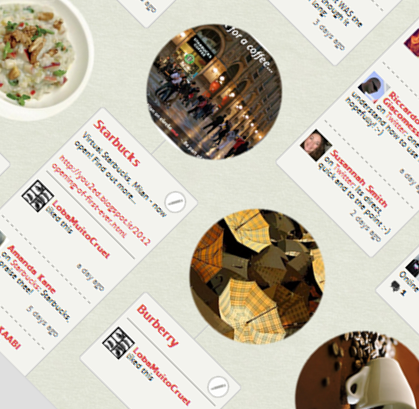 |
| Food and drink, goods, films, book and music: they're all social! |
Looking at the trends on CircleMe, there is a definite
tendency for people to like what may be termed “lifestyle” topics – food, places
to visit, cultural events and phenomena, as well as media such as books, films
and music. Another important group of likes is “Heroes” – people, many of whom,
naturally, are artists, musicians and writers, etc – but also “celebrities” (a term which can be slightly pejorative or dismissive): perhaps the more neutral
“famous people” is better – figures from public life, campaigners and “movers
and shakers” of all kinds. (Interestingly, while these people may not associated with an
obvious product to sell, such as a biography or tee-shirt, the fact that someone likes a topic that is not just
an item to be consumed (e.g. Aung San Suu Kyi or Artificial Intelligence) is significant. This kind of “soft” or nebulous
information fills in the gaps between a person’s consumption patterns across
different product categories and their aspirations and ideals: it tells you about people’s values, what makes
them tick – not just what they have already bought.)
Now, one of the things I really like about CircleMe is the
way that when you add a topic it produces a neat-looking “card” on your wall.
All of these cards together make an attractive collage or overview of your
tastes. (This is definitely the main motivation behind Pinterest – and, to tell
the truth, if you want to produce a “mood board” of images, Pinterest is what you need.) While this collection of likes within CircleMe is appealing, within an individual topic, however, the experience is less satisfactory. Comments can be added in a scrolling list to a topic page; there are areas to add stories
(really just links) and you can see other people who like the same topic or
have planted it on the map. To Do's are also visible, but these offer little
extra info and are not easy to access. So, a topic quickly becomes little more
than a list of comments and links. You can add a picture, but again, these are
just in the form of a slideshow with thumbnails. One picture (generally the
last one added) forms the main picture for the page. The overall feel within a topic page is that of a more-stylish Facebook wall or bulletin board with limited functionality.
My 7 "To Do's" for CircleMe
 |
| Ideas for making CircleMe more social |
Now, I am not sure what CircleMe plans to develop as regards
their site – and I am just floating some
ideas here. (As I mentioned in my last piece about them, they have deployed
Get Satisfaction, a social engagement platform, which has some interesting user
feedback. The CircleMe team are also quite happy to respond to individual
comments and suggestions you send them.) So, here are my suggestions for how
they could improve the experience of their site for users and develop the
communities concept further:
1. Give users more tools to do stuff with the content in each page – e.g. it would be quite cool if you could add links to other likes within comments or tag individual comments. (Also, the ability to automatically generate a preview thumbnail and intro text when you add a link – as on Facebook and LinkedIn – would add value.)
2. Layout and design: One of the main benefits of CircleMe is its aesthetic appeal and textured, tactile design that arranges pages automatically and generally tidies them up so that whenever you look at a page it doesn’t seem cluttered or crowded (on both the PC/Mac and mobile platforms). Extend this principle to individual topic pages by allowing users to add content – but silently manage the design that you (CircleMe) do so well. (In this regard, I have been looking at some automatic page and template generators that you can use to create “fake” newspaper stories or magazine layouts.) The key thing here is that the content and design can be separated: everyone could become a Condé Nast editor and immediately see their comments and pictures beautifully formatted on glossy, “handmade” pages. (Magazines actually use a lot of automated design features in terms of borders, dividers and placeholders for text.)
3. Make it more social: allow collaborative editing of articles, but let the people who are contributing show what they have done. Don’t make the process invisible (as it is, at the moment, e.g. if you add a picture or edit tags (although these do show up in your Activity)). Give contributors a byline (and pic) - it doesn't have to be Wikipedia.
4. Let people vote and decide on which content gets used. Add polls, sticky notes, etc. (These could be in a “design” panel or dashboard (complete with coffee stains and pencil marks – they already have Get Satisfaction on a fly-out menu button at the side which opens up the GS interface.) The key thing is that every time you hit "Refresh" you would see a beautiful,“print-ready” page or layout that incorporates all the material that has been added. (You could also print off hard copies of the lovely pages you have worked on - complete with crop marks and CMYK registration.)
5. Allow users to publish the content from the topic page to their social media sites, profiles and blogs, etc. If a group of people decide to start curating the page on a topic, e.g. Bob Dylan, then give them (full) credit for their work. Make each page a mini-magazine and generate a kind of magazine-style credit list of contributors. Allow people to comment on the work and link back to their main CircleMe profile so you can see everything they like and the other content they have added. (Not everyone will be a designer – there will be writers, researchers, picture editors, fact-checkers, etc.)
6. Be iconic! Compared to the usual experience of Facebook, forums of various kinds – and even the more “serious” collaborative content sites, such as Wikipedia – CircleMe could become known for being distinctive and design-conscious (which are important Italian values too!). Make it virtual Moleskin and Montblanc.
7. Let CircleMe become “the glossy lifestyle magazine you can edit yourself” – Vanity Fair or Rolling Stone with a million guest editors, beautiful black and white photography (sign up professional photographers and picture libraries to showcase their work) and cutting-edge graphics you can load from a simple push-button template.
1. Give users more tools to do stuff with the content in each page – e.g. it would be quite cool if you could add links to other likes within comments or tag individual comments. (Also, the ability to automatically generate a preview thumbnail and intro text when you add a link – as on Facebook and LinkedIn – would add value.)
2. Layout and design: One of the main benefits of CircleMe is its aesthetic appeal and textured, tactile design that arranges pages automatically and generally tidies them up so that whenever you look at a page it doesn’t seem cluttered or crowded (on both the PC/Mac and mobile platforms). Extend this principle to individual topic pages by allowing users to add content – but silently manage the design that you (CircleMe) do so well. (In this regard, I have been looking at some automatic page and template generators that you can use to create “fake” newspaper stories or magazine layouts.) The key thing here is that the content and design can be separated: everyone could become a Condé Nast editor and immediately see their comments and pictures beautifully formatted on glossy, “handmade” pages. (Magazines actually use a lot of automated design features in terms of borders, dividers and placeholders for text.)
3. Make it more social: allow collaborative editing of articles, but let the people who are contributing show what they have done. Don’t make the process invisible (as it is, at the moment, e.g. if you add a picture or edit tags (although these do show up in your Activity)). Give contributors a byline (and pic) - it doesn't have to be Wikipedia.
4. Let people vote and decide on which content gets used. Add polls, sticky notes, etc. (These could be in a “design” panel or dashboard (complete with coffee stains and pencil marks – they already have Get Satisfaction on a fly-out menu button at the side which opens up the GS interface.) The key thing is that every time you hit "Refresh" you would see a beautiful,“print-ready” page or layout that incorporates all the material that has been added. (You could also print off hard copies of the lovely pages you have worked on - complete with crop marks and CMYK registration.)
5. Allow users to publish the content from the topic page to their social media sites, profiles and blogs, etc. If a group of people decide to start curating the page on a topic, e.g. Bob Dylan, then give them (full) credit for their work. Make each page a mini-magazine and generate a kind of magazine-style credit list of contributors. Allow people to comment on the work and link back to their main CircleMe profile so you can see everything they like and the other content they have added. (Not everyone will be a designer – there will be writers, researchers, picture editors, fact-checkers, etc.)
6. Be iconic! Compared to the usual experience of Facebook, forums of various kinds – and even the more “serious” collaborative content sites, such as Wikipedia – CircleMe could become known for being distinctive and design-conscious (which are important Italian values too!). Make it virtual Moleskin and Montblanc.
7. Let CircleMe become “the glossy lifestyle magazine you can edit yourself” – Vanity Fair or Rolling Stone with a million guest editors, beautiful black and white photography (sign up professional photographers and picture libraries to showcase their work) and cutting-edge graphics you can load from a simple push-button template.
A few other ideas regarding the communities clustered around
each like:
· Allow communities to like other communities.
Create a network of “cross-likes” and associations. (e.g. people who are into Deep Purple could hook up with lovers of classic motorbikes; bebop fans could reach out to readers of the Beats and Jack Kerouac). Make it easy to aggregate topics and curated content based
on tags and categories – see Last.fm in
this regard, which allows users to create their own radio stations and listen
to other user’s playlists.
· Develop community activities in the real world
as well as on CircleMe. E.g. if you know that a large number of people are into
a topic in a particular location, use the site to direct people towards each
other. (e.g. if there’s a film or festival that has been planted by users, let
them save the map – include locations of restaurants or bars nearby – and add
reviews from other likes. Allow people to print out or download the whole thing as a
mini-programme, tailored to their individual style and tastes – and also to
send / share this with others. Local vendors could include Groupon-style
vouchers for discounts and there could even be a “print a flier or poster”
option for someone organising an event to produce publicity material – perfect for a band or performance artist who want to connect with their local fan base. (This is significant as CircleMe differentiates itself from other similar sites by making “planting” (or geo-tagging) central to its experience. At present, this feature of the site is under-exploited.)
I will be visiting CircleMe.com over the next few weeks and
months and I’ll be interested to see if they take up any of these ideas!
 |
| My vision of a "collaborative" article created by contributors within a community. (I'm sure CircleMe's designers could do a better job and make it more "bello"!) |


