Showing posts with label communication. Show all posts

Friday, 21 November 2014

BESIG Bonn: Inspirational talks, quality networking and some great beer - a personal view


Note: this is the first instalment of my report from Bonn. I'm working on some more "content-focused" reports about teaching-related material and developments, which will appear probably on the Riverstone blog and in the Milan Business English Network. This is basically an informal snapshot of my immediate impressions of the event and the experience of being in Bonn itself. RD

The 27th IATEFL BESIG Annual Conference took place in Bonn, Germany on the 14-16th November 2014. It was a great opportunity for business English teachers and other professionals working in the sector to meet, exchange ideas and get up to speed on all the latest developments and technology fuelling our industry.

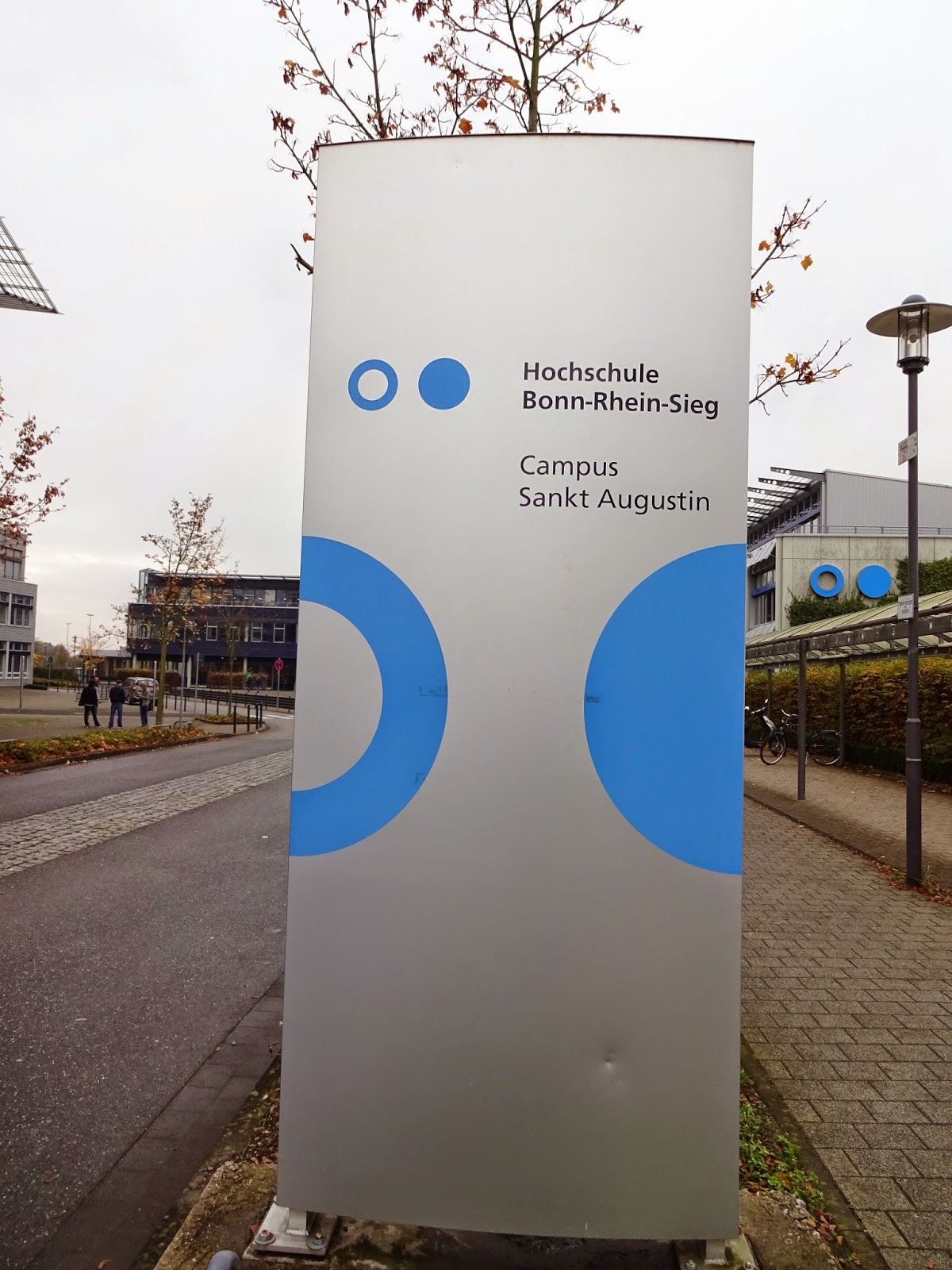
The event was held at the Sankt Augustin Campus of the Hochschule Bonn-Rhein-Sieg, just a short tram ride away from the centre of Bonn itself. The vast majority of BESIG events have been in Germany, mainly due to the fact that the most active members of the organisation are nearly all based in German-speaking countries. It may also be due to the fact that English teachers, like all expats, tend to adapt to their adopted locations and take on the characteristics of the people where they live. So, although there was a BESIG Annual Conference in Milan in 2006, the Italian presence at BESIG has been less noticeable than that of our more dynamic colleagues in the European economic powerhouse of Germany. 

Having said that, though, I did meet Richard Nicholas, who teaches English at Bocconi University in Milan, and took part in his workshop on training students to "hit the ground running" with immediately-useful spoken English skills. Richard drew extensively from his publication "Heads Up", which he co-authored with Mark Tulip and Louise Green.

The IATEFL and BESIG teams all deserve special mention, especially Cornelia Kreis-Meyer, Marjorie Rosenberg , Andrzej Stesik, Rob Szabó, Clare Hart and the many other people who helped to make the event a huge success. I’m sorry if I’ve missed out anyone really important – but I’m basing most of this on my experience as a first-time attendee gradually exploring the hinterland of IATEFL, BESIG and the many other Special Interest Groups. I think one of the interesting phenomena of the digital age is how the full picture of the activities of a group of highly professional people all working in a relatively small sector gradually emerges via various social media channels. This experience then forms the "digital backdrop" to the live international events.

Since I spend an increasing amount of time online it was interesting to make direct contact with so many people that I have come to know or know of through the proliferation of websites, blogs, Facebook pages and tweets, etc that taken together form the ecosystem or cloud of knowledge that we all inhabit these days.

I was also very impressed by the team of helpers from the university itself, who shepherded lost souls from room to room and provided the all-important information about where to find food, drink and other essential amenities.

Paul Emmerson gave a great talk on his new business English venture, BEhereBEthere, which features high quality resources for learners that the best-selling author has made available to students via a site which is 100% under his control. One of the key benefits of BEhereBEthere is the videos of Paul’s own students that he has posted along with exhaustive supporting materials, including detailed language notes and exercises. During his presentation, Paul explained aspects of his developing strategy, which is to build a unique and uniquely useful free resource for business English learners on the web and to gradually introduce premium features. This freemium model is now an established feature of many online English sites, services and apps and the whole question of business models was a recurring theme throughout the talks and chats taking place in and around the conference itself. 

Paul also shared some invaluable insights into how he uses Google Analytics to learn more about where visitors to BEhereBEthere are located. Given Paul Emmerson’s undisputed status as a major star in the business EFL publishing firmament, it was interesting to see how he is making the transition from published author to self-publishing web entrepreneur (webpreneur?). I think the key thing that was clear from Paul’s talk is the passion and commitment he brings to business English – and his genuine interest and engagement with students. Technology and social media in this context become incredibly powerful channels for content producers to connect directly with students (and fellow teachers) – much more directly than is possible through passive media, such as print or CD-ROM. However, as one audience member put it, once the content genie is out of the bottle the question of how content producers can monetize their creations (or, indeed, whether they can at all) becomes critical. 

As perhaps the “most photocopied man in the world”, Paul Emmerson knows more than most people about the problem of piracy and loss of revenue through vast armies of well-meaning teachers whacking his books under the copier. (During one of the dinners at BESIG, I suggested to Paul that he should perhaps consider some sort of deal with Canon, Xerox or any of the other companies that have helped to spread the Emmerson brand around the globe. In fact, he could even produce his own Paul Emmerson-branded photocopier, bundled with exclusive content for any language school that buys one. Another idea we kicked around was having some PE advertising on the underside of the copier’s flap – since there must be at least a million “flap views” a year in various schools around the globe. Why not have some inspirational Paul Emmerson quotes and a link to BEhereBEthere for people to read while they snag pages from Email English?)

Pete Sharma spoke about the development of the business English course book from print to digital. (Fuller report about this talk coming soon.) The last time I had the pleasure of watching Pete speak was a few years ago at the PSA Symposium at the Consulate General in Milan. As well as being one of the leading experts in the world on blended learning Pete is also a marvellous conference speaker and simply a great communicator. He has a sort of magical rapport with his audience and I think this is one of the reasons why face-to-face communication will always be important – despite the onward march of videoconferencing and Skype. His gestures are also incredibly expressive – and, like all foreigners living in Italy, I have become something of a connoisseur of how people talk with their hands. So, if you want to see and hear someone communicating cutting-edge ideas about education in a memorable, absorbing way, I urge you to check out Pete’s forthcoming speaking engagements.

Other highlights of the conference included a talk about the importance of lexical chunks by Jeanne McCarten in the plenary session. Paula Mulanovic's session was entitled "Teach like TED" and offered tips for teachers of business English. Cleve Miller of English 360 spoke about blended learning for business English: how to design it, deliver it and sell it. It was also nice to meet Valentina Dodge from English 360 too. I also ran into Bob Dignen of York Associates, who spoke about virtual teams and virtual meetings as well as presenting "Ten top tips for successful communication" with Ian McMaster. There were so many talks that it would have been impossible to do more than scrape the surface, but that's BESIG, I suppose. The overwhelming impression you get from attending a conference like this is just how diverse and constantly evolving the business English ecosystem actually is. 

One of the great things about a conference is the opportunity for chance meetings which subsequently prove providential. One such random encounter was meeting András Petz of Anglofon, a specialist legal English firm based in Budapest, Hungary. I happened to be sitting near him on the tram to the campus and overheard him asking someone which stop to get off at. I went over and we struck up a conversation, which resulted not only in meeting a really nice person and a dedicated professional but also in attending his presentation and discovering the very impressive range of resources he has created with his team in Hungary. These include a book on the Terminology of Civil Law, which is linked to a wealth of online material specially designed for legal professionals who need to improve their knowledge of English. We both agreed to stay in touch and hopefully collaborate on some interesting future projects. 

Bonn is a truly lovely city, with many historical and cultural associations. As the former capital of the Federal Republic of Germany (or West Germany as it was known before reunification) the city retains a certain gravitas as well as a legacy of imposing administrative buildings and headquarters, including almost twenty UN institutions. My hotel room had a commanding view of the Rhine and the Kennedy Bridge and the occasion also allowed me to explore the historic centre of Bonn. The classical architecture of the University buildings and the Hofgarten (Court Garden) are very impressive and the city is also a place of pilgrimage for music lovers visiting the house where Beethoven was born. The Marktplatz (market place) is dominated by the Alte Rathaus, or old town hall - simply stunning:


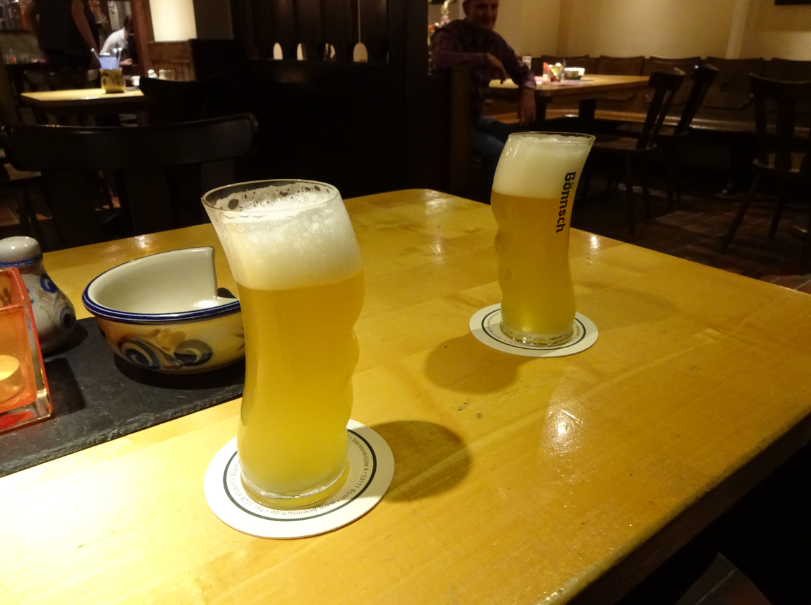
It was also great to spend some time chatting to other delegates in the canteen of the Hochschule as well as in some of the city locations. I had a memorable dinner with Alex Taylor of TJ Taylor, the language school based in Milan with centres in the UK and Ireland, at the First Flush Tea Room, which is also – despite the name – a restaurant serving exotic delights such as pumpkin curry (excellent). We also had tea – everyone gets a teapot of a different design – and sampled the local Kölsch beer, which was equally outstanding. We continued our conversation in Brauhaus Bönnsch, a traditional Rhineland pub serving Kölsch in strangely curved glasses, complete with finger-grips to make imbibing just that much easier. I also managed to squeeze in a visit to Cologne to see its massive and overpowering Cathedral, whose twin spires loom above the station and somewhat cramped squares below. Unfortunately, it was raining quite heavily, which just seemed to add to the sense of oppressive  weight towering overhead – and it was actually something of a relief (architecturally speaking) to be standing in front of Milan’s far more forgiving, though equally impressive, Duomo (cathedral) later the same day.


I flew back to Milan with most of the Italian contingent including freelance business English teachers Louise Goodman and Andy Townsend and our BESIG chat continued well after we had touched down. 

Based on my first experience of BESIG I can honestly say that this was a great experience and for any business English teachers - freelance or otherwise - I would strongly recommend signing up to BESIG and checking out all their events, including regular webinars with experts from the field of business English.

I'll post an update soon when I have sifted through all the notes and stacks of material I accumulated during the conference. Stay tuned!



Thursday, 7 June 2012

Unsquaring the circle: a very different (and good looking) social network


CircleMe: a different kind of social network
I have been exploring CircleMe – a new type of social network that lets you build connections with other people based on shared likes and passions – rather than just who you already know.

There has been a flurry of start-up activity in the social networking sector recently – driven mainly by the flotations of LinkedIn and Facebook, the meteoric rise of Pinterest (and the less meteoric but still significant rise of Google+) as well as the high-profile acquisitions of Instagram by Facebook for $1bn and the imminent purchase of Meebo by Google. And this is without mentioning a vast swarm of smaller, optimistic start-ups – of which CircleMe is one.

I can’t quite remember how CircleMe came to my attention – but over the last few days it has gradually taken hold of me and I am experiencing the same kind of obsessive “I’ll just check and see what’s happening” sensation that I had when I first joined Facebook – and, to a certain extent, LinkedIn. Looking back now though, I’m sure the main motivation of this desire to log in and check on these networks was simply to see who out of the people I already knew had joined my network. It’s a kind of feedback of how popular you (really) are.

Appetising design and ease of use combine to give a great experience
But with CircleMe it’s quite a different feeling altogether. I am really curious to find out which of the topics or people I have “liked” have been shared – and also to see the expanding network of collections that other people have curated. (I’m trying not use the words “pin” or “board” – although, of course, CircleMe bears more than a passing resemblance to Pinterest.) It may be the case that because CircleMe is still a fledgling its early adopters tend to be quite interesting people with eclectic tastes (CircleMe was in beta and available only by invitation until the end of last year). Or it may be that their combination of luscious design and very easy interface attract people who are more design-oriented – and just generally into exploring culture that bit further.

Pinterest: too much of a good thing?
Without pursuing the comparison with Pinterest too much, I can say that after a very short time on the latter I was so overwhelmed by cupcakes and tastefully-appointed living rooms that I didn’t really bother exploring the rest of the site that much. Somehow, CircleMe has avoided cupcake hell (so far) but it is weighted towards what may be loosely termed “lifestyle”. I have to say that its trademark “tondi” (images cropped to a circle) make food (especially Italian food) look very appetising. With an emphasis on the positive and life-affirming, CircleMe shares some of the same warm glow of Pinterest, but doesn’t induce that sort of glazed-over numbness that I would get from flicking through endless glossy home and "gracious living" magazines.

Location, location, location: the iPhone app
CircleMe has introduced one innovation that really does set it apart from the main existing social networks: geo-tagging, or what it refers to as the ability to “plant” a topic at a specific, real-world location on a Google map. Of course, location-based social networking is not new – Foursquare in particular has established the concept of “checking in” at particular locations and there are a plethora of services that will show you the nearest bars and restaurants. The novel refinement that CircleMe has made is its mobile app which allows you to plant a topic (e.g. a song or poem) at a particular location.

I think they could do more with this: at the moment you can plant likes and receive alerts when you pass the location; but given the social network's appeal to stonger and deeper affiliations I believe the true value of connecting passion to place lies in developing the social links and local communities or tribes formed around those passions. For example, as a freelancer and road warrior (or "pavement partisan", to be more accurate), I spend a lot of time in several cafés and bars in the centre of Milan where I tend to network with other freelancers. Location is critical to our attachment to these "virtual offices" and it cannot be separated from our shared passion for not being chained to a desk. This is exactly the kind of floating, informal community that CircleMe needs to engage with. (I will have more to say about this in a later post.)

I am currently adding topics to my profile and focusing mainly on Milan (which, incidentally is where the CircleMe team is based). It’s quite a nice feeling to be able to plant topics on an “uncluttered” map – even though it also seems to be like colonizing a new territory (although certainly not to the extent of Foursquare’s struggles for virtual supremacy which allow you to become the mayor, king or emperor of a location). CircleMe allows a topic to be planted in multiple locations, which makes sense in terms of people and things which move about rather than buildings and places (which don't).

CircleMe feels like the online version of a quality illustrated book.
For me, the chief delight of the site is its design, which has a handmade, high-end feel – a bit like an expensive art book or catalogue (the background has a subtle rag paper texture and the buttons and panels have an almost tactile 3D quality, like digital card). The palettes and default fonts (I think you can tweak them) are a joy to behold. Now, I know that if you don’t live in Italy – or if you’re not into design – this might sound trivial and superficial; but if you spend time looking at a page (especially a digital one) the quality of its design and aesthetic appeal can be really important. It also helps you to absorb the information in front of you more easily. When I switch back to the starker environments of Facebook and LinkedIn it feels slightly like arriving at the metro station or going into the office. CircleMe, on the other hand, offers the kind of relaxing, enveloping comfort and style-conscious ambience of a private members club – it’s like slipping into your favourite worn (or artfully distressed) leather armchair with an expertly-mixed cocktail as you leaf through one of the first editions from its library.

If you haven’t tried CircleMe already, I suggest you give it a go. It’s not really a numbers game; you don’t feel the urge to rack up as many contacts as you can – or even to see if everyone you know is there (they aren’t). It seems much more of a slow-burn experience (or perhaps "organic" is more appropriate). The topics that you plant – or that other people have planted – will gradually grow and blossom. You can also comment and add pictures as well as “stories” to each topic.

I can definitely see CircleMe developing into a version of “Facebook for grown ups” or for people who (really) know what they like. Each topic could become a micro-community, based on a shared interest or passion. The content also tends to have a certain critical edge that is generally missing from the mainstream sites (although see my comment above about early adopters). I doubt CircleMe will surpass or even approach the huge numbers of (let’s be honest) mainly passive users that the “mature” networks enjoy. Instead, I think it will (or should) attract a select number of more active and discerning users (who are probably more engaged with the topics they share). Basically, they should go for quality not quantity (with just enough critical mass to drive the network effect, of course).

In terms of demographics, a more compact but loyal membership can still offer as much – if not greater value when it comes to whatever revenue-generating strategy they have devised. Consider the petite circulation of expensive, special interest glossies (Condé Nast Traveller, Q, etc). Although there is currently nothing as crass as advertising on the site, the people it attracts will undoubtedly be of particular interest to luxury brands and to those in specialist "long tail" markets. Given that the trend for marketing is increasingly social, it may be the case that CircleMe does not intend to turn itself into a digital version of Vanity Fair, but rather to act as a haven or place to hang out for communities built around their favourite topics (some of which will be brands, but others just communities of interest). Given the strong location-based element, there is ample scope for actual real-world activities – events, meet-ups, etc.

There are still some things they need to work on, however: for example, it isn't at all easy to create a new topic. Another is the "Stories" accompanying each topic, which offer little more than a line or two of text - these could be more visually appealing (without necessarily distracting from the main image for each like).

One cool thing that CircleMe have done is to set up a feedback channel using Get Satisfaction, a customer engagement platform with a nice social business feel. Again, given the fact that people are investing their time and energy in building their profiles and collections of topics, it’s good that CircleMe are involving them in the design and development process. (The CircleMe team are also very helpful if you need support or want to make a suggestion on how to improve what already looks like a very promising and different social networking experience.)

Sunday, 27 May 2012

How to "Interpret the Future": understanding Social Business in English and Italian this June


Delegates at the Social Business Forum 2011 at the Marriott Hotel
I am currently working on an exciting project with OpenKnowledge called “Interpret the Future”. The main aim of this project is to co-ordinate and support a group of Italian-English / English-Italian interpreters who will be providing simultaneous translation at the Social Business Forum on 4-5 June 2012 at the Marriott Hotel in Milan.

Interpret the Future has grown from my collaboration with OpenKnowledge, an international consulting firm that specializes in helping large organizations realize their business potential through open and collaborative approaches based on the Social Business paradigm.

We have brought together six young interpreters who are not only brilliant linguists, but who are also using a range of social media tools and practices to develop their professional careers and profiles.

The team is also providing an English translation of the Social Business Manifesto for OpenKnowledge. This seminal document is being published in conjunction with the Harvard Business Review Italia.

As part of the project we have also established a blog called “Interpret the Future” which contains profiles of all the interpreters and team members, as well as topical articles and discussions on the opportunities and challenges facing interpreters in the digital era.

“Interpret the Future” will continue to run after the Social Business Forum in order to provide greater exposure and networking opportunities for the language professionals involved. We also envisage developing and extending “Interpret the Future” as an informal network for (mainly) young interpreters, translators and others who would like to find out more about the opportunities available from combining language skills and insights into social media. (More seasoned linguists who would like to exploit new technology to develop their careers will, of course, also be welcome!)

Visit the “Interpret the Future” blog: http://interpret-future.blogspot.it/

About the Social Business Forum
The Social Business Forum is the leading European event on employee empowerment, customer engagement and collaborative innovation. With over 5 years of international experience and expertise it has attracted over 3600 participants and 150+ speakers. Attendees can meet international practitioners, globally recognized thought-leaders and experts. You can also connect with a network of vendors, managers and consultants to build long term relationships that will help your business.

The SBF features free sessions, keynote speeches, parallel business tracks, and an open conference. And, naturally, real-time translation in English and Italian will be provided by the Interpret the Future team!

In addition to dozens of companies sharing experiences and success stories there will be an Expo Pavilion featuring leading Social Business software vendors.

Find out more and get all the latest news from the Social Business Forum: http://www.socialbusinessforum.com/

The Social Business Forum is an international conference organized by OpenKnowledge, a company founded in Italy, with offices in London, Shanghai and Sydney. OpenKnowledge is a consulting firm helping clients realize and increase their performance and efficiency through creative collaboration approaches. OpenKnowledge brings innovation into organizations by means of the new Social Business paradigm which is based upon a more participative, informal and bottom-up approach.

Visit the OpenKnowledge website: http://www.open-knowledge.it/en

Registration at the Social Business Forum, Milan in 2011


Saturday, 18 June 2011

What's new? - Innovation, of course: An update from Milan by Robert Dennis...

A thermal head being used to create new 
CPUs and chipsets. (Photo: Wikimedia)

OK, time for another update. I have been doing a lot more communications-related work of late (recently) as well as teaching. And as I discussed in my last update, it’s always a challenge keeping up with clients and students who work in highly-specialised fields.

I have been teaching at a company that specialises in designing trains – more specifically, the electrical and pneumatic plant on the underside of the carriage. They work to incredibly tight specifications using 3D graphics programs. As with most other industries there are hundreds of acronyms to get used to (e.g. TCMS (Train Control and Monitoring System and HVAC (HeatingVentilating, and Air Conditioning), as well as a raft (a lot) of engineering and technical terms, such as “bogie”, the wheeled wagon or trolley the carriage sits on. (Confusingly this is known as a “truck” in the US.) But, of course, they also need the day-to-day stuff: meetings, presentations and phone calls, etc.

Lessons are continuing at the biopharma company I teach at. I am always amazed by the deluge (flood, inondazione) of new research that is constantly being undertaken worldwide and the therapies that are being developed. And even for the experts working in the medical and pharmaceutical fields, staying up to date is a constant but fascinating battle.

On the communications side, I was in Cambridge in April, where I visited Bletchley Park, Britain’s wartime top-secret codebreaking facility, where the world’s first programmable computer (Colossus) was built to crack the codes of the German High Command. I watched a video being specially filmed for the social media project I am involved in with OpenKnowledge srl. Again, it was fascinating chatting with scientists working at the cutting edge of technological research (in this case, advanced encryption techniques that exploit the spin effects of electrons).

I have also been spending time with a design firm that specialises in finding solutions relating to structural packaging (e.g. plastic containers for household detergents). This kind of industrial design marries engineering with aesthetics and it’s great to see how an idea goes from a pencil sketch to a rendered 2D image to a 3D prototype literally printed out using stereolithography. I'm really looking forward to developing some great communications projects with these guys!

If I had to pick one theme that unites the various industries I have been teaching people from and working with recently, it would be: innovation. Finding answers to challenging questions in the fields of pharmaceuticals, computer technology or industrial design requires an astonishing amount of insight, trial and error and perseverance. One aspect of what might be termed the “innovation industries” is the amount of research and effort that just gets discarded. The number of drafts that are scrapped or versions that are superseded can at times seem soul-destroying – but, of course, it’s all absolutely necessary as the goal is to find 100% workable solutions. (Interestingly, in the case of the biopharma industry, advances in genetics and computing are allowing compounds that have been thrown on the scrap-heap to be reinvestigated and possibly salvaged as new treatments. This is especially important where huge sums of money have been invested in compounds whose patents have expired: they can be given a new – commercial – lease of life.)

While older manufacturing industries decline in the West – and as Asian economies increasingly take over the “heavy lifting” – the need for ever-greater innovation can only increase. Of course this requires massive amounts of investment, not only from the industries themselves, but also from society as a whole in order to create highly-educated and creative workers able to come up with (think of / imagine) the next wave of solutions and technologies that will add value and drive the economy. Since I live here in Italy I can appreciate the importance placed on education (particularly higher education) in this country. Although at times it can seem that Italians tend to have a much more theoretical approach when compared with their more pragmatic Anglo-Saxon counterparts, you can really appreciate the value of the rounded (and often simply longer) education they receive – especially when it comes to applying creative brain-power to a problem.

I am really looking forward to extending and deepening my contacts with the individuals and businesses I am working with here in Milan. The next few months will also be an exciting time for everyone involved with the Milan Business English Network – we are planning a series of events and initiatives for the autumn. 
(Don't forget to read the latest news in NetworkMilan.com, our online magazine.)

Regards,
Robert

Tuesday, 19 October 2010

Common abbreviations in Business English: e.g., i.e., fyi, CIO, KM... OK?

There are thousands of abbreviations in common use, and with the increased use of computer technology, social media (such as chatting) and the proliferation of organisations, legislation and professional jargon, the number of acronyms and shortened forms of words and expressions that you need to know can seem mind-boggling (totally confusing).

Here’s a selection of some of the more useful ones, which I have organised according to topic. Hope you find them useful.


Writing and email

Perhaps the most common – and yet (certainly for Italian people learning English) the most confusing abbreviations – are e.g. and i.e..

E.g. means “for example”. (Why? Well, that’s because it’s really the initials of the Latin expression “exemplii gratia” – for the sake of example.)

I.e. means “that is” (Italian cioè). (Latin again: id est).

When you send someone an email you can “cc” another person or “copy them in” to the email. Cc means “carbon copy”, a reference to old-fashioned carbon paper used to make copies of a letter while writing them on a typewriter. If you don’t want someone to know that you are copying a third person in, then use “bcc” or “blind carbon copy”.

Digital technology, including the internet, has led to the creation of a huge number of abbreviations, especially as typed or texted forms of real-time communication, such as online chat, internet messaging (IM) and texting (SMS) have gained popularity. Some of the more familiar acronyms from these media include:

FYI = For Your Information. This is typically used when you want to send someone an interesting link you have found, but one which doesn’t require a lengthy (long) introduction.

IMHO – In my humble opinion (used when you express a personal opinion that could be considered arrogant or controversial. It shows that you are aware of this implication.)

LOL – Laugh(s) out loud – This type of digital shorthand (steno) for reactions and emotions has developed due to the often colourless or anonymous nature of online chat.

BTW – By the way – indicates a change of subject or the introduction of an incidental fact.
(btw you can find one of the best online collections of online acronyms and jargon – some of them very funny – on netlingo.com, the internet dictionary. One of my favourites is the term used by IT support staff to indicate that there they cannot find a technical fault: PEBCAK – Problem Exists Between Chair and Keyboard.)

Texting, also known as SMS (Short Message Service) requires the writer to compress a lot of information into as small a space as possible. This has led to a modern form of highly-condensed writing, sometimes surprisingly imaginative.

B4 = before
L8r = later
CU = See you
(Which produces: CU l8r = See you later)


Business Acronyms

There are also thousands of TLAs (Three Letter Acronyms) used in everyday Business English. Here’s a selection of some of the more useful ones:

People / job titles


CEO = Chief Executive Officer
CFO = Chief Financial Officer
CIO = Chief Information Officer
MD = Managing Director
PRO = Public Relations Officer


Other business acronyms


VAT = Value Added Tax (IVA) (recently raised in the UK form 17.5% to 20%)

P&L = Profit & Loss account / statement (one of the financial statements a company has to produce)

KPI = Key Performance Indicators – measurements used to evaluate how well a team or firm is performing

KM = Knowledge Management – a strategic approach to insights undertaken by companies

RRP = Recommended Retail Price – the price customers should pay suggested by the manufacturer

I hope you find these abbreviations useful. If anyone would like to know the meaning of other common business acronyms – or if you have found an acronym that you want to share with other people, visit the Milan Business English Network on Facebook or add a comment here.

Tuesday, 25 May 2010

Make that call! (Part 1)

Effective business telephone calls in English are not as difficult as you think, as Robert Dennis explains...

Do you have to make an important call?
Are you afraid of using the phone in English? Do your hands start to shake when you dial a telephone number and know that you will have to not only speak in English – but also understand the other person? And would you rather send (= Would you prefer to send) an email in order to avoid (evitare) the situation completely? Well, you are not alone. Millions of non-native speakers of English face exactly this situation every day – often at work and in high stress environments, where there is no alternative to talking on the phone.

But using the phone in English doesn’t need to be a nightmare (incubo). If you follow the simple suggestions described below – and learn some of the key business telephone expressions included in section 2 of this article – you will soon find that making phone calls in English is one of the simplest and most direct ways of communicating with your clients, customers or other colleagues.

Steps to making the perfect business phone call

Stop! Take your hand off that receiver (cornetto). Before you pick up the phone... PREPARE! Get yourself ready first – and you will find it much easier to make that important business call. Here’s a checklist of things you can do before you phone someone:

1. Write down the main points that you want to discuss with the person you are going to speak to.

These don’t need to be long notes – in fact, it’s better that you don’t write whole sentences, as you will sound as if you’re reading from a script. (Think of those telephone calls you get from banks and other large companies where an operator sitting in a call centre reads from a long prepared script. It’s like talking to a robot, isn’t it?) Just jot down (write quickly) a few bullet points – single words and short phrases are best. For example:


Contact: Chris Hemming, HKR Communications:

• New designs for brochure

• Printing – how much? When?

• Payment – euros or pounds?


Having these notes in front of you – even if they’re just written on a yellow Post-It™ will help you to focus on what you want you want to say and enable you to structure the conversation.


2. Create the perfect telephoning conditions, if possible.
Get everything ready before you phone. If you’re in a noisy (rumoroso) office, try and find a quiet place where you can make the call. Ideally (perfectly) in a room where you can shut the door to keep background noise to a minimum. Try and choose a time to call when you know the other person will not be in a hurry and has time to speak. (Avoid phoning at awkard (difficult) times, such as early on Monday morning and late on a Friday afternoon. Think about it: would you be happy if someone phoned you during these periods?) Have a pad (blocco noti) and a pen in front of you (with your notes from point 1, above). (You may find it useful to write down words and phrases that the other person says as you are trying to understand them. You can then use these to help form your own replies and questions). If you need to discuss a proposal, design or similar document with the other person, it’s much easier if you both have it on your desk in front of you. You can then refer to the appropriate pages, paragraphs or details that you need to talk about. Send an email with your document attached and ask the other person to print it out or have it open on their PC when you call. Arrange a suitable time to speak so that you can both get ready. (Even for two native speakers, this can save a lot of time.) Spending a short amount of time creating a relaxed, well-ordered phoning environment will be worth the effort (vale la pena) when you are in the middle of the call.


3. Rehearse (provare) the call. You can either do this silently in your head, or (preferably) speaking out loud (ad alta voce). (Of course, you will probably want to do this when no one else is around – or you may find your colleagues are slightly worried (ansiosi) that you are under so much stress that you are talking to people without actually (really) using the telephone!) Think about what you will say, the type of reply you will receive and any possible points or questions that could come up (happen) during the conversation. If you know there are some tricky (difficult) names or technical words that you will have to say, practice them before you ring (phone) the other person. Be ready to spell long or difficult words. (e.g. If you need to tell someone that the project meeting will be in Domodossola, think of words that you can use to spell this out over the phone: “D as in Difficult, O as in Orange, M as in Manchester”, etc.). If you are giving someone a number, such as phone number or account number, get the other person to repeat it back to you. Of course, if there is any really important written information that you need to pass on (give) or receive, tell the other person you will send an email (and don’t forget to send it) – or get them to send one to you.


4. Take a deep breath.
If it’s a really important, make-or-break call, get yourself physically ready. Do some deep breathing exercises before you speak. (Breathe in, count slowly to five, breathe out, repeat two or three times.) You will then find you start the call in a Zen-like state of calm (peaceful relaxation), even if you start to find yourself struggling (lottando) as the call progresses. Have a drink in front of you – when you get stressed your throat (gola) can dry out – which can make you sound even more stressed. Even if it’s only a bottle of mineral water, keep some liquid nearby so you can take a few sips (sorsi) when the other person’s speaking. (A drink’s OK, if you can swallow (inghiottire) quietly, but never eat or chew gum while you’re speaking on the phone – the receiver (microtelefono) amplifies the sound and it’s like talking to a cement-mixer (betoniera) – plus, it can make you more difficult to understand.)


Go ahead and dial

Right, so we’ve looked at how you can prepare for that big call you need to make. Now, let’s consider some survival strategies you can use to help you to help you make it to the end of conversation.

• Put yourself in control

If you phone someone up – using the suggestions in the previous situation – you will automatically be in a better frame of mind than if the other person calls you when you are not ready or in the middle of something else. If it’s a really bad time (for example, the fire alarm has just gone off or your boss (capo) is standing in front of you with a long list of figures that need to be checked (controllato) immediately) ask the other person if you can call them back. (You might even decide to use this as a ruse (stratagemma) so that you can make sure you are 100% (per cent) ready, even if you have to tell a white lie (bugia pietosa), e.g. you’re just about to go into a meeting, but you’ll phone them when you come out.


• Get the other person to slow down

This can be more of a problem if you’re talking to a native speaker: non-native speakers of English know that it is difficult to communicate in a foreign language – particularly on the phone. However, a native English speaker, particularly someone who has little experience of talking to foreigners, may not realise this. Trying to understand a British or American person rabbiting on (parlare a vanvera) at high speed (a tutta velocità) can be incredibly frustrating. Why not tell the person you are speaking to at the beginning of the call that you do speak English, but you sometimes find it a bit tricky (difficult) to understand everything, so it would be a lot easier if they spoke a little (more) slowly. If the other person starts to speed up during the conversation (which is what usually happens), gently remind them to slow down. If you communicate with the same person on a regular basis they will eventually learn to do this automatically when they speak to you, but you need to train (addestrare) them at the beginning.


• Ask the other person to repeat something if you don’t understand

Don’t assume that if you miss (non cogliere) something it probably isn’t that important anyway: it may be the most important thing in the conversation! If you suspect that you haven’t heard something properly – or you simply haven’t understood – ask the other speaker to say it again or to explain. (If you have to do this repeatedly, try and make a joke (scherzo) of it – getting the other person to co-operate is much easier if you keep the tone of the conversation light-hearted (allegro) and friendly. You can still do this and remain professional. Indeed, the more serious or complicated the topic is, the more important it is to make sure that you are both communicating as effectively as possible – and it’s much easier to communicate with someone you like – and who likes you. If you don’t understand a word or phrase because of the way the other person is saying it, try asking them a question like “Sorry, did you say envelopes?” or give them a choice: “Er, sorry, was that thirteen (13) or thirty (30)? I didn’t quite catch what you said.”)


• Check that you both understand and agree on what has been said or decided

It’s surprising how often (even in your native language) you think you’ve said one thing, but the other person has understood something completely different. Even if (or especially if) the two speakers are highly educated, intelligent people, they can get their wires crossed (capirsi male, literally: incrociare le file). At the end of the conversation, summarise what you have agreed or check to see what the other person thinks you have said:

So, are we agreed, them? I’ll send over the designs to your office and you can decide which one you want – and that you’ll confirm that in writing?
- Yes, that’s right.


Focus on action and outcomes (risultati)

You don’t normally phone people up at work just for a chat – and if you do, you probably know the other person very well anyway, so anything important you have to communicate can be done in a fairly relaxed way. Contacting someone you don’t know very well (if at all) in a foreign language, particularly when you are already under stress from other factors (such as deadlines (scadenze) or a bad phone line) demands that you have an effective approach. The key to making a successful business telephone call is to focus on what you want to achieve – on the practical result (or results) of the call. Before you call, ask yourself these questions:

• Why you are making this call?
• Are you talking to the right person?
• What do you want that person to do after the call?
• What do you need to do?
• Does the other person need any more information? Do you?
• Is there any other way you could achieve the same result without making the call?


Why you are making this call?
Be clear about why you are calling. If you are phoning to ask someone whether they have finished the report you need, stick to that topic – don’t be tempted to introduce another point simply because you have that person on the line. If you cannot resist, hint (accennare) that you need to talk about the other topic later and then phone them again on a different occasion, or send an email. (Remember: information is like whisky: its effect is more powerful when it’s neat than when it’s diluted.)

Are you talking to the right person?
If you need a decision, talk to the decision maker whenever possible. Spending an hour explaining your proposal to an assistant may, at best, result in the information being passed on more or less successfully, or the other person simple might explain that they have to ask their boss. Even then, you could find yourself having to repeat everything you said when you finally talk to the person who can give you a definite “yes” or “no”.

What do you want that person to do after the call?
A business telephone call is a little bit like writing a good computer program. You have to have a clear objective – an output or goal – at the beginning, and everything you say during the call should lead (menare) to this objective. If you want someone to send you something, then make sure that you tell them what they have to send, exactly who and where it has to go and when you want it by. Failing to give all the necessary information will only result in delays or unnecessary follow-up calls (or emails) and requests for the name, address or date that wasn’t given during the call.

What do you need to do?
If you tell someone that you will send details of the agreement today, then send details of the agreement today. The longer you wait between hanging up and hitting the send button on your email, the less likely it is that the other person will act promptly (prontamente) and the more likely it is you will have to speak to them again and re-check what you have already agreed.

Does the other person need any more information? Do you?
Put yourself in the position of the person you are communicating with. If they want to contact you later, do they have all your details (phone, mobile (cellulare), address, etc)? Anticipate the other person’s needs or difficulties. Give them your direct number or extension (assuming you do want them to contact you again directly on the phone). If you have referred to a document or web page, send them the exact title or link so they can find it easily.

Is there any other way you could achieve the same result without making the call?
Ask yourself if this is really the best way of communicating with someone. Yes, speaking on the phone is the most direct means of communication, but there can also be many distractions – especially if the other person – or you yourself – are already pre-occupied with another task. A well-written email is often more effective than a phone call – and it also has the advantage that it can be referred to whenever the reader (or you) needs to check the information it contains. You certainly can’t do this (easily) with a phone call, unless you record (and transcribe) all your calls! Quite often the best way to communicate in business is to send someone a clear, well-structured email, follow it up with a brief call (even if it it’s just to check they have received – and read – the email). And then send a short follow-up email (a line or two) confirming in writing the action(s) you have agreed during the call.

Now you’re fully prepared mentally and physically – and with a clear phone strategy – you need some juicy (succoso, vantaggioso) business telephone phrases to make your call as professional and effective as possible. Read the next section, which contains a comprehensive range of useful language to help you achieve your results...

Note: the business telephone phrases in secton 2 of "Make that call!" will soon be available as premium content or to students taking professional business courses with Robert Dennis. (That's enough free content...)