|
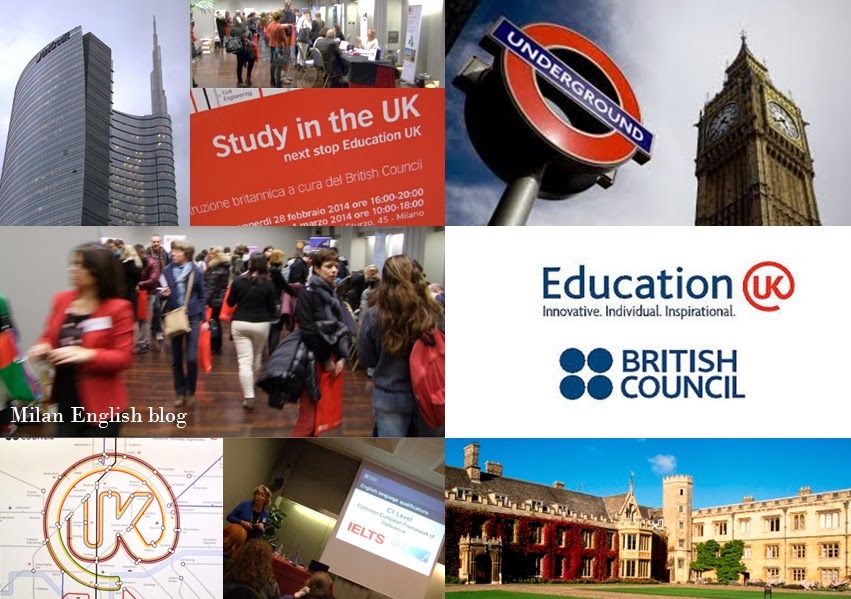
| A conversation that could change your life: students find out what's on offer from top British universities at the Education UK Fair, organised by the British Council |
Held over two days (28th Feb - 1 March 2014) in the comfortable surroundings of the Atahotel Executive in the rapidly-developing Porta Nuova business district of the city, the Fair was a unique opportunity for prospective university students to meet face-to-face with representatives from many of the UK’s leading educational institutions.
In Italy, personal contact is everything. So this was a
great way for British universities as diverse as Oxford, Edinburgh, Leeds, and
Anglia Ruskin, among many others, to explain their unique advantages to a
significant number of highly-demanding Italian students and soon-to-be school
leavers, as well as the parents who want to give their offspring the best start
in life – and who will, in most cases, be footing the bill. (By the way, an extremely useful
document provided by the organisers of this event was the list of scholarship (borse di studio) schemes on offer, which prospective students and their parents should
definitely read for homework.)
When I was there, on Friday afternoon and early evening, the event looked very well-attended with people queuing patiently ten deep (or more) for the opportunity of speaking directly with reps from an impressive selection of British universities including a large contingent from the University of London, business schools, colleges and independent schools – as well as the team from the British Council itself and other education-related organisations that helped out with the event. (Click here for a full list of all the institutions that took part in the Education UK Fair.)
 |
| Four of the top six universities in the world are in the UK (World Rankings, QS) |
When I was there, on Friday afternoon and early evening, the event looked very well-attended with people queuing patiently ten deep (or more) for the opportunity of speaking directly with reps from an impressive selection of British universities including a large contingent from the University of London, business schools, colleges and independent schools – as well as the team from the British Council itself and other education-related organisations that helped out with the event. (Click here for a full list of all the institutions that took part in the Education UK Fair.)
The Fair comprised two main sections: an exhibition of the institutions and their representatives in the main conference hall and in a
smaller, adjoining hall a rolling programme of excellent presentations by speakers from
universities, the British Council and educational publishers, as well as
independent consultants. (See the next section for a report on the Friday presentations.)
Another very popular feature of the event was the British Council "personalised counselling" stand, where visitors had the opportunity to meet expert teachers ready to provide some tips on writing a great Curriculum Vitae and the all-important letter of presentation - in perfect English, of course.
Presentations by expert speakers at the Education UK Fair, Milan (Friday 28th February 2014): A summary
 |
| 97% of UK graduates are employed one year after finishing their course. (BC) |
Presentations by expert speakers at the Education UK Fair, Milan (Friday 28th February 2014): A summary
The programme started with Michael Flynn of Oxford University Press, whose presentation was entitled “What’s new in language
testing? Streamline your English test experience”. (Unfortunately, I missed
this talk but if anyone reading this was attending – or, Michael, if you happen
to see this – I would be very happy to receive a summary or a link to the
slides, etc.)
I came in halfway through a talk by Nadia Macdonald, Deputy
Director International of Coventry University’s London Campus. Nadia was showcasing
Coventry University’s London Summer School, which looked excellent and very
reasonably priced, too. She was also keen to point out the huge cultural
benefits of studying in the UK – a theme emphasised by most of the speakers.
The UK – and especially London – benefit from an enormous range of cultural
activities, such as theatre, music, art galleries and museums as well as
fantastic sporting facilities.
Students also had the opportunity to hear (in Italian) what university life in the UK is like “from the horse’s mouth”. Italian students from Verona who have been studying in Britain provided some excellent insights into university life. They belong to the Ateneo Europa programme, the first “student to student” information network related to education in Europe and organised by the Fondazione Maffei, a Verona-based cultural foundation.
 |
| Students listening to students from Ateneo Europa (Verona) |
The Importance of English
Jane Hoatson of the British Council, who is a Cambridge oral
examiner and an experienced teacher trainer, explained how to apply to a UK
university. In particular, she focused on the application procedure, which in
the UK operates through a centralised system run by UCAS, the Universities and
Colleges Admissions Service. Jane’s talk included a detailed description
of the online applications process. She also spoke about the importance of
English for Italian students who want to study at a British university or
college. While students have to meet the entry requirements set by each
university or institution as regards their final school exams (which in the case of
Italy will usually require a minimum level in the maturità exams), applicants
will also need to demonstrate they can speak and understand English, a theme
which was picked up in the following presentation.
 |
| Jane Hoatson, British Council: Your application will depend on your personal statement |
One vital aspect of applying to a UK university that can be
a real “make or break” factor is the Personal Statement that potential students
have to submit as part of their application. Jane stressed the absolute
importance of this statement and the need for applicants to stand out from the
crowd by demonstrating their unique personal qualities and their attitude not
only to study but to life in general. Perhaps one of the main differences
between studying in the UK and education in Italy is that British universities are
really interested in the “whole person” – not just academic ability. This is
especially true at the top universities, especially Oxford and Cambridge, which
look at a candidates complete profile – including any distinctions in their artistic,
sporting or volunteering activities – as well as academic excellence. However,
without really good English, no student can progress very far in the British
education system – but most universities run pre-sessional courses that can
help prepare learners for the demands of studying in an English-speaking
environment.
 |
| Studying in the UK is a highly rewarding experience - and it's a lot of fun too! |
The next speaker was Margaret Fowler of the British Council. As Director Examinations, British Council Italy, Margaret is responsible here for promoting and organising IELTS, the International English Language Testing System, the world’s number one English
language test, taken by over 1.5 million people every year across the
world.
There are several key benefits of IELTS for
Italian students who intend to study at UK university. Firstly, you can
register up to 14 days before the exam itself and the results will arrive in
the comparatively short time of 13 days. IELTS is recognised and often
preferred by universities in the United Kingdom. The exam is also recognised by
Italian universities in terms of awarding credits. As well as in the UK, IELTS
is recognised in other English-speaking countries including the US, Canada and
Australia. (This is particularly important if you intend to study in one of
these countries.) While other Cambridge exams, such as a the First Certificate,
Advanced and Proficiency are intended to demonstrate a candidate’s all-round
language ability, IELTS is specifically a test of Academic English. (By the
way, it is very important to make sure you take the Academic version of IELTS
if you are applying to a university. The General Training version is primarily
intended for immigration purposes.)
 |
| Margaret Fowler, Director Examinations, BC Italy: UK universities prefer IELTS |
In a detailed exposition of the exam (which I am planning to
write up as a separate blog post focusing on IELTS and English language exams
in general), Margaret took the audience through each part of the exam and
discussed some general strategies which will be of great help to students.
Perhaps the most important of these – and certainly, in my experience of
preparing candidates for the IELTS exam (and most other English exams) – is what
you do in the Speaking Test. Without doubt, for Italian people studying English,
this is the most problematic part of the exam and the thing they dread more than anything else.
Margaret’s advice on this part of the test is invaluable: the examiner is not
interested in your opinion of – or even your knowledge – about the topics they ask
you to talk about. Instead, they are only concerned with how you express
yourself (although what you say should be relevant: don't invent your own questions). Students should use paraphrasing strategies when they can’t think of
the right word or what to say (e.g. “I don’t remember the exact word for this,
but it’s something you use to…”, etc).
Candidates in the Speaking Test should
also show off their knowledge of grammar and vocabulary - especially conversational phrases. As Margaret put it: the examiner can
only credit you with your brilliant knowledge of English if you actually
demonstrate it in the exam. While the Speaking Test is a highly contrived,
artificial situation it is basically ten minutes where you need to focus on HOW
you say things rather than WHAT you are saying (which is the exact opposite of
most situations in life).
(IMPORTANT: Check the IELTS score you need to achieve in order to study at a particular university. This can vary from one institution to another, but typically a university will ask for a score of around 6/6.5 at IELTS. For medical students and people taking other professional courses it can be higher, e.g. 7. However, universities can also exercise some discretion, so even if you don't have exactly the right level you might still be able to study there - or you may be offered a pre-sessional course which includes English training. The main thing is to ASK before you apply.)
 |
| UK-educated international graduates achieve markedly higher average salaries (BIS) |
The final speaker on Friday was Annette Duerdoth, a Consultant
at the Higher Education Advisory Service. Annette’s topic was the importance of
studying in the UK – particularly at top independent schools – and the main differences
between “A” Levels and the International Baccalaureate. Annette started her
talk by asking the audience to decide whether the top schools she highlighted,
such as Stowe School, Malvern College and Charterhouse, offer students the “A” Levels
or the IB. The general picture is that there is a wide diversity, with some
schools offering only “A” Levels or only the IB, while at others students can
take either form of exam. While the vast majority of school pupils in England
and Wales (Scotland and Northern Ireland have different systems) aiming to go
to university take “A” levels, the IB is only taken by students at a handful of
schools, mainly private or fee-paying ones. (Confusingly, in the UK there are a
number of top schools known as “public” schools that are actually private. Yes,
I know: bizarre, isn’t it?)
(Note: this is not really an issue for Italian students, but there is an ongoing debate in the UK about the academic/educational "value" of "A" levels (and GSCEs, which most people take at 16). Newspapers and politicians are always concerned with "grade inflation", since there is a consistent trend for exam grades to rise every year - and an endless debate about the reasons for this: are the students getting better or are the exams getting easier? The IB has been promoted as a possible alternative to "A" levels - which are sometimes referred to as the "gold standard" in UK education. Another blog post on this, I feel...)
As Annette explained, the main difference between “A” levels and the IB is that whereas “A” level students typically take exams in only three subjects (although some students take more – especially at independent/private/”public” schools), the IB has a much wider curriculum and is more similar to the broader range of subjects studied by Italian and most other European students in their school-leaving exams (such as the maturità in Italy).
 |
| Annette Duerdoth, Higher Education Advisory Service: IB is rare but highly regarded. |
As Annette explained, the main difference between “A” levels and the IB is that whereas “A” level students typically take exams in only three subjects (although some students take more – especially at independent/private/”public” schools), the IB has a much wider curriculum and is more similar to the broader range of subjects studied by Italian and most other European students in their school-leaving exams (such as the maturità in Italy).
The profile of an IB learner can defined as follows: they
are inquirers; they tend to be more knowledgeable and open-minded than their “A”
level counterparts; they are thinkers, communicators and risk-takers, who are
on the whole caring, balanced and reflective. (Dare I say it, but that description
could be taken as one that tends to apply more to Italians (and most other
Europeans) than the British – or Americans. While our education system has evolved
to produce pragmatic specialists who can go straight into narrowly-defined
university courses and even more specialised careers, the Continental system
has been designed to produce all-rounders: elegant thinkers who have a
much wider view of the world and a longer historical perspective, especially
when it comes to classical history. (Perhaps I could just interpolate into this
digression - this is becoming "Tristram Shandy" - a personal observation based on my experience of living in a country
where education is still largely modelled on the classical system (and which
the IB philosophy reflects). While a business meeting in the UK or the US will typically
be a brisk, focused affair where people who know their onions – and have been
produced by their respective education systems to operate effectively and under
pressure in a specific field to do just that – and get on with it, in Italy a meeting is much more of a social
affair; and one where, for example, it is not unusual for a technical manager or financial
number cruncher to suddenly draw an analogy with the current situation and a moment
from the First Punic War – and no-one sitting around the table will bat an
eyelid; nor will the remark be accompanied by the sound of jaws dropping onto
the table - or the silent squeak of eyeballs rolling in their sockets - as would happen in London or New York.))
If you've just skipped that last bit, the main point to note that here is that while the IB is obviously a higher species of exam and the fruit
of a more enlightened educational approach, it is also a lot tougher than "A" levels. (Although education and exams in Italy are more punitive than "Anglo-Saxon" ones in general). Therefore, candidates intending
to study at university really need to be aware of all their options and the
best plan of action before they choose either “A” levels or the IB.
Annette included in her presentation a quotation from the Financial Times blog referring to the IB. It is highly pertinent to the main topic of the Education UK Fair, i.e. getting into university:
“Not subject to government tinkering, this international currency is particularly strong, with top IB scores worth the equivalent of six A grades at A level and one A at AS. Not ideal for the pupil who has always wanted to drop maths, the IB does put you significantly ahead in the global race for the best universities.”
The Education UK Fair continued on the Saturday (1st March), although I only attended the Friday session. However, many of the presentations on the first day were reprised by the speakers. You can see the full list of presentations here. I would just like to mention one talk which caught my eye: “How to write a good CV in English” with Keryn Paviour-Smith of the British Council. (Again, if you attended this or if anyone has some feedback about it, I would be very interested to hear it. Not least because of Ms Paviour-Smith’s very impressive professional background, which combines human resources roles at top companies with Business English teaching. I’m sure her talk was excellent and I will be looking forward to seeing her speak at future British Council events.)
Final result: First class, with honours
Overall, then, this was a very well designed, organised and executed event of the kind that the British Council excels at. The participants I spoke to were all highly positive and it is very clear that the UK is one of the main destinations for Italian students who want to give themselves an advantage in their future career and life. If you are considering applying for a university course (or any type of study in the UK), the most important thing is to find out as much as possible before you go – and this event certainly provided a very useful starting point for serious students who are contemplating one of the most important decisions they will make in life: where to go to university.
If you are reading this now and kicking yourself that you didn’t attend the Fair, I hope my summary gives you an insight into the event – and, in any case, you can find a wealth of further information and guidance from the Education UK website and via the ever-helpful British Council itself.
I have no doubt that the Education UK Fair will become a regular feature of the Milan calendar – falling quite neatly between Fashion week and the forthcoming Salone Mobile (“Design Week”). The timing is also crucial, as Jane Hoatson pointed out, given that there are strict deadlines for applying to UK universities (and that in Britain a deadline really is a deadline).
Looking forward to Education UK 2015 in the next, critical, “EXPO” year in Milan!
Links to related websites:
British Council
Education UK
Annette included in her presentation a quotation from the Financial Times blog referring to the IB. It is highly pertinent to the main topic of the Education UK Fair, i.e. getting into university:
“Not subject to government tinkering, this international currency is particularly strong, with top IB scores worth the equivalent of six A grades at A level and one A at AS. Not ideal for the pupil who has always wanted to drop maths, the IB does put you significantly ahead in the global race for the best universities.”
The Education UK Fair continued on the Saturday (1st March), although I only attended the Friday session. However, many of the presentations on the first day were reprised by the speakers. You can see the full list of presentations here. I would just like to mention one talk which caught my eye: “How to write a good CV in English” with Keryn Paviour-Smith of the British Council. (Again, if you attended this or if anyone has some feedback about it, I would be very interested to hear it. Not least because of Ms Paviour-Smith’s very impressive professional background, which combines human resources roles at top companies with Business English teaching. I’m sure her talk was excellent and I will be looking forward to seeing her speak at future British Council events.)
 |
| Employers worldwide consider UK graduates among the most 'employable' (QS) |
Final result: First class, with honours
Overall, then, this was a very well designed, organised and executed event of the kind that the British Council excels at. The participants I spoke to were all highly positive and it is very clear that the UK is one of the main destinations for Italian students who want to give themselves an advantage in their future career and life. If you are considering applying for a university course (or any type of study in the UK), the most important thing is to find out as much as possible before you go – and this event certainly provided a very useful starting point for serious students who are contemplating one of the most important decisions they will make in life: where to go to university.
If you are reading this now and kicking yourself that you didn’t attend the Fair, I hope my summary gives you an insight into the event – and, in any case, you can find a wealth of further information and guidance from the Education UK website and via the ever-helpful British Council itself.
I have no doubt that the Education UK Fair will become a regular feature of the Milan calendar – falling quite neatly between Fashion week and the forthcoming Salone Mobile (“Design Week”). The timing is also crucial, as Jane Hoatson pointed out, given that there are strict deadlines for applying to UK universities (and that in Britain a deadline really is a deadline).
Looking forward to Education UK 2015 in the next, critical, “EXPO” year in Milan!
 |
| A UK university education gives you a significant advantage in the job market. |
 |
| The UK has a rich, diverse culture where you can gain an international perspective. |
Links to related websites:
British Council
Education UK