Showing posts with label languages. Show all posts

Tuesday, 4 March 2014

Italian students come face to face with British universities at the first Education UK Fair in Milan

A conversation that could change your life: students find out what's on offer from top British universities at the Education UK Fair, organised by the British Council
There has never been a better time to study in the United Kingdom: that was the message coming loud and clear from the first-ever Education UK Fair that took place in Milan recently.

The highly innovative - and free - event was organised by the British Council and Education UK, the official website for international students who are interested in a UK education. (In 2012 the website received two million unique visitors worldwide.)

Held over two days (28th Feb - 1 March 2014) in the comfortable surroundings of the Atahotel Executive in the rapidly-developing Porta Nuova business district of the city, the Fair was a unique opportunity for prospective university students to meet face-to-face with representatives from many of the UK’s leading educational institutions.

In Italy, personal contact is everything. So this was a great way for British universities as diverse as Oxford, Edinburgh, Leeds, and Anglia Ruskin, among many others, to explain their unique advantages to a significant number of highly-demanding Italian students and soon-to-be school leavers, as well as the parents who want to give their offspring the best start in life – and who will, in most cases, be footing the bill. (By the way, an extremely useful document provided by the organisers of this event was the list of scholarship (borse di studio) schemes on offer, which prospective students and their parents should definitely read for homework.)

Four of the top six universities in the world are in the UK (World Rankings, QS)

When I was there, on Friday afternoon and early evening, the event looked very well-attended with people queuing patiently ten deep (or more) for the opportunity of speaking directly with reps from an impressive selection of British universities  including a large contingent from the University of London, business schools, colleges and independent schools – as well as the team from the British Council itself and other education-related organisations that helped out with the event. (Click here for a full list of all the institutions that took part in the Education UK Fair.)
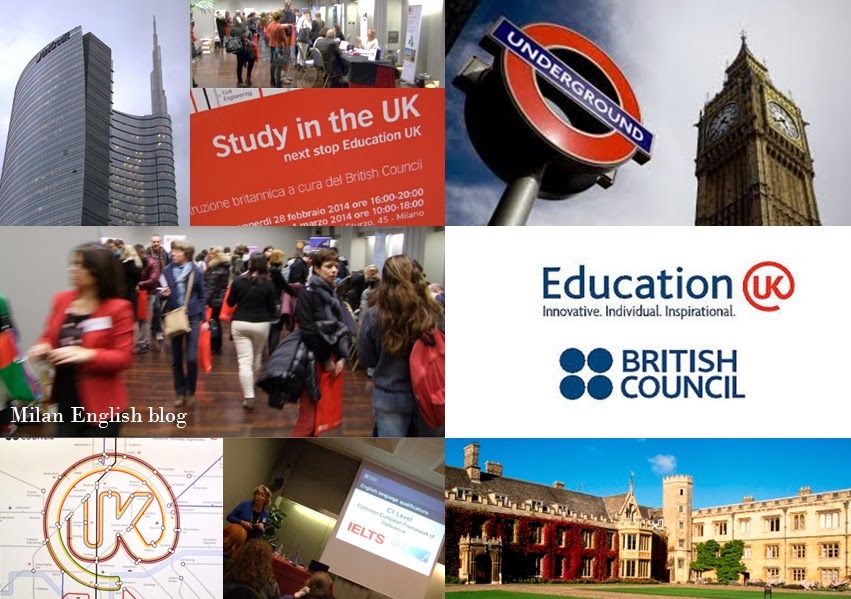
The Fair comprised two main sections: an exhibition of the institutions and their representatives in the main conference hall and in a smaller, adjoining hall a rolling programme of excellent presentations by speakers from universities, the British Council and educational publishers, as well as independent consultants. (See the next section for a report on the Friday presentations.)

Another very popular feature of the event was the British Council "personalised counselling" stand, where visitors had the opportunity to meet expert teachers ready to provide some tips on writing a great Curriculum Vitae and the all-important letter of presentation - in perfect English, of course.

97% of UK graduates are employed one year after finishing their course. (BC)

Presentations by expert speakers at the Education UK Fair, Milan (Friday 28th February 2014): A summary

The programme started with Michael Flynn of Oxford University Press, whose presentation was entitled “What’s new in language testing? Streamline your English test experience”. (Unfortunately, I missed this talk but if anyone reading this was attending – or, Michael, if you happen to see this – I would be very happy to receive a summary or a link to the slides, etc.)

I came in halfway through a talk by Nadia Macdonald, Deputy Director International of Coventry University’s London Campus. Nadia was showcasing Coventry University’s London Summer School, which looked excellent and very reasonably priced, too. She was also keen to point out the huge cultural benefits of studying in the UK – a theme emphasised by most of the speakers. The UK – and especially London – benefit from an enormous range of cultural activities, such as theatre, music, art galleries and museums as well as fantastic sporting facilities.

Students also had the opportunity to hear (in Italian) what university life in the UK is like “from the horse’s mouth”.  Italian students from Verona who have been studying in Britain provided some excellent insights into university life. They belong to the Ateneo Europa programme, the first “student to student” information network related to education in Europe and organised by the Fondazione Maffei, a Verona-based cultural foundation.

Students listening to students from Ateneo Europa (Verona)

The Importance of English

Jane Hoatson of the British Council, who is a Cambridge oral examiner and an experienced teacher trainer, explained how to apply to a UK university. In particular, she focused on the application procedure, which in the UK operates through a centralised system run by UCAS, the Universities and Colleges Admissions Service. Jane’s talk included a detailed description of the online applications process. She also spoke about the importance of English for Italian students who want to study at a British university or college. While students have to meet the entry requirements set by each university or institution as regards their final school exams (which in the case of Italy will usually require a minimum level in the maturità exams), applicants will also need to demonstrate they can speak and understand English, a theme which was picked up in the following presentation.

Jane Hoatson, British Council: Your application will depend on your personal statement

One vital aspect of applying to a UK university that can be a real “make or break” factor is the Personal Statement that potential students have to submit as part of their application. Jane stressed the absolute importance of this statement and the need for applicants to stand out from the crowd by demonstrating their unique personal qualities and their attitude not only to study but to life in general. Perhaps one of the main differences between studying in the UK and education in Italy is that British universities are really interested in the “whole person” – not just academic ability. This is especially true at the top universities, especially Oxford and Cambridge, which look at a candidates complete profile – including any distinctions in their artistic, sporting or volunteering activities – as well as academic excellence. However, without really good English, no student can progress very far in the British education system – but most universities run pre-sessional courses that can help prepare learners for the demands of studying in an English-speaking environment.

Studying in the UK is a highly rewarding experience - and it's a lot of fun too! 

The next speaker was Margaret Fowler of the British Council. As Director Examinations, British Council Italy, Margaret is responsible here for promoting and organising IELTS, the International English Language Testing System, the world’s number one English language test, taken by over 1.5 million people every year across the world.

There are several key benefits of IELTS for Italian students who intend to study at UK university. Firstly, you can register up to 14 days before the exam itself and the results will arrive in the comparatively short time of 13 days. IELTS is recognised and often preferred by universities in the United Kingdom. The exam is also recognised by Italian universities in terms of awarding credits. As well as in the UK, IELTS is recognised in other English-speaking countries including the US, Canada and Australia. (This is particularly important if you intend to study in one of these countries.) While other Cambridge exams, such as a the First Certificate, Advanced and Proficiency are intended to demonstrate a candidate’s all-round language ability, IELTS is specifically a test of Academic English. (By the way, it is very important to make sure you take the Academic version of IELTS if you are applying to a university. The General Training version is primarily intended for immigration purposes.)

Margaret Fowler, Director Examinations, BC Italy: UK universities prefer IELTS

In a detailed exposition of the exam (which I am planning to write up as a separate blog post focusing on IELTS and English language exams in general), Margaret took the audience through each part of the exam and discussed some general strategies which will be of great help to students. Perhaps the most important of these – and certainly, in my experience of preparing candidates for the IELTS exam (and most other English exams) – is what you do in the Speaking Test. Without doubt, for Italian people studying English, this is the most problematic part of the exam and the thing they dread more than anything else. Margaret’s advice on this part of the test is invaluable: the examiner is not interested in your opinion of – or even your knowledge – about the topics they ask you to talk about. Instead, they are only concerned with how you express yourself (although what you say should be relevant: don't invent your own questions). Students should use paraphrasing strategies when they can’t think of the right word or what to say (e.g. “I don’t remember the exact word for this, but it’s something you use to…”, etc). 

Candidates in the Speaking Test should also show off their knowledge of grammar and vocabulary - especially conversational phrases. As Margaret put it: the examiner can only credit you with your brilliant knowledge of English if you actually demonstrate it in the exam. While the Speaking Test is a highly contrived, artificial situation it is basically ten minutes where you need to focus on HOW you say things rather than WHAT you are saying (which is the exact opposite of most situations in life).

(IMPORTANT: Check the IELTS score you need to achieve in order to study at a particular university. This can vary from one institution to another, but typically a university will ask for a score of around 6/6.5 at IELTS. For medical students and people taking other professional courses it can be higher, e.g. 7. However, universities can also exercise some discretion, so even if you don't have exactly the right level you might still be able to study there - or you may be offered a pre-sessional course which includes English training. The main thing is to ASK before you apply.)

UK-educated international graduates achieve markedly higher average salaries (BIS)

The final speaker on Friday was Annette Duerdoth, a Consultant at the Higher Education Advisory Service. Annette’s topic was the importance of studying in the UK – particularly at top independent schools – and the main differences between “A” Levels and the International Baccalaureate. Annette started her talk by asking the audience to decide whether the top schools she highlighted, such as Stowe School, Malvern College and Charterhouse, offer students the “A” Levels or the IB. The general picture is that there is a wide diversity, with some schools offering only “A” Levels or only the IB, while at others students can take either form of exam. While the vast majority of school pupils in England and Wales (Scotland and Northern Ireland have different systems) aiming to go to university take “A” levels, the IB is only taken by students at a handful of schools, mainly private or fee-paying ones. (Confusingly, in the UK there are a number of top schools known as “public” schools that are actually private. Yes, I know: bizarre, isn’t it?)

(Note: this is not really an issue for Italian students, but there is an ongoing debate in the UK about the academic/educational "value" of "A" levels (and GSCEs, which most people take at 16). Newspapers and politicians are always concerned with "grade inflation", since there is a consistent trend for exam grades to rise every year - and an endless debate about the reasons for this: are the students getting better or are the exams getting easier? The IB has been promoted as a possible alternative to "A" levels - which are sometimes referred to as the "gold standard" in UK education. Another blog post on this, I feel...)

Annette Duerdoth, Higher Education Advisory Service: IB is rare but highly regarded.

As Annette explained, the main difference between “A” levels and the IB is that whereas “A” level students typically take exams in only three subjects (although some students take more – especially at independent/private/”public” schools), the IB has a much wider curriculum and is more similar to the broader range of subjects studied by Italian and most other European students in their school-leaving exams (such as the maturità in Italy).

The profile of an IB learner can defined as follows: they are inquirers; they tend to be more knowledgeable and open-minded than their “A” level counterparts; they are thinkers, communicators and risk-takers, who are on the whole caring, balanced and reflective. (Dare I say it, but that description could be taken as one that tends to apply more to Italians (and most other Europeans) than the British – or Americans. While our education system has evolved to produce pragmatic specialists who can go straight into narrowly-defined university courses and even more specialised careers, the Continental system has been designed to produce all-rounders: elegant thinkers who have a much wider view of the world and a longer historical perspective, especially when it comes to classical history. (Perhaps I could just interpolate into this digression - this is becoming "Tristram Shandy" -  a personal observation based on my experience of living in a country where education is still largely modelled on the classical system (and which the IB philosophy reflects). While a business meeting in the UK or the US will typically be a brisk, focused affair where people who know their onions – and have been produced by their respective education systems to operate effectively and under pressure in a specific field to do just that – and get on with it, in Italy a meeting is much more of a social affair; and one where, for example, it is not unusual for a technical manager or financial number cruncher to suddenly draw an analogy with the current situation and a moment from the First Punic War – and no-one sitting around the table will bat an eyelid; nor will the remark be accompanied by the sound of jaws dropping onto the table - or the silent squeak of eyeballs rolling in their sockets - as would happen in London or New York.))

If you've just skipped that last bit, the main point to note that here is that while the IB is obviously a higher species of exam and the fruit of a more enlightened educational approach, it is also a lot tougher than "A" levels. (Although education and exams in Italy are more punitive than "Anglo-Saxon" ones in general). Therefore, candidates intending to study at university really need to be aware of all their options and the best plan of action before they choose either “A” levels or the IB.

Annette included in her presentation a quotation from the Financial Times blog referring to the IB. It is highly pertinent to the main topic of the Education UK Fair, i.e. getting into university:

“Not subject to government tinkering, this international currency is particularly strong, with top IB scores worth the equivalent of six A grades at A level and one A at AS. Not ideal for the pupil who has always wanted to drop maths, the IB does put you significantly ahead in the global race for the best universities.”

The Education UK Fair continued on the Saturday (1st March), although I only attended the Friday session. However, many of the presentations on the first day were reprised by the speakers. You can see the full list of presentations here. I would just like to mention one talk which caught my eye: “How to write a good CV in English” with Keryn Paviour-Smith of the British Council. (Again, if you attended this or if anyone has some feedback about it, I would be very interested to hear it. Not least because of Ms Paviour-Smith’s very impressive professional background, which combines human resources roles at top companies with Business English teaching. I’m sure her talk was excellent and I will be looking forward to seeing her speak at future British Council events.)

Employers worldwide consider UK graduates among the most 'employable' (QS)


Final result: First class, with honours

Overall, then, this was a very well designed, organised and executed event of the kind that the British Council excels at. The participants I spoke to were all highly positive and it is very clear that the UK is one of the main destinations for Italian students who want to give themselves an advantage in their future career and life. If you are considering applying for a university course (or any type of study in the UK), the most important thing is to find out as much as possible before you go – and this event certainly provided a very useful starting point for serious students who are contemplating one of the most important decisions they will make in life: where to go to university.

If you are reading this now and kicking yourself that you didn’t attend the Fair, I hope my summary gives you an insight into the event – and, in any case, you can find a wealth of further information and guidance from the Education UK website and via the ever-helpful British Council itself.

I have no doubt that the Education UK Fair will become a regular feature of the Milan calendar – falling quite neatly between Fashion week and the forthcoming Salone Mobile (“Design Week”). The timing is also crucial, as Jane Hoatson pointed out, given that there are strict deadlines for applying to UK universities (and that in Britain a deadline really is a deadline).

Looking forward to Education UK 2015 in the next, critical, “EXPO” year in Milan!

A UK university education gives you a significant advantage in the job market.


The UK has a rich, diverse culture where you can gain an international perspective.

Links to related websites:

British Council
Education UK


Sunday, 14 October 2012

Pete Sharma rocks Milan (with a little help from his friends): full report from the PSA Symposium, 2012 (Part 3)


Finally we reached the “main attraction” of the Symposium: Pete Sharma’s keynote presentation “New developments in language teaching and learning in the digital age”. As the founder and Director of Training of PSA, as well as being the author of the best-known book on integrating technology with language learning, Blended Learning (written with Barney Barrett), Pete’s reputation goes before him; and yet, as a public speaker, he is incredibly down to earth and is at pains to avoid the kind of hype that is often associated with web 2.0 and technology in general.

He started by describing some of the various hats he wears (apart from his PSA one) including his work as an English for Academic Purposes (EAP) lecturer at Warwick University.

PSA Symposium 2012 at the British Consulate-General, Milan
Referring to the difficulties earlier on in the Symposium, Pete said that there will always be technical problems, however advanced the technology gets. How we manage those problems is as much a part of the process of changing habits and attitudes as is the actual introduction of the technology itself.

Pete sketched out the main structure of his talk. Following an overview of blended learning, he would introduce a number of statements, take a critical analysis of several technologies, and then consider some current controversies concluding with practical ideas about effective, successful blended learning.

Picking up on many of the themes in the earlier talks Pete invited us to step back and take a critical look at blended learning and the use of technology in education in general. This is indeed a new era, and yet the basic needs of students (and teachers) have not fundamentally changed. While technology has brought new opportunities as well as challenges, it is very much a tool to be used to help students rather than an end in itself. The choice of technology and its implementation are key questions for any teaching and learning organisation; however, the key questions will always remain the same: how do we help our students learn, what is the most effective way of organising the language learning classroom – and how do we keep our students motivated and inspired to learn?

Technology adoption lifecycle by Bohlen, Beal and Rogers
The increased use of technology has, though, changed and complicated the language learning  - and teaching – environment. Teachers must now also be adroit in exploiting technology and yet, as was mentioned several times during the Symposium, students tend to be more familiar and comfortable with hi-tech than teachers (although Pete questioned whether the “digital immigrants v digital natives” tag is now falling out of favour). Another crucial aspect of blended learning is that technology is constantly evolving and there will always be innovators, early adopters and digital laggards (as suggested in Rogers’s Bell Curve) with the majority of people somewhere in the middle.

As web 1.0 gives way to web 2.0, user generated content (UGC) is becoming the norm (as we saw in all three of the previous speakers’ talks). Content is becoming more collaborative and social and extends well beyond the classroom.

Blended learning can be viewed from multiple perspectives: students, teachers, schools, publishes, authors and, of course, the various players in the technology industry. Who is driving the push towards the increased use of technology? Who stands to benefit most? Are we moving too fast – or not fast enough? These are questions that have to be resolved – and may never be adequately answered.

The only constant in the equation, however, is change itself: the one scenario that can be discounted is that language teaching will stay the same. Technology has already changed irrevocably the way language are taught. Just about every school is wired to a greater or lesser extent (and many, indeed, are wireless). Course books and dictionaries now depend heavily on corpuses and digital wordbanks that tell us in detail how native speakers really use the language (not just how prescriptive grammarians tell us we should us it).

With at least 32 separate definitions of what blended learning actually is, the average language teacher could be forgiven for a sense of confusion often bordering on bewilderment that often greets the term “Blended Learning”. Hardware (often in the form of interactive whiteboards) has been in the vanguard of the revolution, with virtual learning environments (VLEs) and learning management systems (LMSs) following hot on their heels. Is all of this actually necessary? How much demand is there for all this whizzy hi-tech magic? One of the most refreshing things about watching Pete Sharma talk is that he give you the feeling that you are actually in control: by shifting the focus from the hardware and the software to what students and teachers want to achieve you actually feel empowered and able to make much clearer – and better informed – choices that are right for your own teaching environment and students.

Sharma is even healthily cycnical about his own status and the business he is in. Referring to the title of his book “400 ideas for interactive whiteboards”, co-authored with Barney Barrett and Francis Jones he muses on the figure of 400 - why that number exactly? And what about schools that aren’t equipped with an IWB? His new ebook, Apptivities (also written with Barrett) helps the professional reader to get on top of another new buzzword technology: m-learning or mobile learning, where students can learn on mobile devices such as smartphones and tablets.

Pete has a very useful visual which crystallizes the “trinity” of the three main concepts in blended learning: it’s an iceberg with the three corners labelled Knowledge, Skills and Attitude. He asks each member of the audience to rate themselves on the their level of digital knowledge / skills – between one and five. Most people fall somewhere in the middle, but of course the most important point of all three is attitude: this is the key determining factor, rather than specific know-how or ability.

Attitude is more important than knowledge and skills because this relates most closely to the fundamental questions: Why do we teach? What’s the best way to teach? How can technology help me to teach better? This isn’t about techniques and tips (although practical expertise is significant, of course). This is about motivation – both the teacher’s motivation and their willingness to embrace new technology that they can use to deliver better teaching and content to their students.

There will, for example, be detailed questions about different types of IWB and basic difficulties: Can you use finger to move things round the board or do you need a special pen? And what’s the best type of board to use? etc). But these depend on having a positive and open attitude in which the teacher is also willing to learn. Some educators may simply be technophobic, but even among the majority there is a healthy scepticism about technology – and, as Pete points out – that’s good. It’s good to be critical of any teaching approach or methodology. Everything we do or bring into the classroom should be assessed critically and we should always be on our guard for fads or unrealistic promises.

Audience at the PSA Symposium, Milan
The fact is that we are living through a major paradigm shift in which the teacher as the source of all knowledge is giving way to education as the activity of training learners to learn and discover things for themselves. This too opens up an increasingly wide divide between the digital haves and have-nots. (Pete points out that in Spain, for example, school equipped with the latest digital projectors still have chalk blackboards lurking behind the screens – and they are still used.)

It has taken time for technology to arrive in the classroom.  IWBs for example have taken ten years to come through. But there are also some surprising facts about the distribution of technology around the world: Mexico, for example, is the country with the greatest number of IWBs.

Language courses can take various forms, for example students can learn in a traditional face-to-face setting with a teacher present; a blended learning context which involves some face-to-face lessons and interaction with a computer; and distance learning where the whole course is delivered online (possibly with some teaching over an internet connection, e.g. via a video link or Skype, etc).

How important is pedagogy in a blended learning context? Experienced classroom teachers with limited knowledge or experience of technology should never feel stupid when confronted for the first time with a blended learning environment. Instead, they should remain healthily sceptical and ask the questions they would ask about any proposed learning approach or methodology: What is it? So what? How do I use it? Everyone who uses an IWB needs training – and this should be structured into teacher training courses and in-service training. You should never just accept something just because it exists: always question  the benefit of new technology and ask “How does this help me to teach more effectively – and how does it enable my students to learn more efficiently and increase their motivation?”

The way you see blended learning depends on your viewpoint
The great thing about technology is the affordances it gives to the teacher and learner, i.e. the things it lets you do. Pete quizzed the audience to find out how many people have access to or have use an IWB – the not-necessarily representative sample (since the people present have voted with the feet and attended an event about blended learning) was about a third. Pete looked at some of the pro’s and con’s of IWBs. Firstly, a lesson on an IWB can be more memorable and engaging (if the material is well presented and appropriate). Another advantage is its “saveability”. Once you have created a lesson for an IWB you can just “pull it out of the drawer” and run it. On the down side, IWBs can have quite a steep learning curve – and, of course, they don’t come cheap. As with all types of technology in schools, there is a cost-benefit ratio and the person furthest from classroom has the cheque book.

Schools might get distracted by current debates and fashions surrounding technology (e.g. “Should we get and IWB or wi-fi?” which can end up becoming a kind of “Don’t have fish, have meat” argument). Again, any choice about investing in technology and deploying it in an educational environment should start with the basic question: how does this benefit the learning process and enable both teachers and students? All other considerations should follow on from this fundamental consideration.

Distance learning – perhaps the most “extreme” form of blended learning where the teacher is “in the machine” e.g. on Skype  - can actually produce better results with students on distance courses outperforming those doing a conventional, “on-site” course. As Pete emphasises, when you put teachers and technology together you get an equation that is more than the sum of its parts (“1 + 1 > 2”).

Technology when used appropriately and in a way that respects students’ needs and expectations can be highly motivating. New platforms, such as M-learning, where students can access course material via their mobile devices – and also use these in class – can work particularly well, but again, as with all blended learning it has to be “embedded” into a course rather than simply “bolted on” as an extra. It is this ability to truly blend the technology into the learning process that represents the greatest challenge, but also opportunity, for the teaching profession.

As Nicky Hockley of the Consultants-E has demonstrated, teachers need to be aware of the scales and dimensions involved in m-learning (e.g. depending on whether students are in class or on the move and whether they are using their own devices or equipment provided by the school as class set – e.g. tablets).

Most students no longer carry printed dictionaries around with them: they are far more likely to access an app on their smartphone. Studying on the move, e.g. listening to an IELTS test on a train, for example, is both a natural and motivating way to learn. New and exciting technologies such as Augmented Reality (AR) which allow users to view the world through the “digital lens” of their handheld device (e.g. by displaying text or playing audio when a particular location or object is viewed through the device’s camera) also opens up a whole new dimension of possibilities for educators.

Switched on to m-learning
And, of course, there is the big question at the heart of m-learning: is it a good idea for students to be allowed to keep their phones switched on in the language class? Obviously, it will be very difficult to an m-learning activity if the phone is off; but what about if students are always tempted to check their facebook page while in class?

These questions are as much cultural and social as they are pedagogical or even to do with technology. How wired should the classroom be? Do we want “fully-enabled” classes with every possible plug and play device hooked up – or should the classroom be a sanctuary where phones remain taboo and only human communication is allowed? Pete cited The Flipped Classroom, which takes the line that instruction should take place at home and “homework” should be done in the class: students come to the lesson having already studied the material at home.

Some of the anomalies of blended learning include the fact that productive skills (speaking and writing) have been influenced less by technology than receptive skills (reading and listening). Will this change? Should there be more “heads up” learning in class, where students interact with the teacher and each other while “heads down” activity, such as doing exercises, is reserved for homework (or should this be flipped?)

Collaborative social media such as blogs and wikis can be a great way of encouraging students to write outside of the class, but can also be the focus for in-class teaching. Response devices (such as those described by Valeria in her presentation for SMART) can give a language class the feel of a “Who Wants to be a Millionaire?”-style quiz programme.

Overall, blended learning has gone from being a buzz word to a range of practical considerations about What? How? Who? Where? etc. Investment in educational technology has been greatest in the public (or “state”) school sector – where the “customers”, i.e. the students, have little say about whether or not they want it and how it should be organised. Universities still lag school in their use of technology for learning. And, of course, in the private language teaching sector many school still lack even the most basic equipment  (e.g. IWBs) and there is little or no agreement on questions such as whether m-learning should take place in the class or outside. The debates raging around resources and funding also impact heavily on the uptake of technology in education – but at the same time new generations of students that are perfectly au fait with technology take it for granted that resources will be available online and that learning should fit in with their digital behaviour (which includes ubiquity of access, gaming, messaging and the ability to share anything with anyone). Of course, as more digital natives go into teaching, the sight of the hapless teacher staring with horror at the complex array of buttons and plugs on the desk before them will eventually become trace memory of the educational world.
..............................................................................................

Open Forum at PSA Symposium, Milan 2012
From left to right: Seth Dickens, Paul Rogers, Pete Sharma,
Fabrizio Colombo and Cathy Smith
Finally, Seth Dickens, e-learning consultant and a PSA associate, chaired the Open Forum where many of the themes raised during the Symposium were widened out to include the thoughts and experiences of the audience.

One question was “Will people still be writing with a pen?” in the future, which took us into the whole debate about the impact technology will have on the way we communicate in general, not just in the language classroom.

Attendees were also keen to discuss the platforms and content they had discovered during the Symposium. Emer Gibson, Sales and Marketing Director of Engage Language Services (which I have founded with Emer), questioned Paul Rogers about the online safeguards of the Little Bridge community. Paul pointed to the fact that although all messages created by users typing are monitored, messages composed by using  the drop down menus are not moderated. (These can also be a good way of enabling beginners to make sentences.)

The main discussion in the Forum was how useful is technology for students? Does it help language learning? The overall feeling was that it does enable learning, but it has to be used appropriately and teachers have to have the support and training necessary to use it effectively.

The language teaching world is also somewhat behind the game in terms of deploying new technology. One speaker pointed out that if someone had been frozen 100 years ago and was brought back to life, where would be the best place to them out with inducing too much culture shock? A church, maybe? In fact, the ideal location would be the language classroom as it hasn’t really changed in over a century.
Is technology a threat to teachers? Will it eventually replace them? Seth pointed out that technology really provides a set of tools to help teacher; it’s main aim is not to replace human teachers, but to empower them. Luke from Richmond ELT agreed that there is actually very little research about this question: we just don’t know if doing a drag and drop exercise online is better than filling in the blanks on paper, for example.

There was also some discussion about who is actually driving the push for more technology. Book publishers might seem to have the least motivation – but as Luke and Cathy from Richmond both pointed out online is now inseparable from print as media converges. Technology providers such as SMART obviously have a vested interest, but their success is largely demand-led: they are responding to the growing need felt by schools and teaching organisations for adding greater functionality to the classroom.

Chris Heron, an educational entrepreneur and the founder and CEO of People Communicate Ltd, an innovative online learning platform, asked how will technology change the business model of the language teaching industry? This is a question that has largely been overlooked in the debates that have raged for and against blended learning, but surely one that will become more pertinent as the use of computer technology and digital media in education becomes the norm.

Finally, Pete Sharma said that new technology always has unexpected consequences and that although the current debates reflect our present concerns, no-one can say for certain what the impact will be in the future of the “digital revolution” that is currently taking place in the language teaching world (and beyond).


......................................................................................................

Following a thoroughly informative and lively morning – and having vindicated the role of technology by finally managing to get the presentations running – everyone moved out onto the British Consulate-General’s spacious and elegant terrace, where a buffet and sparkling white wine was served. The networking and discussions were both intense and highly useful.

A special mention should be made for Francesca Amami, Trade Assistant, UK Trade & Investment at the British Consulate-General Milan for her splendid effort in handling the invitations. Valeria Notari, Senior Trade Advisor and Head of E&T Unit, UK Trade & Investment Italy was also involved in the preparation for this highly successful event.

In conclusion, this was a very worthwhile and well-designed event that gave everyone present a great deal of insight into the impact of new technology on the language learning world. We look forward to seeing Pete Sharma – and everyone else involved in the Symposium – back in Milan very soon.


Buffet and informal networking at the British Consulate-General, Milan


Pete Sharma rocks Milan (with a little help from his friends): full report from the PSA Symposium, 2012 (Part 2)


Hold that thought: Luke Baxter of Richmond ELT
Next up were Luke Baxter and Cathy Smith of Richmond ELT, the Oxford-based publisher that is also part of the Santillana Publishing Group which is in turn owned by Prisa, the world’s leading Spanish and Portuguese-language business group in the fields of education, information and entertainment.

Richmond chose to ponder the theme of convergence and Luke started off by quoting the business technology consultant Ifeanyi O. Asonye, who defined convergence as 'the priming of underlying digital technology components and features such as voice, texts, video, pictures, broadcasts, presentation, streaming media, global connectivity and personalized services; the combination of all of these features and abilities from multiple electronic systems into a simplified, converged and computer-mediated communication system to enable individuals to interact, play, communicate, collaborate and share information in many new and different ways'. 

As an experienced EFL teacher, Luke brought along some realia to underline how “old media” from the real world – books and vinyl records are now available on just about any digital platform, including  the cloud. Newspapers and maps can be accessed from an iPad and even analogue gadgets such as a compass and a spirit level have been transformed into digital versions as apps.

In the field of language learning this process of convergence is well under way as content from books, audio and CD-ROM activities is gradually integrated with Virtual Learning Environments. 

Luke Baxter and Cathy Smith of Richmond ELT converge on
the British Consulate-General, Milan for the PSA Symposium
Convergence is also changing both attitudes and behaviour towards learning. As Luke pointed out, when he taught English in Spain, students used CD-ROMs but their teachers really knew exactly what they were doing with them. As learning becomes more integrated this kind of self-study activity can be managed more effectively by teachers with access to students’ activity profile and results (e.g. via the Learning Platforms accompanying several Richmond series – and also in Little Bridge, as we heard earlier).

Cathy demonstrated media convergence in action by introducing delegates to The BigPicture – Richmond’s new course for young adults. This includes wordlists, transcripts and online resources available through the Learning Platform, which has a special interface for teachers. Some of the features designed to enhance learning (and make teachers’ lives easier) include the ability to create drag and drop exercises, detailed student record-keeping functions, e.g. attendance and instant scores on exercises.

Cathy and The Big Picture Learning Platform
The Big Picture also features specially-made videos, Richmond Vodcasts, which are integrated with the course content. Other highlights include the Big Picture blog and the Forum which has a social networking interface. The Test Studio allows teachers to generate tests based on material from any part of the book being used in class and to get instant feedback from students, who can complete tests on the learning platform. Test material can be created as Word files or made interactive.

The Learning Platform also boasts an audio player where students can do listening activities either with or without the audio script. The Teachers Book for each course can be found online and there is a wealth of ready-made extension activities available.

Continuing with the theme of convergence, Luke looked at the (even) bigger picture of how new technology is impacting on teaching languages. He started by considering the Cloud, which, as he pointed out, is not really a new concept. Web mail accounts, such as Hotmail, which send messages to your account not your computer, have been around for a long time. Services such as Google Cloud and Dropbox now allow us access our media wherever we are. This is a huge boon for teachers working in different places who no longer have to cart books, student records and audio devices around. Integrated learning environments, such as Richmond’s, allow teachers to use different media in more flexible and productive ways. (The “golden age of EFL” when students would sit patiently watching their teacher spool through cassette tapes to find the right bit are now becoming a distant memory.) 

The challenge for publishers is to get the content right and produce material that can work both in class and at home or on the move – which is increasingly where a lot of learning and practice takes place (a point picked up during the Open Forum later). Mundane but valuable “heads down” activity, such as grammar exercises can more profitably be done outside of the classroom, while valuable class time can be spent on more engaging activities, such as discussing language problems. (This is especially true nowadays as there is less and less time available for class teaching.)

Richmond's New Framework series for adults and young adults
However, publishers also face an increasing threat from the phenomenon of convergence and digitalisation. While photocopying may become less of an issue as more content goes online, the publishing industry increasingly faces the problems that have beset the music industry. Trying to retain ownership of the music, as Luke pointed out, the music industry nearly managed to kill itself. Publishers should make material available in the cloud, but also ensure that they can generate sufficient revenue from it.

In order for content to appeal to both students and teachers it should be social, updated, fresh and alive. Interest can only be sustained if there is a constant supply of new material , podcasts and blogs. Sourcing and distributing this content sets publishers an extra challenge.
As with Little Bridge, Richmond’s Learning Platform allows students to interact socially. Indeed, it is this social element of online learning that could become the most significant factor in the convergence of “old” and “new” media, a process that could still up to five years in the ELT publishing industry.

The gradual process of media convergence (Richmond ELT)
It should be noted that convergence does not mean “total digitalisation”. There will always be books, for example, and publishers such as Richmond have no intention of completely abandoning printed or “optical” media (CDs / DVDs etc). The key thing is to make content available on as wide a range of platforms as possible – including online – and to give teachers and students the widest possible choice in how they decide to access material. Cathy and Luke pointed out that they themselves are a good example of convergence in action: while Cathy still has a Filofax, Luke is fixated on his iPad. People are free to choose the medium they are most comfortable with.


Interested in Learning Management Systems? Read my write-up of the Pearson / British Council Digital Transformation in the English Teaching World event earlier this year on NetworkMilan.com, which featured Pearson's LMS / VLE MyEnglishLab. 

..........................................................................................................

Valeria Mordenti of SMART Technologies at the PSA Symposium
Valeria Mordenti, Marketing Manager Italy and South East Europe at SMART Technologies, spoke (in Italian) about solutions for teaching foreign languages using SMART’s Interactive Whiteboards (IWBs) known in Italian as Lavagne Interattive Multimediale (LMI).

She started by giving an overview of the company and its mission. As the creator of the world’s first interactive whiteboard in 1991 SMART remains the world’s leading provider of this technology to mainly educational institutions around the world. (It has just under half of the IWB market according to a 2010 study by Futuresource Consulting.)

SMART has been providing solutions for the education,
business and government communities for 25 years.
SMART is based in Calgary, Canada, and has offices worldwide. More than two million SMART Board interactive whiteboards are used by over 40 million students and their teachers, and SMART products are used in more than 175 countries. The company has over 1700 employees, of which 500 work in R&D (40% hardware, 60% software R&D). SMART is the market leader in collaborative solutions for education


SMART’s global distribution network includes 300 resellers in North America and 65 distributors worldwide. Over 400 SMART resources are available for sales, service training and support through its Ecosystem network. SMART Ecosystem Network (SEN), a community designed to nurture the growth of companies and individuals interested in working with SMART. The network provides technical resources, accreditation programs and marketing support to its members, ensuring they are given the resources they need to develop and market software and content that work well with award-winning SMART products, such as the SMART Board interactive whiteboard, the SMART Table interactive learning center and the SMART Response interactive response system.

SMART’s company mission is to improve the learning and teaching experience through the use of technology in lessons. To achieve this objective, the company brings vast technical experience in both hardware and software. It also has extensive experience and know-how in the areas of integrating technology in educational contexts; pedagogy and methodology; and, of course, in implementation and support for its products and services. SMART is also particularly strong in developing online communities, particularly those in the Ecosystem Network.


What will the school learning environment look like in the future?
Valeria then painted a picture of how SMART technology is currently used in different learning environments and she also looked forward to consider what the school of the future will be like.

Typical learning environments include the classic situation of a teacher standing at the front of a class arranged in rows. Another environment is group learning where students work more collaboratively (often the case in communicative language classes). More modern settings include personal learning, where different technologies and devices are integrated and customised for each individual student and finally remote learning, which allows students to share material without the need for the teacher being physically present.


SMART solutions can help educational institutions and
teachers transform the classroom as we know it.
The challenge for educational institutions in the 21st century is to transform the classroom as we know it today, while retaining the benefits of traditional teacher-led instruction. The needs of educators themselves are changing. Digital natives now represent the majority of students in today’s classrooms and the relationship between students and computer technology is growing ever stronger. Encouragingly, the levels of IT competence among teachers is generally increasing and the role of personal devices in education (netbooks, tablets, e-readers, smartphones) is set to increase. 

In SMART’s vision the class of the future will integrate the various learning environments into a single system in which teachers can move easily from environment to another. This will allow them to create and share materials and use them to teach. They will also be able to check students’ progress in learning and provide support both in and outside the classroom.

While SMART is very much a technology company, it recognises that educational institutions often make basic errors when they decide to introduce or upgrade their computer technology. The most common mistake is to consider the various phases as separate projects without a coherent strategy or familiarity with the software architecture that supports the whole system. There are four main “sub projects” that need to be viewed within a single frame. These are: selecting IWB technology, accessing content on the system, intergrating personal devices and setting up distance learning.  While the development can happen in different phases it is critical that the choice made at the outset is correct.


The main advantages of the SMART platform are that it is easy to implement and easy to extend later. The architecture at its core emphasises ease of use. And, of course, the SMART classroom is an integrated learning environment which allows training and professional development to take place, as well as community resources to be accessed and developed. Additional services and support are also easily accessible.

The SMART software architecture has three main benefits. These are that the system is:

1. Open – Software Development Kits (SDKs) to integrate 3rd party applications and its Application Programming Interface (API) allows third party developers to create resources that can be integrated into the LMS and VLE.

2. Interoperable – SMART works with a wide range of platforms and operating systems including Microsoft, Apple, Linux and cloud-based services. It uses standard file formats to allow the widest possible use of existing and new material.

3. Scalable – based on a modular concept using software plug-ins that can be downloaded and customised, it is easy to extend and integrate new SMART hardware components and devices.

The SMART architecture also allows ICT solutions to be developed over time. It is able to meet new demands in training environments and it also “future proof” as technology evolves.

SMART has a range of software solutions designed to complement its state-of-the-art hardware. These include its SMART Notebook collaborative software; SMART Sync classroom management software; SMART Response CE assessment software; SMART Notebook SE (Student Edition) software; and the new SMART Classroom Suite, the first integrated learning software suite specially created for teachers and students, which organises and simplifies all entire teaching and learning activity.


The company also provides a range of complementary hardware including the SMART document camera which allows a teacher give students a close-up of both documents and 3D objects on the screen. The SMART Response handheld devices allow students to give instant feedback and take part in “Who Wants to Be A Millionaire”-style votes and quizzes, which can be highly motivating. Other technology on offer includes SMART Audio and the SMART Wireless slate, an input device specially adapted for class teaching.

Despite the relative lack of research about the efficacy and impact of new technology in the classroom, SMART’s IWB has been studied by Fabienne Gérard and Jamey Widener [1]. The authors of the study found that the SMART IWB can facilitate both the learning and teaching processes by supporting oral skills and cognitive processes  and by sustaining student motivation and encouraging emulation. However, the researchers also pointed to potential problems with the technology if teachers are not properly trained in its use. (The study also highlighted certain practical problems relating to pens, which have to replaced in the pen tray in order for the system to recognise that the teacher no longer wishes to write on the board.)

Overall, then SMART’s interactive whiteboards in conjunction with their supporting software and community resources can provide a bridge that allows the benefits of computer technology to be accesses while encouraging human-to-human communication. Its SMART classroom enhances new kinds of learning and it brings the internet into every foreign language class. The technology also provides access to authentic documents and both represents and encourages a major shift in attitudes and practice in modern language learning and teaching practices.


As a postscript to her talk, Valeria added an example of SMART technology in action in the language learning classroom. She showed us “Teacher's Kitchen”, a resource created by Maite Cervera, Susana Zaera at Colegio Montserrat, which allows students to followa recipe in a bilingual class.

Using the Document Camera, the teachers created “A Tasty Salad” that included some useful lexis along with video “explanations” (e.g. chop, slice, etc). The lesson also involved a multiple choice component, which students could complete using their SMART Response devices. (Ingredients that you don't find in a salad: a) Vinegar b) Olives, c) Flour d) Pepper e) Lettuce – if you’re not sure of the answer, you’re either a) not a very good cook b) English or c) both!)

1. Gerard, F., &Widener, J. A SMARTer Way to Teach Foreign Language: The SMART Board Interactive Whiteboard as a Language Learning Tool[online]. Edcomapss. 1999. [cit. 2011-06-17]. Available at: http://edcompass.smarttech.com/en/learning/research/SBforeignlanguageclass.pdf.


SMART Board 885ix interactive whiteboard system:
Up to 4 students can work together anywhere on the surface