Showing posts with label digital media. Show all posts

Monday, 25 June 2012

The perfect blend? Pearson and the British Council team up for "Digital Transformation in the English Teaching World"


The Melià, Milan: great setting for a "cool" event
It was a blessed relief to step from the sweltering June heatwave engulfing Milan into the cool and spacious Melià Hotel last week, the setting for “Digital Transformation in the English Teaching World”, an event co-hosted by Pearson Longman and the British Council. Informative and inspiring speakers opened up the possibilities offered by integrating new technology with more conventional approaches to language teaching in a series of engaging presentations. The sizeable audience was made up mainly of teachers and other language professionals from universities, private language schools and the swelling ranks of freelance English teachers. (I was one of the very small minority of token men in the audience: ELT is obviously a woman’s world.)
Delegates at the Pearson / British Council event "Digital Transformation
 in the English Teaching World at the Melià Hotel, Milan, 20 June 2012

Joint effort
Co-hosts of "Digital Transformations
in the English Teaching World"
As you might expect from a conference co-hosted by Pearson, there was quite a large emphasis on the products and platforms they have developed, in particular the My EnglishLab learning management platform, as well as the materials Pearson has produced for this system. But there were also contributions from the British Council on how it is increasingly employing digital technology in the vast undertaking of providing testing and certification for the many thousands of candidates who take IELTS, Cambridge exams and other tests every year.

Digital literacy: what native digital speakers know
Nicky Hockly
Nicky Hockly, Director of Pedagogy at The Consultants-E, a Pearson Longman author and a renowned international teacher trainer talked about the importance of understanding digital literacies in today’s web-enabled learning environment: these literacies affect how we perceive, interpret, judge and use online content. With examples of how to use existing material from the web as a way of encouraging students to understand how material is presented, as well as the language itself, she also explored the use of video and even texting in the  classroom. (We were all intrigued by the case of the Pacific Northwest Tree Octopus, which Nicky used to show how context can impact on credibility)

She introduced techniques such as subtitling video and using “literal videos” to engage learners (particularly younger ones). One of the themes of this conference was the wide gap that exists between teenagers who are “native digital speakers” and older people who have had to learn (rather than acquire) their web skills the hard way. Typically, it is the students who are more web-savvy – with teachers lagging behind (although there are exceptions). One of the benefits of this situation is that both teachers and students have knowledge they can both bring to the party and share – making the teacher-student relationship less “asymmetrical”.

Txt: the way we communicate is being transformed by technology

Using authentic video with English learners

Antonia Clare
Antonia Clare, one of the authors of Pearson’s Speakout series, presented “Effective learning from authentic video content”. A collaboration between Pearson and the BBC, Speakout enjoys the huge advantage of incorporating video and other material from BBC Worldwide and BBC Learning English. The coursebook content dovetails with the MyEnglishLab platform and provides some very impressive features, such as the ability to watch a video and access the complete transcript in a scrolling panel underneath. (Each sentence is highlighted as the language is spoken.) Antonia talked about using video as a springboard to encouraging students to talk about their own lives and experiences. Speakout (intermediate) includes voxpop conversations in the street with people from both Barcelona and London. She pointed out that students could make this kind of video themselves using readily-available consumer technology (flip cams or camera phones) and post it on a video-sharing site where it could be used as the basis of further language activities, such as subtitling (with the corrected text appearing at the bottom of the screen). Again, while this event was a showcase for Pearson’s platform, the speakers all provided examples of how (largely free) social media sites and services can be combined with professionally-produced classroom materials (books, DVDs – as well as the online content in systems such as MyEnglishLab). 

Blended learning – something of a buzzword currently, but not always understood or appreciated in practice – can therefore be seen as a way of bringing many different strands together: online content, material produced by students themselves as well as more conventional tests and exercises. While blended learning increases the opportunities it also brings new challenges, such as keeping activities focused on learning rather than the technology becoming an end in itself.
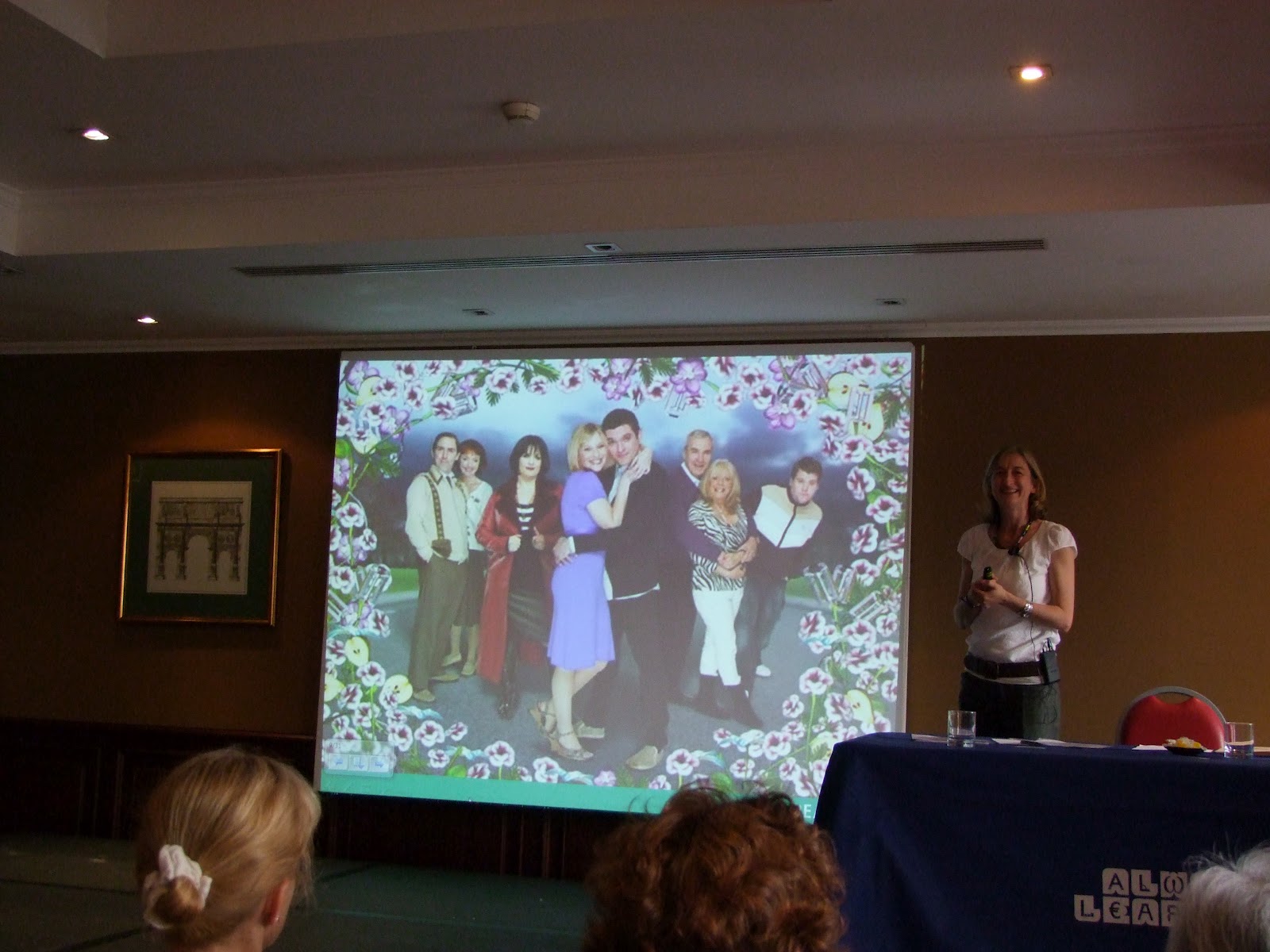
What's occurrin'? Antonia presents "Gavin and Stacey" from Speakout
One of the most well-received sections of Antonia’s presentation was the video from the award-winning BBC TV series, “Gavin and Stacey” (where Gavin’s first day at work is unintentionally sabotaged by a succession of well-meaning calls and visits by relatives and friends). The Pearson-BBC tie-up is obviously a huge coup in terms of bringing this type of genuinely entertaining and engaging material into the classroom in such a way that Intellectual Property (IP) rights are respected. The crossover between mainstream media and language teaching is something that Pearson in particular has exploited by means of the media giant’s existing holdings, such as the Financial Times (which provides the content backbone in the widely-used Market Leader series), as well as its Economist-branded Intelligent Business textbooks for language learning.

Technology to empower but not replace the teacher (MyEnglishLabs)
Chris Morris
Chris Morris, a Pearson international teacher trainer on new digital initiatives showcased MyEnglishLabs with the theme of “Informed teaching and personalised learning”. Chris flagged up further the divide between “digital natives” and “digital immigrants” that was something of a leitmotif throughout this event. Despite the “brave new world” of digital technology and all the benefits it has to bring to the classroom some teachers are suspicious – if not downright terrified – of the impact it could have. Chris pointed out that technology will “empower not replace” the teacher: in fact, it can be liberating, by doing away with routine tasks such as endless marking and correcting of textbooks. In his presentation of MyEnglishLabs Chris showed how the platform can allow the teacher to assign online homework which students can complete at their own pace – and even on their mobile phone, if they download the app. Exercises can be selected for an individual student giving the teacher "fine-grained" control over their personal syllabus. MyEnglishLabs contains over twenty activity types, including various types of exercises (gap-fill, word search, etc), tests and comprehension practice linked to the course content. From the teacher’s perspective, perhaps the main benefit of this system is that it gives you an overview of all the material students have completed as well as their progress and scores. The teacher can “zero in” on those areas of a student’s language that require particular attention. This can also help in planning future courses by showing those areas where students in general are having difficulty (a point that also featured in the British Council section of "Digital Transformations" in the context of exams - technology is reducing the random element in ELT materials and activities, which can only be a good thing).

MyEnglishLab live and direct during Chris's presentation

MyEnglishLabs is an impressive platform that certainly reduces the drudgery of routine activities such as assigning and marking homework, testing and providing additional practice – and it’s always a joy to see someone demonstrate technology which they are genuinely enthusiastic and even passionate about. However, I personally have always been slightly underwhelmed by these systems when I have actually tried to base a complete course around them. MyEnglishLabs seems quite similar to English360 – the newly-independent course management system that features ELT material from Cambridge English (in particular). I suppose that both these systems and other similar products are of most use to large institutions where administration and the ability to monitor the performance of large numbers of students is critical (i.e. schools, colleges and universities). These “large customers” (who will inevitably produce the bulk of the revenues for providers of learning management systems, such as MyEnglishLab and others) work on a more industrial scale – and the automation at the heart of these management systems can produce not only savings in terms of teacher time, energy and even costs (especially as regards photocopying and printing), but also produce benefits for the students – not least by allowing a high level of individual customisation. With smaller schools, specialist training companies and freelancers, there is less need for this kind of “enterprise” technology.

The other key factor is that while these systems are often described as “intuitive” by developers and vendors, they can actually impose quite a large burden on the teacher who must add “system administrator” to their ever-lengthening list of roles. I haven’t really explored MyEnglishLabs in depth yet – but while the presentations were impressive, especially in terms of content – I would like to know more about the training and support that goes with the system. I often find that a “social” approach works best in these situations: an active online community is usually the best source of knowledge and support when you get stuck or are seeking inspiration.

Teachers can see progress through course material and grades at a glance on MyEnglishLabs

Going online: how the exam process is going digital (British Council)
Margaret Fowler talks about digital technology and the British Council
Margaret Fowler of the British Council spoke about the impact of computer technology on the exams that the BC administers and manages in Italy and worldwide. With many exams now available in either paper- or computer-based versions, students can choose which form to take. (Currently, only ESOL exams e.g., PET, BEC, FCE, CAE and KET are available in computer-based format. There is no computer-based version of IELTS yet.)

There are some slight differences. In the computer-based exam (and others), students use headphones for the listening section, for example. (Interestingly, while this can increase confidence when compared to listening to audio output from loudspeakers, it doesn’t actually affect grades.) The test takes less time as there is no need to transfer answers to another sheet for marking. Basic word-processing functions such as copy and paste and word count are also available for the writing section, although some candidates may find it uncomfortable to scroll through the reading passages.

Exam security has gone high-tech too. All candidates are photographed on the day of the test and the images are stored in a central database in the UK: these can be used to verify someone’s identity in the case of doubt about a "dodgy" certificate or someone's claim to be the awardee. Digital technology is also crucial to the development of exams run by the British Council: for example, the Cambridge Learner Corpus, a database of exam scripts (completed papers) that incorporates a treasure-trove of student errors, can be plundered to help exam writers understand which areas of the language students need to focus on. And any so-called “jagged profiles” or anomalies between language skills (e.g. an unusually low mark in a reading or listening paper for an otherwise strong candidate) will be immediately picked up by the analytical software used to crunch all the exam results.

The British Council’s exams service is increasingly in demand. There has been a 20% rise in the number of people taking CambridgeProficiency (CPE) - currently celebrating its 100th anniversary - this year. Margaret’s presentation included some striking images of the (truly) industrial process that underlies this success: warehouses stacked full of completed test papers and high-security printing, for example. With the increasing use of computer-based exams, however, these could eventually become a legacy of the “dead tree” age of information (and it would help the environment a bit, too).

The secret to a successful conference on digital technology: expert hosting 
Russell Lewis thanks Antonia Clare
The whole event was kept moving along at a brisk pace by the very capable Andy Barbiero and Russell Lewis of Pearson, who wove the various sections together with both wit and veuve. (I’d like to see more of these guys presenting Pearson’s materials: they’re obviously both great at winning professional audiences over with their enthusiasm, knowledge of the products and sensitivity to what classroom teachers need.) Both Pearson and the British Council had stalls well-stocked with books, brochures and leaflets covering a range of issues of interest to English teachers. Helpful and informative representatives from the two organisations were also on hand to field queries and provide details of new products and services. The event was a welcome opportunity for some useful networking in addition to the excellent presentations. (And, by the way, it was all free. Not bad!)

Andy Barbiero of Pearson in the hot seat during a simulation of a classroom activity 
So, following this brief introduction to how digital technology is transforming the English teaching world, it was back into the cauldron of the Milan heat (happily weighed down somewhat by a free copy of MyGrammarLab, which all the delegates received). But as I left the air-conditioned oasis of the Melià I certainly felt that I had gained a good insight into how Pearson and the British Council – among many other companies, organisations and individuals working in this field – are helping language teachers and students to benefit from the many advantages that technology can bring to our profession.

Pushing the right button(s): Longman Pearson's "MyGrammarLab" 


Thursday, 7 June 2012

Unsquaring the circle: a very different (and good looking) social network


CircleMe: a different kind of social network
I have been exploring CircleMe – a new type of social network that lets you build connections with other people based on shared likes and passions – rather than just who you already know.

There has been a flurry of start-up activity in the social networking sector recently – driven mainly by the flotations of LinkedIn and Facebook, the meteoric rise of Pinterest (and the less meteoric but still significant rise of Google+) as well as the high-profile acquisitions of Instagram by Facebook for $1bn and the imminent purchase of Meebo by Google. And this is without mentioning a vast swarm of smaller, optimistic start-ups – of which CircleMe is one.

I can’t quite remember how CircleMe came to my attention – but over the last few days it has gradually taken hold of me and I am experiencing the same kind of obsessive “I’ll just check and see what’s happening” sensation that I had when I first joined Facebook – and, to a certain extent, LinkedIn. Looking back now though, I’m sure the main motivation of this desire to log in and check on these networks was simply to see who out of the people I already knew had joined my network. It’s a kind of feedback of how popular you (really) are.

Appetising design and ease of use combine to give a great experience
But with CircleMe it’s quite a different feeling altogether. I am really curious to find out which of the topics or people I have “liked” have been shared – and also to see the expanding network of collections that other people have curated. (I’m trying not use the words “pin” or “board” – although, of course, CircleMe bears more than a passing resemblance to Pinterest.) It may be the case that because CircleMe is still a fledgling its early adopters tend to be quite interesting people with eclectic tastes (CircleMe was in beta and available only by invitation until the end of last year). Or it may be that their combination of luscious design and very easy interface attract people who are more design-oriented – and just generally into exploring culture that bit further.

Pinterest: too much of a good thing?
Without pursuing the comparison with Pinterest too much, I can say that after a very short time on the latter I was so overwhelmed by cupcakes and tastefully-appointed living rooms that I didn’t really bother exploring the rest of the site that much. Somehow, CircleMe has avoided cupcake hell (so far) but it is weighted towards what may be loosely termed “lifestyle”. I have to say that its trademark “tondi” (images cropped to a circle) make food (especially Italian food) look very appetising. With an emphasis on the positive and life-affirming, CircleMe shares some of the same warm glow of Pinterest, but doesn’t induce that sort of glazed-over numbness that I would get from flicking through endless glossy home and "gracious living" magazines.

Location, location, location: the iPhone app
CircleMe has introduced one innovation that really does set it apart from the main existing social networks: geo-tagging, or what it refers to as the ability to “plant” a topic at a specific, real-world location on a Google map. Of course, location-based social networking is not new – Foursquare in particular has established the concept of “checking in” at particular locations and there are a plethora of services that will show you the nearest bars and restaurants. The novel refinement that CircleMe has made is its mobile app which allows you to plant a topic (e.g. a song or poem) at a particular location.

I think they could do more with this: at the moment you can plant likes and receive alerts when you pass the location; but given the social network's appeal to stonger and deeper affiliations I believe the true value of connecting passion to place lies in developing the social links and local communities or tribes formed around those passions. For example, as a freelancer and road warrior (or "pavement partisan", to be more accurate), I spend a lot of time in several cafés and bars in the centre of Milan where I tend to network with other freelancers. Location is critical to our attachment to these "virtual offices" and it cannot be separated from our shared passion for not being chained to a desk. This is exactly the kind of floating, informal community that CircleMe needs to engage with. (I will have more to say about this in a later post.)

I am currently adding topics to my profile and focusing mainly on Milan (which, incidentally is where the CircleMe team is based). It’s quite a nice feeling to be able to plant topics on an “uncluttered” map – even though it also seems to be like colonizing a new territory (although certainly not to the extent of Foursquare’s struggles for virtual supremacy which allow you to become the mayor, king or emperor of a location). CircleMe allows a topic to be planted in multiple locations, which makes sense in terms of people and things which move about rather than buildings and places (which don't).

CircleMe feels like the online version of a quality illustrated book.
For me, the chief delight of the site is its design, which has a handmade, high-end feel – a bit like an expensive art book or catalogue (the background has a subtle rag paper texture and the buttons and panels have an almost tactile 3D quality, like digital card). The palettes and default fonts (I think you can tweak them) are a joy to behold. Now, I know that if you don’t live in Italy – or if you’re not into design – this might sound trivial and superficial; but if you spend time looking at a page (especially a digital one) the quality of its design and aesthetic appeal can be really important. It also helps you to absorb the information in front of you more easily. When I switch back to the starker environments of Facebook and LinkedIn it feels slightly like arriving at the metro station or going into the office. CircleMe, on the other hand, offers the kind of relaxing, enveloping comfort and style-conscious ambience of a private members club – it’s like slipping into your favourite worn (or artfully distressed) leather armchair with an expertly-mixed cocktail as you leaf through one of the first editions from its library.

If you haven’t tried CircleMe already, I suggest you give it a go. It’s not really a numbers game; you don’t feel the urge to rack up as many contacts as you can – or even to see if everyone you know is there (they aren’t). It seems much more of a slow-burn experience (or perhaps "organic" is more appropriate). The topics that you plant – or that other people have planted – will gradually grow and blossom. You can also comment and add pictures as well as “stories” to each topic.

I can definitely see CircleMe developing into a version of “Facebook for grown ups” or for people who (really) know what they like. Each topic could become a micro-community, based on a shared interest or passion. The content also tends to have a certain critical edge that is generally missing from the mainstream sites (although see my comment above about early adopters). I doubt CircleMe will surpass or even approach the huge numbers of (let’s be honest) mainly passive users that the “mature” networks enjoy. Instead, I think it will (or should) attract a select number of more active and discerning users (who are probably more engaged with the topics they share). Basically, they should go for quality not quantity (with just enough critical mass to drive the network effect, of course).

In terms of demographics, a more compact but loyal membership can still offer as much – if not greater value when it comes to whatever revenue-generating strategy they have devised. Consider the petite circulation of expensive, special interest glossies (Condé Nast Traveller, Q, etc). Although there is currently nothing as crass as advertising on the site, the people it attracts will undoubtedly be of particular interest to luxury brands and to those in specialist "long tail" markets. Given that the trend for marketing is increasingly social, it may be the case that CircleMe does not intend to turn itself into a digital version of Vanity Fair, but rather to act as a haven or place to hang out for communities built around their favourite topics (some of which will be brands, but others just communities of interest). Given the strong location-based element, there is ample scope for actual real-world activities – events, meet-ups, etc.

There are still some things they need to work on, however: for example, it isn't at all easy to create a new topic. Another is the "Stories" accompanying each topic, which offer little more than a line or two of text - these could be more visually appealing (without necessarily distracting from the main image for each like).

One cool thing that CircleMe have done is to set up a feedback channel using Get Satisfaction, a customer engagement platform with a nice social business feel. Again, given the fact that people are investing their time and energy in building their profiles and collections of topics, it’s good that CircleMe are involving them in the design and development process. (The CircleMe team are also very helpful if you need support or want to make a suggestion on how to improve what already looks like a very promising and different social networking experience.)

Saturday, 18 June 2011

What's new? - Innovation, of course: An update from Milan by Robert Dennis...

A thermal head being used to create new 
CPUs and chipsets. (Photo: Wikimedia)

OK, time for another update. I have been doing a lot more communications-related work of late (recently) as well as teaching. And as I discussed in my last update, it’s always a challenge keeping up with clients and students who work in highly-specialised fields.

I have been teaching at a company that specialises in designing trains – more specifically, the electrical and pneumatic plant on the underside of the carriage. They work to incredibly tight specifications using 3D graphics programs. As with most other industries there are hundreds of acronyms to get used to (e.g. TCMS (Train Control and Monitoring System and HVAC (HeatingVentilating, and Air Conditioning), as well as a raft (a lot) of engineering and technical terms, such as “bogie”, the wheeled wagon or trolley the carriage sits on. (Confusingly this is known as a “truck” in the US.) But, of course, they also need the day-to-day stuff: meetings, presentations and phone calls, etc.

Lessons are continuing at the biopharma company I teach at. I am always amazed by the deluge (flood, inondazione) of new research that is constantly being undertaken worldwide and the therapies that are being developed. And even for the experts working in the medical and pharmaceutical fields, staying up to date is a constant but fascinating battle.

On the communications side, I was in Cambridge in April, where I visited Bletchley Park, Britain’s wartime top-secret codebreaking facility, where the world’s first programmable computer (Colossus) was built to crack the codes of the German High Command. I watched a video being specially filmed for the social media project I am involved in with OpenKnowledge srl. Again, it was fascinating chatting with scientists working at the cutting edge of technological research (in this case, advanced encryption techniques that exploit the spin effects of electrons).

I have also been spending time with a design firm that specialises in finding solutions relating to structural packaging (e.g. plastic containers for household detergents). This kind of industrial design marries engineering with aesthetics and it’s great to see how an idea goes from a pencil sketch to a rendered 2D image to a 3D prototype literally printed out using stereolithography. I'm really looking forward to developing some great communications projects with these guys!

If I had to pick one theme that unites the various industries I have been teaching people from and working with recently, it would be: innovation. Finding answers to challenging questions in the fields of pharmaceuticals, computer technology or industrial design requires an astonishing amount of insight, trial and error and perseverance. One aspect of what might be termed the “innovation industries” is the amount of research and effort that just gets discarded. The number of drafts that are scrapped or versions that are superseded can at times seem soul-destroying – but, of course, it’s all absolutely necessary as the goal is to find 100% workable solutions. (Interestingly, in the case of the biopharma industry, advances in genetics and computing are allowing compounds that have been thrown on the scrap-heap to be reinvestigated and possibly salvaged as new treatments. This is especially important where huge sums of money have been invested in compounds whose patents have expired: they can be given a new – commercial – lease of life.)

While older manufacturing industries decline in the West – and as Asian economies increasingly take over the “heavy lifting” – the need for ever-greater innovation can only increase. Of course this requires massive amounts of investment, not only from the industries themselves, but also from society as a whole in order to create highly-educated and creative workers able to come up with (think of / imagine) the next wave of solutions and technologies that will add value and drive the economy. Since I live here in Italy I can appreciate the importance placed on education (particularly higher education) in this country. Although at times it can seem that Italians tend to have a much more theoretical approach when compared with their more pragmatic Anglo-Saxon counterparts, you can really appreciate the value of the rounded (and often simply longer) education they receive – especially when it comes to applying creative brain-power to a problem.

I am really looking forward to extending and deepening my contacts with the individuals and businesses I am working with here in Milan. The next few months will also be an exciting time for everyone involved with the Milan Business English Network – we are planning a series of events and initiatives for the autumn. 
(Don't forget to read the latest news in NetworkMilan.com, our online magazine.)

Regards,
Robert

Saturday, 19 March 2011

Teaching, copywriting and exploring social media in Milan: an update

It’s been a while since I posted anything here on the Milan English blog, so I thought I’d write an update on what I’ve been doing and what’s been happening here in Milan.

Well, the first thing is – I’ve been incredibly busy this year. As well as teaching I’ve been working on a social media project for a communications company here in Milan (more on that later). In terms of teaching, I’ve been focused mainly on the pharmaceutical sector. My main client is a NASDAQ-quoted American biopharmaceutical company with national offices here in Italy; but I’ve also been teaching at a much older manufacturer of pharmaceutical products with a production facility in the north of the city.

It’s been quite interesting to compare the two firms and their company cultures. While the American firm is a relatively new startup specialising in the research and development of hi-tech drugs for the treatment of rare forms of cancer, the Italian company (established in 1938) provides pre-filled syringes used to treat a range of conditions and also manufactures generic drugs and active ingredients for other pharma firms.

It’s always a challenge to design and deliver an English language course for people who work in a highly-specialised industry, especially where there is a lot of technical jargon to master and complex processes that have to be understood and explained. Personally, I find this is one of the most interesting and satisfying aspects of being a Business English teacher: going into a company where people perform a wide variety of technical and executive functions, talking to them about what they do and enabling them to do their job more effectively by helping them to master the English language.

In fact, it’s been as much of a learning experience for me as it has been for my students. The pharmaceutical industry has developed its own “sub-language” and procedures over many years. Obviously, people who research, manufacture and sell drugs have to use a lot of medical and scientific terms, as well as specialist marketing terminology. There’s an alphabet soup of acronyms to become familiar with (e.g. CRA – Clinical Research Associate, KOL – Key Opinion Leader and FDA – the American Food and Drug Administration, which is the de facto global authority for approving medicines in the world’s largest market for drugs).

I always find it fascinating to discover what other people do at work. In twenty years of teaching English to people in both Britain and (for the last three years) here in Italy, I have basically sat in classrooms or offices and been initiated into the mysteries of various professions, such as financial trading in the share and bond markets. I have also discovered how insurers (and re-insurers) operate; what problems engineers and architects face when executing a project; and what computer programmers and software developers need to know in order to carry out their work. Journalists, TV executives and media planners have discussed the finer points of their craft with me. And I’ve been introduced to the worlds of fashion, design, hotel management, diplomacy and the military. In fact, there aren’t many sectors or professions from which I haven’t taught people. I’ve also met countless researchers and academics, university students (at all levels) and teachers like myself who simply want to improve their English.

One of the most important things about teaching Business English is that whatever sector, industry or profession someone works in, they usually have a common core of needs in terms of the skills and general communication requirements their job entails. So, for example, everyone needs to be able to use the telephone, write emails and hold a meeting in English. Some people might need to do presentations (e.g. sales and marketing professionals or those who have to present data as part of their work); they might also need to be able to negotiate in English. Others (such as lawyers) may have to read huge amounts of material and be able to summarise the main points, or take detailed notes in meetings. And for a lot of students, their main priority might just be speaking – becoming more confident and fluent in a range of business as well as general situations, such as travelling, meeting new clients or socializing in English.

So, I’ve been very happy this year – and continue to enjoy living and working in Milan as a teacher and communications consultant. Northern Italy is indisputably one of the commercial power-houses of Europe, with firms operating in a wide diversity of sectors (including pharmaceuticals, banking and finance, fashion and design, media and advertising – and, of course, food, leisure and tourism.) I always look forward to meeting new people and finding out about their job and the linguistic challenges they face.

Well, that’s on the teaching side. I also mentioned earlier that I have been working on a social media project. This is basically a research and copywriting job in which I have to produce material for the web relating to technology. I am working as a consultant for OpenKnowledge srl, a company which helps clients by leveraging their social capital and specialises in developing social networks. The client for this particular project is a well-known consumer electronics company that wants to engage more closely with its customers via social media. This is definitely something I feel comfortable with – and, as with the pharmaceutical companies I have been teaching in – the project involves intellectual challenges as well as making potentially dull technical information more appealing to the target audience of the project. Although I have focused more on teaching than copywriting since I came to Milan, it’s nice having the two activities running side by side. I am also able to fit my online research and copywriting round my teaching – so, as you can imagine, I’m usually quite busy.

Social media has been in the news a lot this year. Not only have Facebook and Twitter featured heavily in the revolutions sweeping across the Arab world, but the speculation that a new dot.com boom is on the way has been fuelled by media interest surrounding the imminent stock market flotations of social networking sites such as LinkedIn and Facebook itself. Obviously, social media is an arena in which the written word plays a crucial role. It’s also having a major impact on the way people get their daily diet of information and news. So as a language teacher and a writer, I am personally affected by the massive changes that are taking place not only in the media environment but in the way individuals learn about the world and communicate with each other. I seem to spend increasing amounts of time “catching up” with the latest developments and experimenting (or sometimes just playing) with new platforms and social media tools (such as FriendFeed and Tumblr, which both pull together social media from across different sites; Popplet, an innovative and intuitive mind-mapping tool; as well as a plethora of social media sites and blogs, such as Mashable and 43things.com).

I’ve also been developing my own social and professional networks. The Milan Business English Network (MBEN) recently reached 100 members on LinkedIn. (There’s a parallel group with the same name on Facebook.) I took the opportunity to turn MBEN on LinkedIn into an open group. Although this disabled a lot of interesting discussions between members, I am looking forward to extending this group and connecting with even more people who are interested in learning, teaching or using English in a professional context. Although we weren’t quite able to find the time for live discussion groups, I am hoping that these will take place over the coming months. (If you haven’t already joined, sign up now and start taking part in the ongoing conversations around English at work, writing CVs, doing job interviews and using your English language skills more effectively.)

So, overall, it's been a hectic few months – but very enjoyable nonetheless. I'll be posting more updates shortly, so visit the Milan English blog soon for more enlightening and useful articles on learning English, British and Italian culture - and other subjects that grab my attention which I think you might also be interested in.

Regards,
Robert 

Tuesday, 19 October 2010

Common abbreviations in Business English: e.g., i.e., fyi, CIO, KM... OK?

There are thousands of abbreviations in common use, and with the increased use of computer technology, social media (such as chatting) and the proliferation of organisations, legislation and professional jargon, the number of acronyms and shortened forms of words and expressions that you need to know can seem mind-boggling (totally confusing).

Here’s a selection of some of the more useful ones, which I have organised according to topic. Hope you find them useful.


Writing and email

Perhaps the most common – and yet (certainly for Italian people learning English) the most confusing abbreviations – are e.g. and i.e..

E.g. means “for example”. (Why? Well, that’s because it’s really the initials of the Latin expression “exemplii gratia” – for the sake of example.)

I.e. means “that is” (Italian cioè). (Latin again: id est).

When you send someone an email you can “cc” another person or “copy them in” to the email. Cc means “carbon copy”, a reference to old-fashioned carbon paper used to make copies of a letter while writing them on a typewriter. If you don’t want someone to know that you are copying a third person in, then use “bcc” or “blind carbon copy”.

Digital technology, including the internet, has led to the creation of a huge number of abbreviations, especially as typed or texted forms of real-time communication, such as online chat, internet messaging (IM) and texting (SMS) have gained popularity. Some of the more familiar acronyms from these media include:

FYI = For Your Information. This is typically used when you want to send someone an interesting link you have found, but one which doesn’t require a lengthy (long) introduction.

IMHO – In my humble opinion (used when you express a personal opinion that could be considered arrogant or controversial. It shows that you are aware of this implication.)

LOL – Laugh(s) out loud – This type of digital shorthand (steno) for reactions and emotions has developed due to the often colourless or anonymous nature of online chat.

BTW – By the way – indicates a change of subject or the introduction of an incidental fact.
(btw you can find one of the best online collections of online acronyms and jargon – some of them very funny – on netlingo.com, the internet dictionary. One of my favourites is the term used by IT support staff to indicate that there they cannot find a technical fault: PEBCAK – Problem Exists Between Chair and Keyboard.)

Texting, also known as SMS (Short Message Service) requires the writer to compress a lot of information into as small a space as possible. This has led to a modern form of highly-condensed writing, sometimes surprisingly imaginative.

B4 = before
L8r = later
CU = See you
(Which produces: CU l8r = See you later)


Business Acronyms

There are also thousands of TLAs (Three Letter Acronyms) used in everyday Business English. Here’s a selection of some of the more useful ones:

People / job titles


CEO = Chief Executive Officer
CFO = Chief Financial Officer
CIO = Chief Information Officer
MD = Managing Director
PRO = Public Relations Officer


Other business acronyms


VAT = Value Added Tax (IVA) (recently raised in the UK form 17.5% to 20%)

P&L = Profit & Loss account / statement (one of the financial statements a company has to produce)

KPI = Key Performance Indicators – measurements used to evaluate how well a team or firm is performing

KM = Knowledge Management – a strategic approach to insights undertaken by companies

RRP = Recommended Retail Price – the price customers should pay suggested by the manufacturer

I hope you find these abbreviations useful. If anyone would like to know the meaning of other common business acronyms – or if you have found an acronym that you want to share with other people, visit the Milan Business English Network on Facebook or add a comment here.

Tuesday, 10 November 2009

Digital media articles: Audio branding and recruitment

Here are two articles that I wrote in 2006 for New Media Knowledge, a learning and business information hub for companies and individuals working in UK digital media.

Sounds Subliminal: Branding The Future With Audio
Ringtones, radio and TV audio branding, MP3s and podcasting all offer ways for brands to connect with consumers. This article is a write-up of an event held jointly by NMK and Music Tank. The event looked at how marketers and brands can use audio as a way to engage with consumers in the digital space.
Click here to read the original article on audio branding on the NMK website.


Situations Pretty Vacant
This is a report of a speaker event held by NMK at One Aldwych which looked at how agencies large and small are facing up to the skills shortage. It also examined the strategies agencies are employing to find talented people.
To read this article about the skills gap in the digital media sector on the NMK website, click here.

About NMK
NMK is a not-for-profit body in receipt of public funding. NMK operates across economic boundaries, bringing together knowledge and expertise from commercial companies, professional bodies and higher education to provide objective, independent guidance and promote the success of the UK's digital economy. Since NMK began as New Media Knowledge in 1997, it has been supported by the University of Westminster, one of the UK's leading educational institutions for digital media.