Showing posts with label ideas. Show all posts

Tuesday, 11 February 2014

Incidentally...

“Los Olvidados” (“The Forgotten Ones”) is a film shot in Mexico in 1950 and directed by the great Spanish visionary, Luis Buñuel, who in 1929 had made the haunting, dream-like surrealist film “Un Chien Andalou” with Salvador Dalí. “Los Olvidados” is a kind of social realist picture, at times almost like a documentary. The story concerns a group of street kids subsisting in a desolate, crumbling Mexico City. The main characters are El Jaibo, an anarchic Jack the Lad who is basically amoral and his gullible sidekick Pedro, who actually has a conscience.

The film is pretty depressing actually. Most acts of kindness or humanity are met with indifference or lead to tragedy and overall the movie paints a picture of life as nasty, brutish and short.

Now, I don’t intend here to explore the various themes of the film and Buñuel’s cinematic treatment of his subject (although I will just mention the surrealist dream sequence that seems almost out of place in the otherwise bleak realism of the film). Instead, I just want to draw your attention to one little scene which is almost inconsequential but highly memorable. A man has two dogs dressed in little costumes with hats, which he takes around the slums to entertain people with and earn a few pennies. The street children go crazy when he comes and all shout out “the dancing dogs, the dancing dogs!”. You then see a few minutes where the camera is basically held on these bizarre, absurd but poignant dogs dancing for the crowd.

I’m sure academics and film historians have written very significant interpretations and analyses of what this scene means. (It is, in fact, one of several references to and actual appearances of dogs in the film.) It is an interesting bit of cinema verité: obviously, the filmmakers must have seen the dancing dogs while they were shooting or perhaps they knew the owner or just ran into him. However, the thing that struck me most about this scene was the fact that it was really quite incidental. It just happens to be there and doesn’t really add  much to the plot. In fact, once you’ve seen it you just remember it as the bit with the dancing dogs, even if you can’t really say how (or where) it fits into the film.

There are in fact a lot of scenes, characters or things that just happened to get included in films largely at random and which don’t really drive the plot or mean much more than themselves. But somehow they stick in the mind simply because they are strange or poetic. Perhaps they function as symbols or metaphors, but often they are really just opportune (and opportunistic) bits of footage where the director of the film just thought they worked.

Here’s another one. In “Stromboli” (also made – coincidentally – in 1950), Ingrid Bergman plays Karin, a displaced Lithuanian woman who finds herself in an internment camp at the end of the Second World War. She conducts a romance with a Sicilian fisherman through the wire fence of the camp and ends up marrying him. They return to his home village, which is tiny and religiously conservative, on the island of Stromboli, near Sicily. The local women are very unimpressed by Ingrid Bergman and her free-spirited attitude to life. (At one point she is sent to Coventry and impugned for her lack of “modesty” after she decorates the fisherman’s cottage with a mural.)

Like “Cleopatra” (1963) starring Elizabeth Taylor and Richard Burton, "Stromboli" is more famous for what happened off-screen than on. Bergman fell in love with the director, Roberto Rossellini, and they had an affair while they were making the film. (The US was scandalised when Bergman gave birth to Rossellini’s son – they weren’t married – in the same month as the film’s release.) The couple tied the knot later (in Mexico) and went on to have twin girls – Ingrid and Isabella. Isabella Rossellini, of course, is the woman whose main credits include her role in David Lynch’s “Blue Velvet” (which also relaunched Dennis Hopper's film career) and the fact that for many years she was the face of L’Oréal.

Now, again, this isn’t really a critical study of "Stromboli". I will just note that it’s a strangely wooden, halting piece of storytelling that never really gets going on an emotional level. Instead, what you remember when you watch it are the incidental, “background” set pieces, which include actual footage of the volcano on Stromboli erupting at the end while Ingrid Bergman is clambering over the rocks on her way to freedom. The most powerful scene, however, is where all the men of the village go out fishing. They row out to sea (at night?) and when they arrive at the fishing ground they spread out a huge circular net – and wait. This is a village where fishing is de rigeur and it’s communal. It’s also for men only (although the impudent Karin rows out to join her husband, much to the surprised delight but also social embarrassment of her husband). Eventually the fish arrive and then the men start heaving the net upwards, with all the biggest fish thrashing around as the haul nears the surface. The men sing as they work and they all (literally) pull together. Once the fish are at the surface the men then set about clubbing and spiking them in a truly horrific scene, which the uninvited Karin/Bergman is also forced to observe – along with the viewer. (This is definitely one of those films you want to watch after you've had your dinner - especially if it's tuna.)

As with the dancing dogs, once you’ve seen the Stromboli fishermen you’ll never forget them. And again, this is really an opportune bit of documentary reportage spliced into a much weaker movie. The power of the scene comes from the fact that you’re not watching actors but real people at work doing what they have been doing perhaps for centuries. In fact, although this kind of real-life scene is common in post-war Italian neo-realist film-making, it’s always surprising when you actually see it. You get the same frisson as from looking at old photos where people stare out at you from the past as if through aspic. Or when you see something personal and poignant in a museum like a child’s doll or a pair of gloves with a hole in one of them. It’s really something human, not artificial or contrived. It’s like hearing someone scream or cry: it bypasses the intellect and the rational mind and hits you in the stomach or touches your heart.

I’ll just add a third and final incidental scene from another black-and-white post-war classic. This time it’s Vittorio De Sica’s 1948 “Bicycle Thieves” (“Ladri di biciclette” in Italian) which like the other films is a story of ordinary people trying to survive in a bombed-out, post-traumatic world of concrete rubble and shattered ideals. In “Bicycle Thieves” a young married man with a small son living in Rome has the possibility of getting a job putting up film posters for the newly-resurgent movie industry – but only if he has a bike. He and his wife knock their heads together trying to think of how they can come up with the money needed. Eventually, she decides they have to pawn (or hock) their linen. Again, it’s one of those scenes that creeps up on you without warning and then sends you reeling with a sensation of shock and pity with historical fascination and poetry all mixed in.

The pawn shop is huge. It’s basically a warehouse and when the woman hands over the bundle it gets taken through a huge stack of towering shelves and carried up a ladder onto a perilously high rack. There’s linen everywhere – thousands of uniform bundles all packed onto shelves and waiting to be redeemed. Indeed, this one really is symbolic – the shock of the scene is partly that you could never have imagined such a huge pawn shop – but also historical in the blow-to-the-stomach way described earlier: it seems as if the entire working-class population of Rome have pawned their belongings (which they probably had). I suppose the place must have been well-known to the film-makers (I haven’t really looked this one up) or maybe they just heard about it as they were filming. Anyway, the effect it has on the viewer is devastating – and, although it happens in a different way – so is the ending, which of course you will have to watch for yourself. (Let me just say here that it’s one of the saddest endings of any film ever made – so have some Kleenex handy; you’ll need it.)

Well, there you have it. I’m not really sure what these scenes mean – or if they were consciously intended to mean that much, but they are all equally memorable and although you can’t imagine these films without them they don’t really function as indispensable narrative devices. In fact, that’s partly what them makes them so interesting: they’re just there. They simply sit in their respective places and will forever jump out at an unsuspecting audience or viewer and have the same or at least very similar effect for ever.

I think this is a topic I’ll be returning to – not necessarily from films, but from novels, paintings and other media. I like the idea of having a collection of memorable but inconsequential moments; of people, animals and places that just happen to have been included in a larger narrative; of odd, vivid memories that seem both random but significant and suggest a life beyond that of that the immediate film or book and its characters.

(c) Robert Dennis 2014


Incidental but memorable: dancing dogs from “Los Olvidados”, the fishing scene from “Stromboli”  and the pawn shop from “Bicycle Thieves” 


Note: I checked a few facts while writing this post (mainly dates), but I haven’t re-watched the scenes described to ensure that I have recalled them exactly. However, the emotional impact they make is unmistakable – so in this sense they’re like other trace memories in life: a feeling that stays with you, even if the exact details are slightly fuzzy.


Thursday, 14 June 2012

CircleMe: Some suggestions for making the user experience of "the social network from Milan" more social

I recently wrote a review of CircleMe, the fast-growing “Made in Italy” social network where you can share your passions and interact with other people who like the same things as you. I have been thinking about how this experience could be deepened and enriched socially and in this article I discuss some of the key factors that need to be taken into account.

CircleMe is a social network for sharing the things you like
I like something; so do you – so what?

The first thing to consider is what is the significance of people liking things - and more importantly telling other people they like them? I suppose this is a basic, human thing that we do all the time. We show other people what we like – e.g. allegiance to a particular football team, the choice of brands we make (what we wear, the car we drive round in) as well as more subtle, less articulated passions and values – e.g. our desire to be taken seriously and to be considered interesting or cool. In fact, if you look at most of the decisions we make regarding the things we buy, use, etc – as well as where we live, the places we visit, the people we know – all of these are really “likes”: we are telling the world “this is me, these things are important to me” – and we tend to feel positive and generally well-disposed to people who share our likes and passions. (Conversely, we can feel quite negative towards those who have a completely different set of likes – and, hence, passions, values or even an opposing world-view.)

More than just a directory?

How is CircleMe different from a (good-looking) list or database?
Now, from the perspective of sites and services such as CircleMe, how does the data they accumulate help them to deliver a better experience? Assuming that CircleMe is not just a huge survey or questionnaire designed to garner information that is useful to marketers and brand-owners (which I’m sure it is, but there must be more to it than that), how does the relationship between what people like and the way they interact with each other through CircleMe become significant or achieve something meaningful enough for people to stick with the site and keep returning to it? (And how will it differentiate itself from other "recommendation" sites which offer a similar service?)

I believe the answer is: communities. By initially declaring what you like and finding other “like-minded” individuals, you start to develop a kind of footprint or to map out an area / territory that defines you (or the part of you that you want to show publicly). If enough people start to cluster or congregate around a particular topic, that topic will start to take on a life of its own. It may also draw in existing goodwill and energy (e.g. fans of a singer or film director who already belong to other sites and communities relating to that topic or “hero”). Eventually, the community establishes itself as a permanent presence on the web (perhaps clustered around certain sites or networks) – and, indeed, spilling out into the offline world as well. (I have noticed, by the way, that CircleMe has been using the word "community" in some of its likes – but perhaps this is more wishful thinking at present than an accurate description of what is happening. More on this topic coming up...)

The network is the message

Sharing interests can bring people together
These online communities are often associated with a particular social networking site or or other virtual location (e.g. forum, blog, etc). Groups dedicated to certain topics may favour one platform over another. MySpace, for example, tends to attract music fans, while Google+ has a large number of (mainly male) tech aficionados. Pinterest (which I touched on in my earlier article about CircleMe) attracts mainly female “pinners” who are particularly interested in fashion, interior design – and, of course, cupcakes. It isn’t exactly clear yet what the main focus is for people who CircleMe attracts: it’s still early days for this feisty all-Italian startup. Obviously, there is a bias towards leisure and entertainment. However, I have attempted to identify some trends which may point towards its eventual focus or “centre of gravity” (or "centre of levity", even).

As I said before, CircleMe is good-looking and offers an intensely pleasurable aesthetic experience. Its interface is a delight. (I have compared it to an expertly-produced – and up-market – glossy magazine - or perhaps just the Contents page in such a periodcal.) This analogy with high-end magazines could be significant. It is very much oriented towards cultural consumption: books, films, music, food and drink, etc. Looking at the mainly offline publications that tend to attract a devoted following (as opposed to casual passers-by who are probably looking for immediate gratification: clips, downloads, etc), it is clear that the people who buy music magazines, for example Q, Mojo, Rolling Stone, etc tend to be slightly older and to belong to a comparatively “higher” social demographic. If someone is interested in the background, discography and forthcoming gigs for a band, they are more likely a) to actually buy the music and b) have a greater stake in the band’s “social” context or community. This is also true for films (again – the analogy with magazines such as Empire or even the more serious Sight and Sound is telling: a person who identifies strongly enough with a particular director or performer to be active in the community surrounding that individual probably also goes to the cinema and buys DVDs / other (physical) formats, e.g. BluRay) – or actually spends money on downloading and streaming services. (In my last article I used the phrase “Facebook for grown ups”. I would refine that here, perhaps, to “Facebook for predominantly metropolitan, style-conscious grown ups who are still into old media and visit restaurants with friends” – i.e. a pretty significant group of people when it comes to spending their disposable income and influencing others.)

Consuming passions

Food and drink, goods, films, book and music: they're all social!
Looking at the trends on CircleMe, there is a definite tendency for people to like what may be termed “lifestyle” topics – food, places to visit, cultural events and phenomena, as well as media such as books, films and music. Another important group of likes is “Heroes” – people, many of whom, naturally, are artists, musicians and writers, etc – but also “celebrities” (a term which can be slightly pejorative or dismissive): perhaps the more neutral “famous people” is better – figures from public life, campaigners and “movers and shakers” of all kinds. (Interestingly, while these people may not associated with an obvious product to sell, such as a biography or tee-shirt, the fact that someone likes a topic that is not just an item to be consumed (e.g. Aung San Suu Kyi or Artificial Intelligence) is significant. This kind of “soft” or nebulous information fills in the gaps between a person’s consumption patterns across different product categories and their aspirations and ideals: it tells you about people’s values, what makes them tick – not just what they have already bought.)

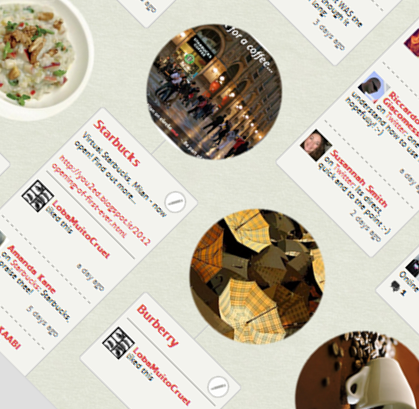
Now, one of the things I really like about CircleMe is the way that when you add a topic it produces a neat-looking “card” on your wall. All of these cards together make an attractive collage or overview of your tastes. (This is definitely the main motivation behind Pinterest – and, to tell the truth, if you want to produce a “mood board” of images, Pinterest is what you need.) While this collection of likes within CircleMe is appealing, within an individual topic, however, the experience is less satisfactory. Comments can be added in a scrolling list to a topic page; there are areas to add stories (really just links) and you can see other people who like the same topic or have planted it on the map. To Do's are also visible, but these offer little extra info and are not easy to access. So, a topic quickly becomes little more than a list of comments and links. You can add a picture, but again, these are just in the form of a slideshow with thumbnails. One picture (generally the last one added) forms the main picture for the page. The overall feel within a topic page is that of a more-stylish Facebook wall or bulletin board with limited functionality.

My 7 "To Do's" for CircleMe

Ideas for making CircleMe more social
Now, I am not sure what CircleMe plans to develop as regards their site – and I am just floating some ideas here. (As I mentioned in my last piece about them, they have deployed Get Satisfaction, a social engagement platform, which has some interesting user feedback. The CircleMe team are also quite happy to respond to individual comments and suggestions you send them.) So, here are my suggestions for how they could improve the experience of their site for users and develop the communities concept further:
1.  Give users more tools to do stuff with the content in each page – e.g. it would be quite cool if you could add links to other likes within comments or tag individual comments. (Also, the ability to automatically generate a preview thumbnail and intro text when you add a link – as on Facebook and LinkedIn – would add value.)
2.  Layout and design: One of the main benefits of CircleMe is its aesthetic appeal and textured, tactile design that arranges pages automatically and generally tidies them up so that whenever you look at a page it doesn’t seem cluttered or crowded (on both the PC/Mac and mobile platforms). Extend this principle to individual topic pages by allowing users to add content – but silently manage the design that you (CircleMe) do so well. (In this regard, I have been looking at some automatic page and template generators that you can use to create “fake” newspaper stories or magazine layouts.) The key thing here is that the content and design can be separated: everyone could become a Condé Nast editor and immediately see their comments and pictures beautifully formatted on glossy, “handmade” pages. (Magazines actually use a lot of automated design features in terms of borders, dividers and placeholders for text.)
3.   Make it more social: allow collaborative editing of articles, but let the people who are contributing show what they have done. Don’t make the process invisible (as it is, at the moment, e.g. if you add a picture or edit tags (although these do show up in your Activity)). Give contributors a byline (and pic) - it doesn't have to be Wikipedia.
4.   Let people vote and decide on which content gets used. Add polls, sticky notes, etc. (These could be in a “design” panel or dashboard (complete with coffee stains and pencil marks – they already have Get Satisfaction on a fly-out menu button at the side which opens up the GS interface.) The key thing is that every time you hit "Refresh" you would see a beautiful,“print-ready” page or layout that incorporates all the material that has been added. (You could also print off hard copies of the lovely pages you have worked on - complete with crop marks and CMYK registration.)
5.   Allow users to publish the content from the topic page to their social media sites, profiles and blogs, etc. If a group of people decide to start curating the page on a topic, e.g. Bob Dylan, then give them (full) credit for their work. Make each page a mini-magazine and generate a kind of magazine-style credit list of contributors. Allow people to comment on the work and link back to their main CircleMe profile so you can see everything they like and the other content they have added. (Not everyone will be a designer – there will be writers, researchers, picture editors, fact-checkers, etc.)
6.   Be iconic! Compared to the usual experience of Facebook, forums of various kinds – and even the more “serious” collaborative content sites, such as Wikipedia – CircleMe could become known for being distinctive and design-conscious (which are important Italian values too!). Make it virtual Moleskin and Montblanc.
7.   Let CircleMe become “the glossy lifestyle magazine you can edit yourself” – Vanity Fair or Rolling Stone with a million guest editors, beautiful black and white photography (sign up professional photographers and picture libraries to showcase their work) and cutting-edge graphics you can load from a simple push-button template.

A few other ideas regarding the communities clustered around each like:
·       Allow communities to like other communities. Create a network of “cross-likes” and associations. (e.g. people who are into Deep Purple could hook up with lovers of classic motorbikes; bebop fans could reach out to readers of the Beats and Jack Kerouac). Make it easy to aggregate topics and curated content based on tags and categories – see Last.fm in this regard, which allows users to create their own radio stations and listen to other user’s playlists.
·       Develop community activities in the real world as well as on CircleMe. E.g. if you know that a large number of people are into a topic in a particular location, use the site to direct people towards each other. (e.g. if there’s a film or festival that has been planted by users, let them save the map – include locations of restaurants or bars nearby – and add reviews from other likes. Allow people to print out or download the whole thing as a mini-programme, tailored to their individual style and tastes – and also to send / share this with others. Local vendors could include Groupon-style vouchers for discounts and there could even be a “print a flier or poster” option for someone organising an event to produce publicity material  perfect for a band or performance artist who want to connect with their local fan base. (This is significant as CircleMe differentiates itself from other similar sites by making planting” (or geo-tagging) central to its experience. At present, this feature of the site is under-exploited.)

I will be visiting CircleMe.com over the next few weeks and months and I’ll be interested to see if they take up any of these ideas!

My vision of a "collaborative" article created by contributors within a community.
(I'm sure CircleMe's designers could do a better job and make it more "bello"!)