Showing posts with label video. Show all posts

Monday, 7 June 2021

Welcome to Milan! Robert Dennis walks and talks in the city centre


Welcome to Milan! In this video, Business English teacher Robert Dennis talks about where he's from - a "leafy suburb" just outside London. Find out what "commute" means, experience some street life in Italy's business capital, Milano, and spend a few minutes in the company of Robert. 

Check out the Business English YouTube channel for some useful and fun videos to help you learn English!


Tuesday, 2 June 2015

An Empowering experience at the Piccolo: VIP event to launch the new integrated Cambridge English course


On Monday 25th May 2015, Cambridge English held a VIP presentation of their new Empower course. The event was a great opportunity to see the books and get some hands-on practice with the online materials and testing package, integrated with the publisher’s own learning management system. The afternoon also provided a nice networking opportunity and a chance to meet other English language professionals in the suitably dramatic setting of the Piccolo theatre (near Piazza Cordusio in central Milan. The theatre is a satellite of the larger Piccolo in the city's Lanza district). 

Cambridge English Empower is a new general adult course that combines content from Cambridge University Press with validated assessment from Cambridge English Language Assessment. As Chris Jory, Publishing Manager of ELT adult courses at CUP pointed out, this makes the course unique and marks a new chapter in the closer integration of course materials and testing from one of the main ELT publishers and testing organisations.


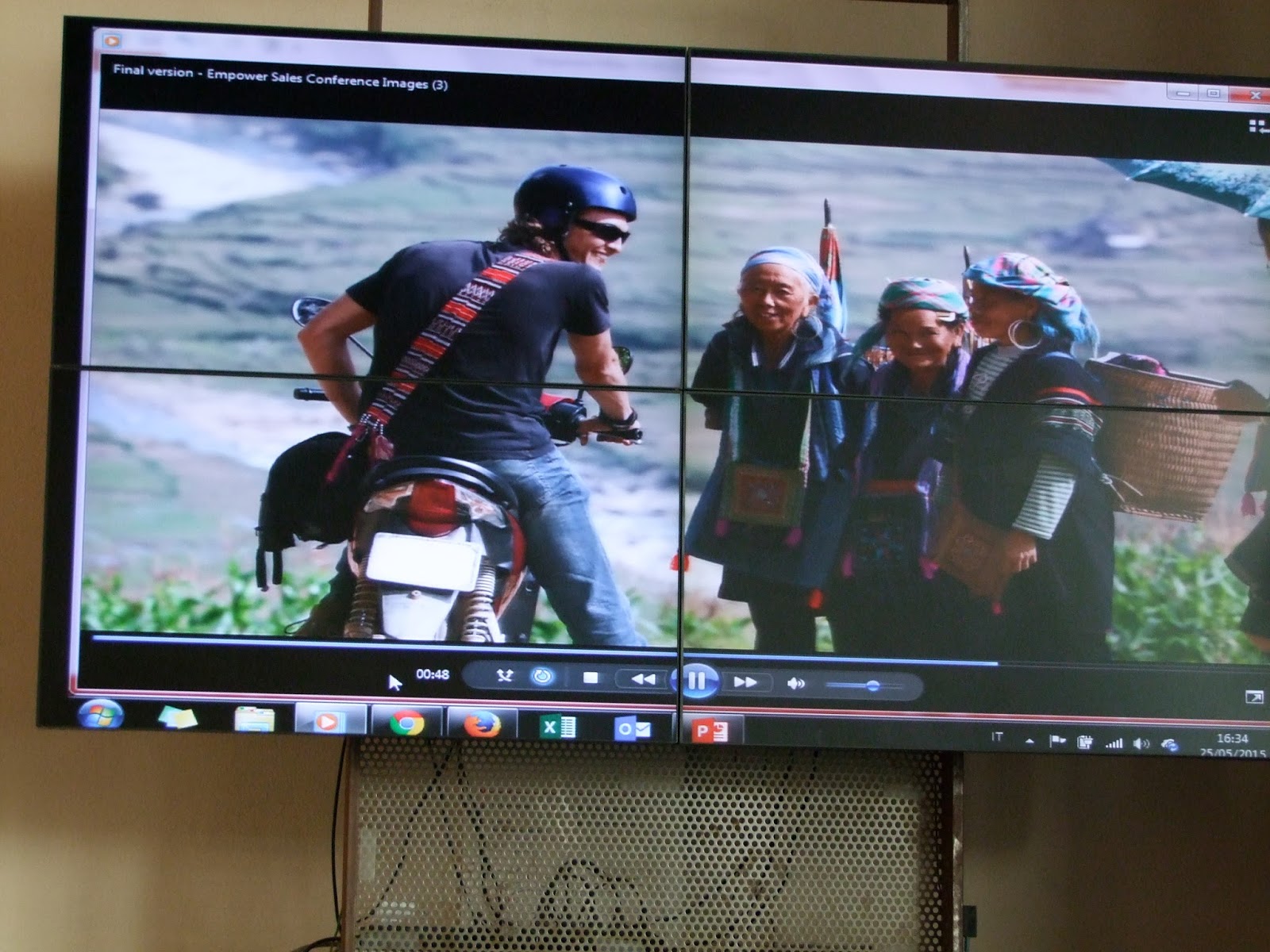
The first thing that you notice about Empower is the fresh and exciting graphic treatment Cambridge have lavished on the course. In particular, gone are the rather tired standard images used to accompany the text in traditional class-based course books. Instead, Cambridge have commissioned and gathered a wealth of really exciting and unusual visuals, including photos that have a strong narrative content and that can be used to stimulate class discussions. Chris’s presentation featured a montage of images including a backpacking biker’s tour of South America, a busker dressed as a chicken playing the double bass and a beach house perched precariously on a raised platform. All of these images immediately invite the wh- questions that trigger active discussions between students and in whole class discussions. (Who are these people? What are they doing – and why? etc.)

Indeed, the emphasis of Empower is very much on eliciting personal experiences and encouraging students to talk about their own lives and to discover the life stories of fellow students. As language teachers, we know that this is always the most enjoyable and rewarding aspect of classroom teaching – and the visually-rich materials of Empower will certainly help teachers and students to have these discussions.


The structure of the course is actually fairly conventional. Chris was at pains to point out that although the course features innovation in terms of its visual design, integration with technology and the testing package, in pedagogical terms it doesn’t try to reinvent the wheel. In fact, it allows time-poor teachers to teach “off the page” with minimal preparation and follows a tried and trusted communicative pedagogical approach.

The course also features naturalistic and engaging video content, which can be used in both in class and for students to watch in their own time on a range of devices.


Clare McCallum, Head of ELT Marketing Europe and UK Sales at Cambridge University Press, spoke about how Empower dovetails with Cambridge’s other academic activities: language assessment and testing. This is undoubtedly the main innovation of the series for teachers as well as teaching institutions: a course book from a heavyweight publisher that is designed to plug straight in the Common European Framework of Reference (CEFR). Cambridge has also drawn on its insights from English Profile, its collaboration with the Council of Europe, that provides  a ‘profile’ or set of Reference Level Descriptions for English. For example, each chapter of Empower features the “Can do” objectives for the appropriate level on the “Getting Started” page.


Since the blended learning approach is now becoming standard in all course books, teachers have come to expect online resources that are both effective and easy to use – and here as well, Cambridge has delivered with a suite of digital materials that allow a high degree of personalisation. Indeed, making everything as personal and relevant for the individual student is now the main challenge in a publishing industry that has recently been likened by Nick Robinson of ELT Jam to a supertanker changing  direction. The shift towards individualised learning and adaptive technology is clearly in evidence in Cambridge’s design of the assessment component of its course. Empower allows learners to take up to 25 different paths through its testing software and features a range of intelligent technologies, including voice recognition and software that can assess fluency based on a speaker’s propensity to hesitate, for example.


Technology and big data also feature in Empower’s use of the Cambridge English Corpus, a multi-billion word collection of written, spoken and learner texts drawn from a huge range of sources: newspapers, the web, books, magazines, radio, exams, schools, universities, the workplace and everyday conversation. The CLC also includes the Cambridge Learner Corpus - a unique 50 million word collection of exam scripts written by students taking Cambridge exams all over the world.


Marcus Tubby, an ELT Consultant at Cambridge University Press based in Italy, demonstrated the assessment package in action and walked participants at the event through the Cambridge Learning Management System. Using PCs provided by Cambridge, we were given the chance to try out the live demo of the course and the platform, which includes a range of useful tools such as individual and class enrolment, as well as a Grade Book with exhaustive analyses of student and group performance. While some teachers might find all the number crunching and endless graphics of pie-charts a bit bewildering, obviously, this is the way the industry / professions is moving – and for schools, especially those providing training to corporate clients, having this kind of instant feedback on individual students is a huge boon.


Along with the other major ELT publishers, Cambridge has been at pains to make their course and the integrated technology as user-friendly as possible. However, at the digital chalk face most teachers will need increasing support as well as training to really capitalise on the benefits of this innovation.


The event concluded with a delicious buffet and a chance to chat and mingle with the VIP participants and the speakers. Russell Lewis, Marketing Manager at CUP, Italy was also on hand with members of his team to answer questions and demonstrate the live version of Empower. The particpants received an information pack which, in addition to sample chapters from the course, included a "fold-out" USB key containing a link to the Cambridge Empower site.

Robert Dennis
Director, Riverstone Language & Communications

You can see all the photos from this event in a special album I have created on Flickr. (Please note that if you would like to use these images, you can contact me and I will be happy to share them with you - but some "link love" or an attribution is always appreciated!)




Monday, 25 June 2012

The perfect blend? Pearson and the British Council team up for "Digital Transformation in the English Teaching World"


The Melià, Milan: great setting for a "cool" event
It was a blessed relief to step from the sweltering June heatwave engulfing Milan into the cool and spacious Melià Hotel last week, the setting for “Digital Transformation in the English Teaching World”, an event co-hosted by Pearson Longman and the British Council. Informative and inspiring speakers opened up the possibilities offered by integrating new technology with more conventional approaches to language teaching in a series of engaging presentations. The sizeable audience was made up mainly of teachers and other language professionals from universities, private language schools and the swelling ranks of freelance English teachers. (I was one of the very small minority of token men in the audience: ELT is obviously a woman’s world.)
Delegates at the Pearson / British Council event "Digital Transformation
 in the English Teaching World at the Melià Hotel, Milan, 20 June 2012

Joint effort
Co-hosts of "Digital Transformations
in the English Teaching World"
As you might expect from a conference co-hosted by Pearson, there was quite a large emphasis on the products and platforms they have developed, in particular the My EnglishLab learning management platform, as well as the materials Pearson has produced for this system. But there were also contributions from the British Council on how it is increasingly employing digital technology in the vast undertaking of providing testing and certification for the many thousands of candidates who take IELTS, Cambridge exams and other tests every year.

Digital literacy: what native digital speakers know
Nicky Hockly
Nicky Hockly, Director of Pedagogy at The Consultants-E, a Pearson Longman author and a renowned international teacher trainer talked about the importance of understanding digital literacies in today’s web-enabled learning environment: these literacies affect how we perceive, interpret, judge and use online content. With examples of how to use existing material from the web as a way of encouraging students to understand how material is presented, as well as the language itself, she also explored the use of video and even texting in the  classroom. (We were all intrigued by the case of the Pacific Northwest Tree Octopus, which Nicky used to show how context can impact on credibility)

She introduced techniques such as subtitling video and using “literal videos” to engage learners (particularly younger ones). One of the themes of this conference was the wide gap that exists between teenagers who are “native digital speakers” and older people who have had to learn (rather than acquire) their web skills the hard way. Typically, it is the students who are more web-savvy – with teachers lagging behind (although there are exceptions). One of the benefits of this situation is that both teachers and students have knowledge they can both bring to the party and share – making the teacher-student relationship less “asymmetrical”.

Txt: the way we communicate is being transformed by technology

Using authentic video with English learners

Antonia Clare
Antonia Clare, one of the authors of Pearson’s Speakout series, presented “Effective learning from authentic video content”. A collaboration between Pearson and the BBC, Speakout enjoys the huge advantage of incorporating video and other material from BBC Worldwide and BBC Learning English. The coursebook content dovetails with the MyEnglishLab platform and provides some very impressive features, such as the ability to watch a video and access the complete transcript in a scrolling panel underneath. (Each sentence is highlighted as the language is spoken.) Antonia talked about using video as a springboard to encouraging students to talk about their own lives and experiences. Speakout (intermediate) includes voxpop conversations in the street with people from both Barcelona and London. She pointed out that students could make this kind of video themselves using readily-available consumer technology (flip cams or camera phones) and post it on a video-sharing site where it could be used as the basis of further language activities, such as subtitling (with the corrected text appearing at the bottom of the screen). Again, while this event was a showcase for Pearson’s platform, the speakers all provided examples of how (largely free) social media sites and services can be combined with professionally-produced classroom materials (books, DVDs – as well as the online content in systems such as MyEnglishLab). 

Blended learning – something of a buzzword currently, but not always understood or appreciated in practice – can therefore be seen as a way of bringing many different strands together: online content, material produced by students themselves as well as more conventional tests and exercises. While blended learning increases the opportunities it also brings new challenges, such as keeping activities focused on learning rather than the technology becoming an end in itself.

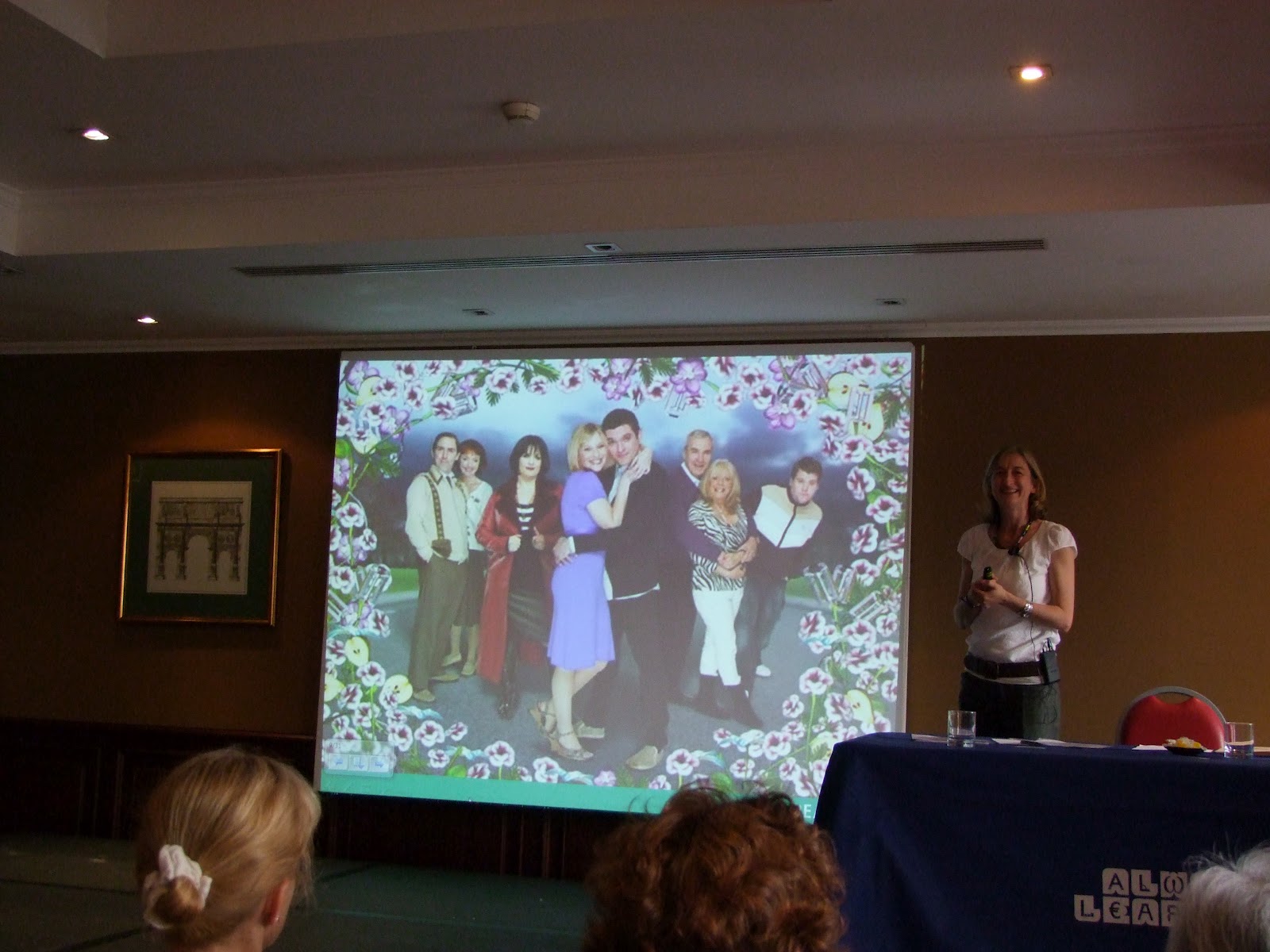
What's occurrin'? Antonia presents "Gavin and Stacey" from Speakout
One of the most well-received sections of Antonia’s presentation was the video from the award-winning BBC TV series, “Gavin and Stacey” (where Gavin’s first day at work is unintentionally sabotaged by a succession of well-meaning calls and visits by relatives and friends). The Pearson-BBC tie-up is obviously a huge coup in terms of bringing this type of genuinely entertaining and engaging material into the classroom in such a way that Intellectual Property (IP) rights are respected. The crossover between mainstream media and language teaching is something that Pearson in particular has exploited by means of the media giant’s existing holdings, such as the Financial Times (which provides the content backbone in the widely-used Market Leader series), as well as its Economist-branded Intelligent Business textbooks for language learning.

Technology to empower but not replace the teacher (MyEnglishLabs)
Chris Morris
Chris Morris, a Pearson international teacher trainer on new digital initiatives showcased MyEnglishLabs with the theme of “Informed teaching and personalised learning”. Chris flagged up further the divide between “digital natives” and “digital immigrants” that was something of a leitmotif throughout this event. Despite the “brave new world” of digital technology and all the benefits it has to bring to the classroom some teachers are suspicious – if not downright terrified – of the impact it could have. Chris pointed out that technology will “empower not replace” the teacher: in fact, it can be liberating, by doing away with routine tasks such as endless marking and correcting of textbooks. In his presentation of MyEnglishLabs Chris showed how the platform can allow the teacher to assign online homework which students can complete at their own pace – and even on their mobile phone, if they download the app. Exercises can be selected for an individual student giving the teacher "fine-grained" control over their personal syllabus. MyEnglishLabs contains over twenty activity types, including various types of exercises (gap-fill, word search, etc), tests and comprehension practice linked to the course content. From the teacher’s perspective, perhaps the main benefit of this system is that it gives you an overview of all the material students have completed as well as their progress and scores. The teacher can “zero in” on those areas of a student’s language that require particular attention. This can also help in planning future courses by showing those areas where students in general are having difficulty (a point that also featured in the British Council section of "Digital Transformations" in the context of exams - technology is reducing the random element in ELT materials and activities, which can only be a good thing).

MyEnglishLab live and direct during Chris's presentation

MyEnglishLabs is an impressive platform that certainly reduces the drudgery of routine activities such as assigning and marking homework, testing and providing additional practice – and it’s always a joy to see someone demonstrate technology which they are genuinely enthusiastic and even passionate about. However, I personally have always been slightly underwhelmed by these systems when I have actually tried to base a complete course around them. MyEnglishLabs seems quite similar to English360 – the newly-independent course management system that features ELT material from Cambridge English (in particular). I suppose that both these systems and other similar products are of most use to large institutions where administration and the ability to monitor the performance of large numbers of students is critical (i.e. schools, colleges and universities). These “large customers” (who will inevitably produce the bulk of the revenues for providers of learning management systems, such as MyEnglishLab and others) work on a more industrial scale – and the automation at the heart of these management systems can produce not only savings in terms of teacher time, energy and even costs (especially as regards photocopying and printing), but also produce benefits for the students – not least by allowing a high level of individual customisation. With smaller schools, specialist training companies and freelancers, there is less need for this kind of “enterprise” technology.

The other key factor is that while these systems are often described as “intuitive” by developers and vendors, they can actually impose quite a large burden on the teacher who must add “system administrator” to their ever-lengthening list of roles. I haven’t really explored MyEnglishLabs in depth yet – but while the presentations were impressive, especially in terms of content – I would like to know more about the training and support that goes with the system. I often find that a “social” approach works best in these situations: an active online community is usually the best source of knowledge and support when you get stuck or are seeking inspiration.

Teachers can see progress through course material and grades at a glance on MyEnglishLabs

Going online: how the exam process is going digital (British Council)
Margaret Fowler talks about digital technology and the British Council
Margaret Fowler of the British Council spoke about the impact of computer technology on the exams that the BC administers and manages in Italy and worldwide. With many exams now available in either paper- or computer-based versions, students can choose which form to take. (Currently, only ESOL exams e.g., PET, BEC, FCE, CAE and KET are available in computer-based format. There is no computer-based version of IELTS yet.)

There are some slight differences. In the computer-based exam (and others), students use headphones for the listening section, for example. (Interestingly, while this can increase confidence when compared to listening to audio output from loudspeakers, it doesn’t actually affect grades.) The test takes less time as there is no need to transfer answers to another sheet for marking. Basic word-processing functions such as copy and paste and word count are also available for the writing section, although some candidates may find it uncomfortable to scroll through the reading passages.

Exam security has gone high-tech too. All candidates are photographed on the day of the test and the images are stored in a central database in the UK: these can be used to verify someone’s identity in the case of doubt about a "dodgy" certificate or someone's claim to be the awardee. Digital technology is also crucial to the development of exams run by the British Council: for example, the Cambridge Learner Corpus, a database of exam scripts (completed papers) that incorporates a treasure-trove of student errors, can be plundered to help exam writers understand which areas of the language students need to focus on. And any so-called “jagged profiles” or anomalies between language skills (e.g. an unusually low mark in a reading or listening paper for an otherwise strong candidate) will be immediately picked up by the analytical software used to crunch all the exam results.

The British Council’s exams service is increasingly in demand. There has been a 20% rise in the number of people taking CambridgeProficiency (CPE) - currently celebrating its 100th anniversary - this year. Margaret’s presentation included some striking images of the (truly) industrial process that underlies this success: warehouses stacked full of completed test papers and high-security printing, for example. With the increasing use of computer-based exams, however, these could eventually become a legacy of the “dead tree” age of information (and it would help the environment a bit, too).

The secret to a successful conference on digital technology: expert hosting 
Russell Lewis thanks Antonia Clare
The whole event was kept moving along at a brisk pace by the very capable Andy Barbiero and Russell Lewis of Pearson, who wove the various sections together with both wit and veuve. (I’d like to see more of these guys presenting Pearson’s materials: they’re obviously both great at winning professional audiences over with their enthusiasm, knowledge of the products and sensitivity to what classroom teachers need.) Both Pearson and the British Council had stalls well-stocked with books, brochures and leaflets covering a range of issues of interest to English teachers. Helpful and informative representatives from the two organisations were also on hand to field queries and provide details of new products and services. The event was a welcome opportunity for some useful networking in addition to the excellent presentations. (And, by the way, it was all free. Not bad!)

Andy Barbiero of Pearson in the hot seat during a simulation of a classroom activity 
So, following this brief introduction to how digital technology is transforming the English teaching world, it was back into the cauldron of the Milan heat (happily weighed down somewhat by a free copy of MyGrammarLab, which all the delegates received). But as I left the air-conditioned oasis of the Melià I certainly felt that I had gained a good insight into how Pearson and the British Council – among many other companies, organisations and individuals working in this field – are helping language teachers and students to benefit from the many advantages that technology can bring to our profession.

Pushing the right button(s): Longman Pearson's "MyGrammarLab"