Showing posts with label London. Show all posts

Tuesday, 30 November 2021

Swingin' London comes to Milan, courtesy of Mark Worden and Alfredo Marziano


A Field Guide 
by Mark Worden and Alfredo Marziano 

The term Swinging London entered the language in 1965 when Time magazine ran a cover story on the subject. More than fifty years later, the idea is still very much alive. This book takes the reader to the places that made London swing. 

Fully illustrated throughout, Swingin’ London: A Field Guide looks at some of the most important locations in the scene and reveals what became of them. It is based on extensive research and entertaining reminiscences by the bright young things who frequented them. They include Private Eye cartoonist and A Whole Scene Going presenter Barry Fantoni, Groupie author Jenny Fabian and musician Brian Auger, as well as some late greats like actress Anita Pallenberg, ‘Social Deviant’ Mick Farren, artist Duggie Fields and album cover designer Storm Thorgerson. The result is an affectionate and informative tribute to a bygone era – a time when London appeared to be the centre of life on earth.

Multi-media Presentation

Après-coup, Porta Romana provided the perfect setting for Mark and Alfredo's presentation of Swingin' London on Thursday 25th November 2021, with music and video clips from the interviews, entertainingly and expertly narrated by Mark (mainly in Italian with some English for good measure). He was also joined on stage by James Clough, who shared some reminiscences from the heady days of the 1960s. It was a truly memorable evening and a chance to see "old" friends and make some new ones. 

Swinging London: A Field Guide by Mark Worden and Alfredo Marziano is available in both print and digital format (Kindle) from Amazon, IBS.it and in all good bookshops. It's the perfect Christmas gift for anybody visiting or living in London who wants to explore this fascinating part of the capital's history.


Monday, 7 June 2021

Welcome to Milan! Robert Dennis walks and talks in the city centre


Welcome to Milan! In this video, Business English teacher Robert Dennis talks about where he's from - a "leafy suburb" just outside London. Find out what "commute" means, experience some street life in Italy's business capital, Milano, and spend a few minutes in the company of Robert. 

Check out the Business English YouTube channel for some useful and fun videos to help you learn English!


Tuesday, 4 March 2014

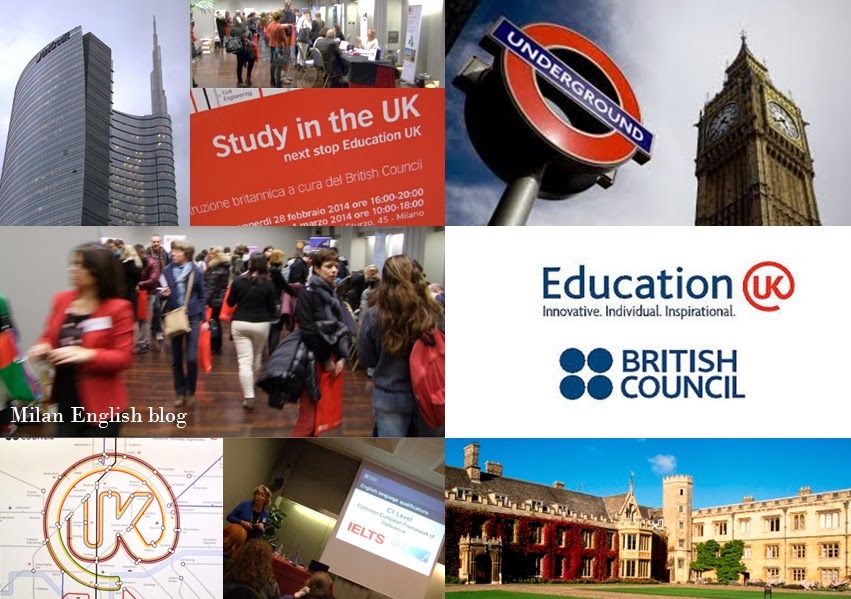
Italian students come face to face with British universities at the first Education UK Fair in Milan

A conversation that could change your life: students find out what's on offer from top British universities at the Education UK Fair, organised by the British Council
There has never been a better time to study in the United Kingdom: that was the message coming loud and clear from the first-ever Education UK Fair that took place in Milan recently.

The highly innovative - and free - event was organised by the British Council and Education UK, the official website for international students who are interested in a UK education. (In 2012 the website received two million unique visitors worldwide.)

Held over two days (28th Feb - 1 March 2014) in the comfortable surroundings of the Atahotel Executive in the rapidly-developing Porta Nuova business district of the city, the Fair was a unique opportunity for prospective university students to meet face-to-face with representatives from many of the UK’s leading educational institutions.

In Italy, personal contact is everything. So this was a great way for British universities as diverse as Oxford, Edinburgh, Leeds, and Anglia Ruskin, among many others, to explain their unique advantages to a significant number of highly-demanding Italian students and soon-to-be school leavers, as well as the parents who want to give their offspring the best start in life – and who will, in most cases, be footing the bill. (By the way, an extremely useful document provided by the organisers of this event was the list of scholarship (borse di studio) schemes on offer, which prospective students and their parents should definitely read for homework.)

Four of the top six universities in the world are in the UK (World Rankings, QS)

When I was there, on Friday afternoon and early evening, the event looked very well-attended with people queuing patiently ten deep (or more) for the opportunity of speaking directly with reps from an impressive selection of British universities  including a large contingent from the University of London, business schools, colleges and independent schools – as well as the team from the British Council itself and other education-related organisations that helped out with the event. (Click here for a full list of all the institutions that took part in the Education UK Fair.)

The Fair comprised two main sections: an exhibition of the institutions and their representatives in the main conference hall and in a smaller, adjoining hall a rolling programme of excellent presentations by speakers from universities, the British Council and educational publishers, as well as independent consultants. (See the next section for a report on the Friday presentations.)

Another very popular feature of the event was the British Council "personalised counselling" stand, where visitors had the opportunity to meet expert teachers ready to provide some tips on writing a great Curriculum Vitae and the all-important letter of presentation - in perfect English, of course.

97% of UK graduates are employed one year after finishing their course. (BC)

Presentations by expert speakers at the Education UK Fair, Milan (Friday 28th February 2014): A summary

The programme started with Michael Flynn of Oxford University Press, whose presentation was entitled “What’s new in language testing? Streamline your English test experience”. (Unfortunately, I missed this talk but if anyone reading this was attending – or, Michael, if you happen to see this – I would be very happy to receive a summary or a link to the slides, etc.)

I came in halfway through a talk by Nadia Macdonald, Deputy Director International of Coventry University’s London Campus. Nadia was showcasing Coventry University’s London Summer School, which looked excellent and very reasonably priced, too. She was also keen to point out the huge cultural benefits of studying in the UK – a theme emphasised by most of the speakers. The UK – and especially London – benefit from an enormous range of cultural activities, such as theatre, music, art galleries and museums as well as fantastic sporting facilities.

Students also had the opportunity to hear (in Italian) what university life in the UK is like “from the horse’s mouth”.  Italian students from Verona who have been studying in Britain provided some excellent insights into university life. They belong to the Ateneo Europa programme, the first “student to student” information network related to education in Europe and organised by the Fondazione Maffei, a Verona-based cultural foundation.

Students listening to students from Ateneo Europa (Verona)

The Importance of English

Jane Hoatson of the British Council, who is a Cambridge oral examiner and an experienced teacher trainer, explained how to apply to a UK university. In particular, she focused on the application procedure, which in the UK operates through a centralised system run by UCAS, the Universities and Colleges Admissions Service. Jane’s talk included a detailed description of the online applications process. She also spoke about the importance of English for Italian students who want to study at a British university or college. While students have to meet the entry requirements set by each university or institution as regards their final school exams (which in the case of Italy will usually require a minimum level in the maturità exams), applicants will also need to demonstrate they can speak and understand English, a theme which was picked up in the following presentation.

Jane Hoatson, British Council: Your application will depend on your personal statement

One vital aspect of applying to a UK university that can be a real “make or break” factor is the Personal Statement that potential students have to submit as part of their application. Jane stressed the absolute importance of this statement and the need for applicants to stand out from the crowd by demonstrating their unique personal qualities and their attitude not only to study but to life in general. Perhaps one of the main differences between studying in the UK and education in Italy is that British universities are really interested in the “whole person” – not just academic ability. This is especially true at the top universities, especially Oxford and Cambridge, which look at a candidates complete profile – including any distinctions in their artistic, sporting or volunteering activities – as well as academic excellence. However, without really good English, no student can progress very far in the British education system – but most universities run pre-sessional courses that can help prepare learners for the demands of studying in an English-speaking environment.

Studying in the UK is a highly rewarding experience - and it's a lot of fun too! 

The next speaker was Margaret Fowler of the British Council. As Director Examinations, British Council Italy, Margaret is responsible here for promoting and organising IELTS, the International English Language Testing System, the world’s number one English language test, taken by over 1.5 million people every year across the world.

There are several key benefits of IELTS for Italian students who intend to study at UK university. Firstly, you can register up to 14 days before the exam itself and the results will arrive in the comparatively short time of 13 days. IELTS is recognised and often preferred by universities in the United Kingdom. The exam is also recognised by Italian universities in terms of awarding credits. As well as in the UK, IELTS is recognised in other English-speaking countries including the US, Canada and Australia. (This is particularly important if you intend to study in one of these countries.) While other Cambridge exams, such as a the First Certificate, Advanced and Proficiency are intended to demonstrate a candidate’s all-round language ability, IELTS is specifically a test of Academic English. (By the way, it is very important to make sure you take the Academic version of IELTS if you are applying to a university. The General Training version is primarily intended for immigration purposes.)

Margaret Fowler, Director Examinations, BC Italy: UK universities prefer IELTS

In a detailed exposition of the exam (which I am planning to write up as a separate blog post focusing on IELTS and English language exams in general), Margaret took the audience through each part of the exam and discussed some general strategies which will be of great help to students. Perhaps the most important of these – and certainly, in my experience of preparing candidates for the IELTS exam (and most other English exams) – is what you do in the Speaking Test. Without doubt, for Italian people studying English, this is the most problematic part of the exam and the thing they dread more than anything else. Margaret’s advice on this part of the test is invaluable: the examiner is not interested in your opinion of – or even your knowledge – about the topics they ask you to talk about. Instead, they are only concerned with how you express yourself (although what you say should be relevant: don't invent your own questions). Students should use paraphrasing strategies when they can’t think of the right word or what to say (e.g. “I don’t remember the exact word for this, but it’s something you use to…”, etc). 

Candidates in the Speaking Test should also show off their knowledge of grammar and vocabulary - especially conversational phrases. As Margaret put it: the examiner can only credit you with your brilliant knowledge of English if you actually demonstrate it in the exam. While the Speaking Test is a highly contrived, artificial situation it is basically ten minutes where you need to focus on HOW you say things rather than WHAT you are saying (which is the exact opposite of most situations in life).

(IMPORTANT: Check the IELTS score you need to achieve in order to study at a particular university. This can vary from one institution to another, but typically a university will ask for a score of around 6/6.5 at IELTS. For medical students and people taking other professional courses it can be higher, e.g. 7. However, universities can also exercise some discretion, so even if you don't have exactly the right level you might still be able to study there - or you may be offered a pre-sessional course which includes English training. The main thing is to ASK before you apply.)

UK-educated international graduates achieve markedly higher average salaries (BIS)

The final speaker on Friday was Annette Duerdoth, a Consultant at the Higher Education Advisory Service. Annette’s topic was the importance of studying in the UK – particularly at top independent schools – and the main differences between “A” Levels and the International Baccalaureate. Annette started her talk by asking the audience to decide whether the top schools she highlighted, such as Stowe School, Malvern College and Charterhouse, offer students the “A” Levels or the IB. The general picture is that there is a wide diversity, with some schools offering only “A” Levels or only the IB, while at others students can take either form of exam. While the vast majority of school pupils in England and Wales (Scotland and Northern Ireland have different systems) aiming to go to university take “A” levels, the IB is only taken by students at a handful of schools, mainly private or fee-paying ones. (Confusingly, in the UK there are a number of top schools known as “public” schools that are actually private. Yes, I know: bizarre, isn’t it?)

(Note: this is not really an issue for Italian students, but there is an ongoing debate in the UK about the academic/educational "value" of "A" levels (and GSCEs, which most people take at 16). Newspapers and politicians are always concerned with "grade inflation", since there is a consistent trend for exam grades to rise every year - and an endless debate about the reasons for this: are the students getting better or are the exams getting easier? The IB has been promoted as a possible alternative to "A" levels - which are sometimes referred to as the "gold standard" in UK education. Another blog post on this, I feel...)

Annette Duerdoth, Higher Education Advisory Service: IB is rare but highly regarded.

As Annette explained, the main difference between “A” levels and the IB is that whereas “A” level students typically take exams in only three subjects (although some students take more – especially at independent/private/”public” schools), the IB has a much wider curriculum and is more similar to the broader range of subjects studied by Italian and most other European students in their school-leaving exams (such as the maturità in Italy).

The profile of an IB learner can defined as follows: they are inquirers; they tend to be more knowledgeable and open-minded than their “A” level counterparts; they are thinkers, communicators and risk-takers, who are on the whole caring, balanced and reflective. (Dare I say it, but that description could be taken as one that tends to apply more to Italians (and most other Europeans) than the British – or Americans. While our education system has evolved to produce pragmatic specialists who can go straight into narrowly-defined university courses and even more specialised careers, the Continental system has been designed to produce all-rounders: elegant thinkers who have a much wider view of the world and a longer historical perspective, especially when it comes to classical history. (Perhaps I could just interpolate into this digression - this is becoming "Tristram Shandy" -  a personal observation based on my experience of living in a country where education is still largely modelled on the classical system (and which the IB philosophy reflects). While a business meeting in the UK or the US will typically be a brisk, focused affair where people who know their onions – and have been produced by their respective education systems to operate effectively and under pressure in a specific field to do just that – and get on with it, in Italy a meeting is much more of a social affair; and one where, for example, it is not unusual for a technical manager or financial number cruncher to suddenly draw an analogy with the current situation and a moment from the First Punic War – and no-one sitting around the table will bat an eyelid; nor will the remark be accompanied by the sound of jaws dropping onto the table - or the silent squeak of eyeballs rolling in their sockets - as would happen in London or New York.))

If you've just skipped that last bit, the main point to note that here is that while the IB is obviously a higher species of exam and the fruit of a more enlightened educational approach, it is also a lot tougher than "A" levels. (Although education and exams in Italy are more punitive than "Anglo-Saxon" ones in general). Therefore, candidates intending to study at university really need to be aware of all their options and the best plan of action before they choose either “A” levels or the IB.

Annette included in her presentation a quotation from the Financial Times blog referring to the IB. It is highly pertinent to the main topic of the Education UK Fair, i.e. getting into university:

“Not subject to government tinkering, this international currency is particularly strong, with top IB scores worth the equivalent of six A grades at A level and one A at AS. Not ideal for the pupil who has always wanted to drop maths, the IB does put you significantly ahead in the global race for the best universities.”

The Education UK Fair continued on the Saturday (1st March), although I only attended the Friday session. However, many of the presentations on the first day were reprised by the speakers. You can see the full list of presentations here. I would just like to mention one talk which caught my eye: “How to write a good CV in English” with Keryn Paviour-Smith of the British Council. (Again, if you attended this or if anyone has some feedback about it, I would be very interested to hear it. Not least because of Ms Paviour-Smith’s very impressive professional background, which combines human resources roles at top companies with Business English teaching. I’m sure her talk was excellent and I will be looking forward to seeing her speak at future British Council events.)

Employers worldwide consider UK graduates among the most 'employable' (QS)


Final result: First class, with honours

Overall, then, this was a very well designed, organised and executed event of the kind that the British Council excels at. The participants I spoke to were all highly positive and it is very clear that the UK is one of the main destinations for Italian students who want to give themselves an advantage in their future career and life. If you are considering applying for a university course (or any type of study in the UK), the most important thing is to find out as much as possible before you go – and this event certainly provided a very useful starting point for serious students who are contemplating one of the most important decisions they will make in life: where to go to university.

If you are reading this now and kicking yourself that you didn’t attend the Fair, I hope my summary gives you an insight into the event – and, in any case, you can find a wealth of further information and guidance from the Education UK website and via the ever-helpful British Council itself.

I have no doubt that the Education UK Fair will become a regular feature of the Milan calendar – falling quite neatly between Fashion week and the forthcoming Salone Mobile (“Design Week”). The timing is also crucial, as Jane Hoatson pointed out, given that there are strict deadlines for applying to UK universities (and that in Britain a deadline really is a deadline).

Looking forward to Education UK 2015 in the next, critical, “EXPO” year in Milan!

A UK university education gives you a significant advantage in the job market.


The UK has a rich, diverse culture where you can gain an international perspective.

Links to related websites:

British Council
Education UK


Thursday, 7 June 2012

Unsquaring the circle: a very different (and good looking) social network


CircleMe: a different kind of social network
I have been exploring CircleMe – a new type of social network that lets you build connections with other people based on shared likes and passions – rather than just who you already know.

There has been a flurry of start-up activity in the social networking sector recently – driven mainly by the flotations of LinkedIn and Facebook, the meteoric rise of Pinterest (and the less meteoric but still significant rise of Google+) as well as the high-profile acquisitions of Instagram by Facebook for $1bn and the imminent purchase of Meebo by Google. And this is without mentioning a vast swarm of smaller, optimistic start-ups – of which CircleMe is one.

I can’t quite remember how CircleMe came to my attention – but over the last few days it has gradually taken hold of me and I am experiencing the same kind of obsessive “I’ll just check and see what’s happening” sensation that I had when I first joined Facebook – and, to a certain extent, LinkedIn. Looking back now though, I’m sure the main motivation of this desire to log in and check on these networks was simply to see who out of the people I already knew had joined my network. It’s a kind of feedback of how popular you (really) are.

Appetising design and ease of use combine to give a great experience
But with CircleMe it’s quite a different feeling altogether. I am really curious to find out which of the topics or people I have “liked” have been shared – and also to see the expanding network of collections that other people have curated. (I’m trying not use the words “pin” or “board” – although, of course, CircleMe bears more than a passing resemblance to Pinterest.) It may be the case that because CircleMe is still a fledgling its early adopters tend to be quite interesting people with eclectic tastes (CircleMe was in beta and available only by invitation until the end of last year). Or it may be that their combination of luscious design and very easy interface attract people who are more design-oriented – and just generally into exploring culture that bit further.

Pinterest: too much of a good thing?
Without pursuing the comparison with Pinterest too much, I can say that after a very short time on the latter I was so overwhelmed by cupcakes and tastefully-appointed living rooms that I didn’t really bother exploring the rest of the site that much. Somehow, CircleMe has avoided cupcake hell (so far) but it is weighted towards what may be loosely termed “lifestyle”. I have to say that its trademark “tondi” (images cropped to a circle) make food (especially Italian food) look very appetising. With an emphasis on the positive and life-affirming, CircleMe shares some of the same warm glow of Pinterest, but doesn’t induce that sort of glazed-over numbness that I would get from flicking through endless glossy home and "gracious living" magazines.

Location, location, location: the iPhone app
CircleMe has introduced one innovation that really does set it apart from the main existing social networks: geo-tagging, or what it refers to as the ability to “plant” a topic at a specific, real-world location on a Google map. Of course, location-based social networking is not new – Foursquare in particular has established the concept of “checking in” at particular locations and there are a plethora of services that will show you the nearest bars and restaurants. The novel refinement that CircleMe has made is its mobile app which allows you to plant a topic (e.g. a song or poem) at a particular location.

I think they could do more with this: at the moment you can plant likes and receive alerts when you pass the location; but given the social network's appeal to stonger and deeper affiliations I believe the true value of connecting passion to place lies in developing the social links and local communities or tribes formed around those passions. For example, as a freelancer and road warrior (or "pavement partisan", to be more accurate), I spend a lot of time in several cafés and bars in the centre of Milan where I tend to network with other freelancers. Location is critical to our attachment to these "virtual offices" and it cannot be separated from our shared passion for not being chained to a desk. This is exactly the kind of floating, informal community that CircleMe needs to engage with. (I will have more to say about this in a later post.)

I am currently adding topics to my profile and focusing mainly on Milan (which, incidentally is where the CircleMe team is based). It’s quite a nice feeling to be able to plant topics on an “uncluttered” map – even though it also seems to be like colonizing a new territory (although certainly not to the extent of Foursquare’s struggles for virtual supremacy which allow you to become the mayor, king or emperor of a location). CircleMe allows a topic to be planted in multiple locations, which makes sense in terms of people and things which move about rather than buildings and places (which don't).

CircleMe feels like the online version of a quality illustrated book.
For me, the chief delight of the site is its design, which has a handmade, high-end feel – a bit like an expensive art book or catalogue (the background has a subtle rag paper texture and the buttons and panels have an almost tactile 3D quality, like digital card). The palettes and default fonts (I think you can tweak them) are a joy to behold. Now, I know that if you don’t live in Italy – or if you’re not into design – this might sound trivial and superficial; but if you spend time looking at a page (especially a digital one) the quality of its design and aesthetic appeal can be really important. It also helps you to absorb the information in front of you more easily. When I switch back to the starker environments of Facebook and LinkedIn it feels slightly like arriving at the metro station or going into the office. CircleMe, on the other hand, offers the kind of relaxing, enveloping comfort and style-conscious ambience of a private members club – it’s like slipping into your favourite worn (or artfully distressed) leather armchair with an expertly-mixed cocktail as you leaf through one of the first editions from its library.

If you haven’t tried CircleMe already, I suggest you give it a go. It’s not really a numbers game; you don’t feel the urge to rack up as many contacts as you can – or even to see if everyone you know is there (they aren’t). It seems much more of a slow-burn experience (or perhaps "organic" is more appropriate). The topics that you plant – or that other people have planted – will gradually grow and blossom. You can also comment and add pictures as well as “stories” to each topic.

I can definitely see CircleMe developing into a version of “Facebook for grown ups” or for people who (really) know what they like. Each topic could become a micro-community, based on a shared interest or passion. The content also tends to have a certain critical edge that is generally missing from the mainstream sites (although see my comment above about early adopters). I doubt CircleMe will surpass or even approach the huge numbers of (let’s be honest) mainly passive users that the “mature” networks enjoy. Instead, I think it will (or should) attract a select number of more active and discerning users (who are probably more engaged with the topics they share). Basically, they should go for quality not quantity (with just enough critical mass to drive the network effect, of course).

In terms of demographics, a more compact but loyal membership can still offer as much – if not greater value when it comes to whatever revenue-generating strategy they have devised. Consider the petite circulation of expensive, special interest glossies (Condé Nast Traveller, Q, etc). Although there is currently nothing as crass as advertising on the site, the people it attracts will undoubtedly be of particular interest to luxury brands and to those in specialist "long tail" markets. Given that the trend for marketing is increasingly social, it may be the case that CircleMe does not intend to turn itself into a digital version of Vanity Fair, but rather to act as a haven or place to hang out for communities built around their favourite topics (some of which will be brands, but others just communities of interest). Given the strong location-based element, there is ample scope for actual real-world activities – events, meet-ups, etc.

There are still some things they need to work on, however: for example, it isn't at all easy to create a new topic. Another is the "Stories" accompanying each topic, which offer little more than a line or two of text - these could be more visually appealing (without necessarily distracting from the main image for each like).

One cool thing that CircleMe have done is to set up a feedback channel using Get Satisfaction, a customer engagement platform with a nice social business feel. Again, given the fact that people are investing their time and energy in building their profiles and collections of topics, it’s good that CircleMe are involving them in the design and development process. (The CircleMe team are also very helpful if you need support or want to make a suggestion on how to improve what already looks like a very promising and different social networking experience.)

Monday, 5 September 2011

JOHN PETER SLOAN IN “INSTANT PLAGIARISM” SHOCK!

"Instant English 2" by John Peter Sloan
Loyal readers and fans of John Peter Sloan have expressed outrage and disappointment at the shocking revelations of plagiarism made against his series of “Instant English” books. With the launch of “Instant English 2” only days away, a startling discovery has come to light: John Peter Sloan has actually COPIED all his material from an earlier work – without any acknowledgement or reference to the original.

Published in London in 1907, “Instantaneous English” was the best-selling title written by James Parker Sloope, an itinerant music hall singer and comedian. Sloope achieved a certain level of fame in the early 20th century with his popular stage perfomances, during which he would explain the basics of the English language to those hungry for his unique and humorous delivery. His shows also included a cast of hilarious characters, such as the two pupils at the Basingstoke Academy for Young Ladies, Gwendolen and Beatrix. Best-known for his catch-phrase “The writing instrument lies prostrate upon the desk” and his frequent appearances on seaside piers and in music halls, Sloope also pioneered the use of early recording equipment to immortalise his wit and wisdom. Thomas Edison himself referred to Sloope in New York in 1901: “Bringing Mr Sloope’s ironic discourses to the masses are exactly what I invented the phonograph for”.

It was the chance discovery of a vintage copy of “Instantaneous English” in a second-hand bookshop in Charing Cross Road that led to Sloan being found out. Luca Spicchisi, an Italian student of English on holiday in London,  came across the book while browsing the language titles. “I was shocked,” he explained to journalists, “I already own “Instant English” and was really looking forward to the publication of “Instant English 2” this month. But now I am very upset: Sloan has obviously lifted all his material and ideas from Sloope’s book. All he has done is to update some of the references – for example, Sloope’s brilliant chapter on “How to write personal letters and commercial correspondence” becomes advice on writing emails in Sloane’s book. Quite frankly, I feel cheated.”

Reporters are keen to confront Mr Sloan with the allegations, but a spokesperson for the man who has been dubbed Italy’s first “rockstar of English” said he was unavailable for comment.

The cover of "Instantaneous English" by James Parker Sloope, 1907.


Tuesday, 10 November 2009

Digital media articles: Audio branding and recruitment

Here are two articles that I wrote in 2006 for New Media Knowledge, a learning and business information hub for companies and individuals working in UK digital media.

Sounds Subliminal: Branding The Future With Audio
Ringtones, radio and TV audio branding, MP3s and podcasting all offer ways for brands to connect with consumers. This article is a write-up of an event held jointly by NMK and Music Tank. The event looked at how marketers and brands can use audio as a way to engage with consumers in the digital space.
Click here to read the original article on audio branding on the NMK website.


Situations Pretty Vacant
This is a report of a speaker event held by NMK at One Aldwych which looked at how agencies large and small are facing up to the skills shortage. It also examined the strategies agencies are employing to find talented people.
To read this article about the skills gap in the digital media sector on the NMK website, click here.

About NMK
NMK is a not-for-profit body in receipt of public funding. NMK operates across economic boundaries, bringing together knowledge and expertise from commercial companies, professional bodies and higher education to provide objective, independent guidance and promote the success of the UK's digital economy. Since NMK began as New Media Knowledge in 1997, it has been supported by the University of Westminster, one of the UK's leading educational institutions for digital media.

London South Central: Bermondsey Street and the South Bank

This is an article I wrote a few years ago for World Language Consultants Ltd, a language school in Bermondsey Street in South London. Some of the facts have changed (e.g. the Eurostar train terminal that connects Britain to the Continent is now at St Pancras), but most of the places referred to are the same. If you plan to visit the capital it might be a good idea to check some of the tourist websites (such as visitlondon.com) that contain current information on visiting times and prices, etc.

Exploring London South Central
Whether you live in London or are just visiting, you'll find there's plenty to see and do in London South Central. Explore the area's rich history and culture, hunt for bargains in its arcades and markets, and chill out at some of the trendiest cafés and bars in the capital.

London South What ?
London South Central is the new name for one of London's oldest districts. It includes Vauxhall, Waterloo, London Bridge, Bankside and Elephant & Castle. Traditionally, the area has always been seen as charming but dodgy. (In Shakespeare's day the South Bank was as famous for its brothels as its theatres). And in more recent times, taxi drivers have refused to go "south of the river" at night.

But all that is about to change. South London has been smartening up its act, and is attracting a new generation of artisans and professionals who have transformed some of its most run-down areas into thriving local economies. While the attractions of the South Bank are a must for visitors to the capital, there's also plenty to discover in some of the smaller streets tucked away behind the waterfront.

How to get there
The Eurostar terminal at Waterloo [now at St Pancras - and featuring the longest champagne bar in Europe] has brought the area within easy reach of the Continent, and there is also a good rail service to London Bridge and Waterloo stations if just you're coming in to town for the day. If you're already in London, hop on the tube (Jubilee and Northern Line trains stop at London Bridge, while Waterloo connects with the Jubilee, Northern and Bakerloo Line as well.) There are also plenty of buses, and there's even a river bus service, if you really want to arrive in style.

What to see
Go for a spin on the London Eye for a breathtaking bird's-eye view of the capital, and marvel at Sir Norman Foster's London Assembly building near Tower Bridge. Check out Tate Modern art gallery (formerly Bankside power station), Shakespeare's Globe and the Millennium Bridge. Relax in the precincts of Southwark Cathedral, then stroll down to Hay's Galleria and Gabriel's Wharf where you can shop and take in the view from one of the many waterside cafés or bars.

Step back in time
The Thames has always been London's gateway to the wider world, and you don't need to look far to discover Britain's maritime history. Visit Sir Francis Drake's reconstructed ship, The Golden Hinde, at St Mary Overie Dock, or explore HMS Belfast, which played a leading part in the Normandy Landings.

Shakespeare's Globe, a faithful reconstruction of the original theatre, stages open-air plays (take an umbrella just in case) and has a fascinating permanent exhibition about the building in Elizabethan times. To see the darker side of London's history, descend into the South Bank's medieval Clink prison (which is where the expression comes from). And if that's not grisly enough, the London Dungeons in Tooley Street will bring you face to face with the Black Death and Jack the Ripper. (Stick close to the guide, and don't wander off on your own, if you want to make it to the gift shop!)

Make a scene
Playing host to both the Royal National Theatre and the Globe, the South Bank is rightly regarded as the home of drama in London, with the West End having long ago given up any claims to that title. Plays are staged throughout the summer in The Scoop, a modern amphitheatre next to the London Assembly. Head for the Old Vic, where you can currently catch Kevin Spacey's production of Cloaca (until 11 December).

Make it new
If you're looking for Old Masters, you won't find them on the South Bank. (Try the National Gallery, or catch the regular boat service that takes gallery-goers from Tate Modern to Tate Britain). Tate Modern hosts installations and exhibits outsize sculpture in the massive Turbine Hall. It also has cafés, a superb restaurant and a well-stocked bookshop. Further down the South Bank, you'll find the Saatchi Gallery, which boasts Damien Hirst's shark and Tracey Emin's infamous unmade bed. The Hayward Gallery, behind the Royal National Theatre, has a fascinating exhibition, Eyes, Lies & Illusions (until 3 January 2005) which features optical illusions, magic lanterns and all sorts of visual trickery. And if that's not enough, why not pop into the Salvador Dali exhibition in County Hall. Or just enjoy the surrealist statues outside, including Space Elephant (an elephant with spider legs carrying an obelisk on its back.)

Handbags and Glad-rags
While most of London South Central's tourist hot-spots are along the river, there are also some great places to discover away from the South Bank. But Bermondsey Street must surely be the hottest spot of all. Once a desolate wasteland of derelict factories and disused warehouses, it's now home to design studios (including Kurt Geiger), loft apartments and some great restaurants.

Dominating Bermondsey Street is Zandra Rhodes's Fashion and Textile Museum. This striking building, a former warehouse painted bright orange, is also the home of the shocking-pink-haired designer, who lives in the penthouse (complete with palm trees).

Bermondsey Street's latest addition is World Language Consultants Ltd, one of London's longest-established business language schools, which specialises in teaching English and foreign languages to professionals. WLC is located directly opposite the Fashion and Textile Museum, adding a complementary splash of colour to the other side of the street with its distinctive blue door.

Food for thought
London South Central has more than its fair share of great restaurants and cafés.Bermondsey street boasts several superior eateries, including the Delfina Studio Café, the Bermondsey Kitchen and The Garrison, a gastropub with its own cinema in the basement. Other places to check out are Terence Conran's Blue Print restaurant and the Oxo Tower, which has stunning panoramic views. Vinopolis, the museum and temple to the god of wine rolled into one, has an excellent restaurant (with, needless to say, an outstanding wine-list). And fans of Bridget Jones will recognise Borough Market, even if they have yet to sample the unbelievably fresh produce from its specialist gourmet stalls, selling everything from game to white truffle oil.

What makes London South Central exciting and distinctive is its mix of the historical with the ultra-modern: you can find them side by side in its architecture its culture, and its diverse communities of long-established residents and those who have discovered more recently the charms of this unique area.

© Robert Dennis 2004

Thursday, 29 October 2009

Autumn: Harvest Festival and Thanksgiving

Bringing in the sheaves
Living in a city you have a hugely distorted sense of the traditional significance of the seasons. The end of the summer and the beginning of autumn is when crops are harvested and all sorts of vegetables, such as carrots, potatoes, leeks, turnips, marrows and pumpkins reach maturity. Since most types of food are available all year round (such as strawberries flown in at Christmas time) we city-dwellers have little appreciation of how the seasons shape life in the country.

The custom of the harvest festival still survives in churches (and some schools). Produce from the fields and from gardens is brought into the church and the congregation offer thanks for the natural bounty supplied by the Lord (or whoever you think supplies it – perhaps for most people in Britain it is now Tesco’s, the UK’s largest supermarket chain).

While many schools and schoolteachers are reluctant to promote religion when they lack religious convictions themselves, the harvest festival is still a feature of British school life (with or without religious overtones). It seems like a good idea to not take the food we eat for granted and to at least consider that while food may be abundant in the rich countries of the west and the northern hemisphere its scarcity is a fact of life in many other parts of the less developed (or poor) world.

I remember when I was at school that everyone would bring something from home – perhaps a tin of baked beans or a packet of biscuits and it would all be stacked on the stage for a full-school assembly (which, looking back now, must have made the headmaster and the senior teachers look slightly like delegates at a trade fair promoting a range of household brands). After the service the food would be donated to a local old people’s home or children’s home. I actually still think that’s a good thing to do – whether or not there’s an accompanying religious service.

In a similar vein, the American festival of Thanksgiving, held in November, marks the first harvest produced by the Pilgrim Fathers – the Puritan settlers who left Europe and landed in New England. Thanksgiving is only celebrated in the US (and Canada) and is a bit of a mystery to most Brits who only really know about it from films and TV programmes or the fact that Wall Street is closed for a public holiday. Thanksgiving dinner features a turkey (which is what the British have for Christmas dinner) with cranberry sauce (ditto) and pumpkin pie (which doesn’t really exist in the UK).

With a significant North American expatriate population in (west) London (due mainly, but not entirely to the phenomenal success of the romantic comedy “Notting Hill”*), some shops now cater for customers in search of typical Thanksgiving fare. A posh (high-class) butcher near Holland Park tube station (close to the London School of English, where I used to teach) has a sign in the window at this time of year advising its well-heeled stateside clientele that they can now order their Thanksgiving turkeys. I’m sure a similar offer must be made to the Americans and Canadians in Milan by at least one enterprising butcher, but I haven’t seen any firsthand evidence of this. (If you’re an American or Canadian in Milan, or a butcher, I’d love to hear.)

*Click here to see a picture of Notting Hill Underground station and other picture postcard views of London.