Showing posts with label teaching. Show all posts

Friday, 21 November 2014

BESIG Bonn: Inspirational talks, quality networking and some great beer - a personal view


Note: this is the first instalment of my report from Bonn. I'm working on some more "content-focused" reports about teaching-related material and developments, which will appear probably on the Riverstone blog and in the Milan Business English Network. This is basically an informal snapshot of my immediate impressions of the event and the experience of being in Bonn itself. RD

The 27th IATEFL BESIG Annual Conference took place in Bonn, Germany on the 14-16th November 2014. It was a great opportunity for business English teachers and other professionals working in the sector to meet, exchange ideas and get up to speed on all the latest developments and technology fuelling our industry.

The event was held at the Sankt Augustin Campus of the Hochschule Bonn-Rhein-Sieg, just a short tram ride away from the centre of Bonn itself. The vast majority of BESIG events have been in Germany, mainly due to the fact that the most active members of the organisation are nearly all based in German-speaking countries. It may also be due to the fact that English teachers, like all expats, tend to adapt to their adopted locations and take on the characteristics of the people where they live. So, although there was a BESIG Annual Conference in Milan in 2006, the Italian presence at BESIG has been less noticeable than that of our more dynamic colleagues in the European economic powerhouse of Germany. 

Having said that, though, I did meet Richard Nicholas, who teaches English at Bocconi University in Milan, and took part in his workshop on training students to "hit the ground running" with immediately-useful spoken English skills. Richard drew extensively from his publication "Heads Up", which he co-authored with Mark Tulip and Louise Green.

The IATEFL and BESIG teams all deserve special mention, especially Cornelia Kreis-Meyer, Marjorie Rosenberg , Andrzej Stesik, Rob Szabó, Clare Hart and the many other people who helped to make the event a huge success. I’m sorry if I’ve missed out anyone really important – but I’m basing most of this on my experience as a first-time attendee gradually exploring the hinterland of IATEFL, BESIG and the many other Special Interest Groups. I think one of the interesting phenomena of the digital age is how the full picture of the activities of a group of highly professional people all working in a relatively small sector gradually emerges via various social media channels. This experience then forms the "digital backdrop" to the live international events.

Since I spend an increasing amount of time online it was interesting to make direct contact with so many people that I have come to know or know of through the proliferation of websites, blogs, Facebook pages and tweets, etc that taken together form the ecosystem or cloud of knowledge that we all inhabit these days.

I was also very impressed by the team of helpers from the university itself, who shepherded lost souls from room to room and provided the all-important information about where to find food, drink and other essential amenities.

Paul Emmerson gave a great talk on his new business English venture, BEhereBEthere, which features high quality resources for learners that the best-selling author has made available to students via a site which is 100% under his control. One of the key benefits of BEhereBEthere is the videos of Paul’s own students that he has posted along with exhaustive supporting materials, including detailed language notes and exercises. During his presentation, Paul explained aspects of his developing strategy, which is to build a unique and uniquely useful free resource for business English learners on the web and to gradually introduce premium features. This freemium model is now an established feature of many online English sites, services and apps and the whole question of business models was a recurring theme throughout the talks and chats taking place in and around the conference itself. 

Paul also shared some invaluable insights into how he uses Google Analytics to learn more about where visitors to BEhereBEthere are located. Given Paul Emmerson’s undisputed status as a major star in the business EFL publishing firmament, it was interesting to see how he is making the transition from published author to self-publishing web entrepreneur (webpreneur?). I think the key thing that was clear from Paul’s talk is the passion and commitment he brings to business English – and his genuine interest and engagement with students. Technology and social media in this context become incredibly powerful channels for content producers to connect directly with students (and fellow teachers) – much more directly than is possible through passive media, such as print or CD-ROM. However, as one audience member put it, once the content genie is out of the bottle the question of how content producers can monetize their creations (or, indeed, whether they can at all) becomes critical. 

As perhaps the “most photocopied man in the world”, Paul Emmerson knows more than most people about the problem of piracy and loss of revenue through vast armies of well-meaning teachers whacking his books under the copier. (During one of the dinners at BESIG, I suggested to Paul that he should perhaps consider some sort of deal with Canon, Xerox or any of the other companies that have helped to spread the Emmerson brand around the globe. In fact, he could even produce his own Paul Emmerson-branded photocopier, bundled with exclusive content for any language school that buys one. Another idea we kicked around was having some PE advertising on the underside of the copier’s flap – since there must be at least a million “flap views” a year in various schools around the globe. Why not have some inspirational Paul Emmerson quotes and a link to BEhereBEthere for people to read while they snag pages from Email English?)

Pete Sharma spoke about the development of the business English course book from print to digital. (Fuller report about this talk coming soon.) The last time I had the pleasure of watching Pete speak was a few years ago at the PSA Symposium at the Consulate General in Milan. As well as being one of the leading experts in the world on blended learning Pete is also a marvellous conference speaker and simply a great communicator. He has a sort of magical rapport with his audience and I think this is one of the reasons why face-to-face communication will always be important – despite the onward march of videoconferencing and Skype. His gestures are also incredibly expressive – and, like all foreigners living in Italy, I have become something of a connoisseur of how people talk with their hands. So, if you want to see and hear someone communicating cutting-edge ideas about education in a memorable, absorbing way, I urge you to check out Pete’s forthcoming speaking engagements.

Other highlights of the conference included a talk about the importance of lexical chunks by Jeanne McCarten in the plenary session. Paula Mulanovic's session was entitled "Teach like TED" and offered tips for teachers of business English. Cleve Miller of English 360 spoke about blended learning for business English: how to design it, deliver it and sell it. It was also nice to meet Valentina Dodge from English 360 too. I also ran into Bob Dignen of York Associates, who spoke about virtual teams and virtual meetings as well as presenting "Ten top tips for successful communication" with Ian McMaster. There were so many talks that it would have been impossible to do more than scrape the surface, but that's BESIG, I suppose. The overwhelming impression you get from attending a conference like this is just how diverse and constantly evolving the business English ecosystem actually is. 

One of the great things about a conference is the opportunity for chance meetings which subsequently prove providential. One such random encounter was meeting András Petz of Anglofon, a specialist legal English firm based in Budapest, Hungary. I happened to be sitting near him on the tram to the campus and overheard him asking someone which stop to get off at. I went over and we struck up a conversation, which resulted not only in meeting a really nice person and a dedicated professional but also in attending his presentation and discovering the very impressive range of resources he has created with his team in Hungary. These include a book on the Terminology of Civil Law, which is linked to a wealth of online material specially designed for legal professionals who need to improve their knowledge of English. We both agreed to stay in touch and hopefully collaborate on some interesting future projects. 

Bonn is a truly lovely city, with many historical and cultural associations. As the former capital of the Federal Republic of Germany (or West Germany as it was known before reunification) the city retains a certain gravitas as well as a legacy of imposing administrative buildings and headquarters, including almost twenty UN institutions. My hotel room had a commanding view of the Rhine and the Kennedy Bridge and the occasion also allowed me to explore the historic centre of Bonn. The classical architecture of the University buildings and the Hofgarten (Court Garden) are very impressive and the city is also a place of pilgrimage for music lovers visiting the house where Beethoven was born. The Marktplatz (market place) is dominated by the Alte Rathaus, or old town hall - simply stunning:


It was also great to spend some time chatting to other delegates in the canteen of the Hochschule as well as in some of the city locations. I had a memorable dinner with Alex Taylor of TJ Taylor, the language school based in Milan with centres in the UK and Ireland, at the First Flush Tea Room, which is also – despite the name – a restaurant serving exotic delights such as pumpkin curry (excellent). We also had tea – everyone gets a teapot of a different design – and sampled the local Kölsch beer, which was equally outstanding. We continued our conversation in Brauhaus Bönnsch, a traditional Rhineland pub serving Kölsch in strangely curved glasses, complete with finger-grips to make imbibing just that much easier. I also managed to squeeze in a visit to Cologne to see its massive and overpowering Cathedral, whose twin spires loom above the station and somewhat cramped squares below. Unfortunately, it was raining quite heavily, which just seemed to add to the sense of oppressive  weight towering overhead – and it was actually something of a relief (architecturally speaking) to be standing in front of Milan’s far more forgiving, though equally impressive, Duomo (cathedral) later the same day.



I flew back to Milan with most of the Italian contingent including freelance business English teachers Louise Goodman and Andy Townsend and our BESIG chat continued well after we had touched down. 

Based on my first experience of BESIG I can honestly say that this was a great experience and for any business English teachers - freelance or otherwise - I would strongly recommend signing up to BESIG and checking out all their events, including regular webinars with experts from the field of business English.

I'll post an update soon when I have sifted through all the notes and stacks of material I accumulated during the conference. Stay tuned!



Wednesday, 8 August 2012

Learning how to market yourself should be part of every EFL teacher training course


Sandwich board: Even the most passionate and
enthusiastic teacher has to be able to earn a crust.
(Image: Boston Street Characters, 1859
via Wikimedia Commons)


Every year an increasing number of newly-qualified English teachers enter the profession, many of whom will be heading abroad to find work. The training courses they have done – CELTA, Trinity College, etc – will have equipped them with a basic knowledge of how to survive in the EFL classroom; how to field those tricky questions about the Present Perfect; and also given them an insight into key teaching areas such as classroom management, preparing materials and maybe a taster of some linguistic and educational theories. Clutching their shiny new certificates this cohort of newbies will mainly be applying for teaching jobs in language schools and possibly with companies. A lot of teachers will also want to teach private students and find work on a freelance basis.

While the training courses they have taken provide a good foundation on which to build their career as teachers in terms of the language and teaching, how many of these bright-eyed hopefuls will have the business skills and resources to really thrive in their new profession? The answer, sadly, is not many. Of course, people who already have a business background and have decided to branch out into teaching (either as a form of escape from the corporate world or maybe because of a life-event, such as retirement or moving to another country for personal reasons) will be able to apply their knowledge to their career. Others will pick up ideas and tips along the way – and, generally, learn the hard way (often by realising that if they continue to work as an employee for a school they have virtually no chance of earning a decent salary without a Stakhanovite workload of contact hours).

As a freelance business English teacher who has learnt the hard way rather than coming from a business background, I am in a good position to see the problem clearly. I have termed this the “missing middle” – basically, a vacuum of know-how and strategy that teachers find themselves facing when they try to branch out on their own. Some people just rely on word of mouth and building up their clientele locally via their ex-students and contacts; others try their hand at social media to find people willing to pay to them to teach; and a small minority will actually decide that it’s much more profitable not to teach at all, but rather to set up a school and focus on developing the business side while others take care of the teaching.

The truth is that most teachers are generally ill-equipped to build up a business based on freelance teaching. Luckily, there is a now an eco-system of online resources, blogs and websites where teachers can network and share ideas. But even here, finding the information and contacts you need requires a lot of dedication and input from the individual teacher.

Wouldn’t it be useful if every teacher entering the profession had at least a basic grounding in how to sell their language and teaching skills? I am not suggesting that every freelance English teacher needs to do an MBA in order to make a living. I just think it would be really helpful if at the end of their training course there was a module / component on how to take all this fantastic knowledge and the teaching techniques you have acquired and plug them into a system or structure that can help you earn a decent living.

This mini-crash course in marketing yourself could include:

·         Understanding how the EFL market is structured
·         Different types of trader (e.g. self-employed sole trader, partnership, limited company)
·         How to find an accountant and sort out your tax status, contributions, pension, etc
·         An introduction to Google, SEO (Search Engine Optimisation), copywriting
·         Using social media to promote yourself and your business
·         Networking, LinkedIn and membership of professional organisations
·         Information on how to specialise and find more lucrative sectors (e.g. Business English)
·         Other information and ideas relating to the specific market you want to work in

I have also floated the idea of a publically-owned brand that freelancers could use to promote themselves as a profession; as well as being involved in the production of high-quality EFL materials distributed under a Creative Commons licence (using the freelancers’ brand).

I would be very interested to hear the opinions of other freelance EFL teachers regarding this suggestion. And I would be very much like to hear what people involved in teacher training think as well – especially Cambridge, Trinity College, the British Council, FE, IATEFL, BESIG and other organisations based in countries other than the UK.

Have your say here by leaving a comment. You can also air your opinions on the Global Business English Network on LinkedIn.

Note: I have developed some of these ideas further on my English Revolution! blog ("Justice and luxury spa holidays for freelance English teachers... NOW!")


Wednesday, 18 July 2012

Team Writing: a new project for people who want to write well in English... together!

Would you like to improve your writing skills in English, connect with other professionals and raise your profile? Freelancers, bloggers, students and teachers, welcome!

Team Writing: Join us!
Good writing is a both an art and a science. It’s an ability you can be born with – but it’s also a set of techniques that you can learn. Anyone can write: it’s not always easy to say exactly what you mean, but with practice you can get better. It’s also more fun when you do it with other people.

I am starting a project, called Team Writing, which is for people who want to write collaboratively and produce interesting material other people want to read. This is a not-for-profit exercise – you won’t receive any money, but you won’t have to pay anything either. It’s just a group of people who like writing.

Team Writing will take place online and will make use of various different tools for collaboration. The most important part of writing is what you actually do BEFORE you start: organising your ideas and material, finding sources, links and images, etc. We will use collaborative platforms such as Google Docs to share our ideas and resources.

For the actual writing itself I would like people in Team Writing to experiment with different collaborative writing tools. These will allow us to work together on the same text, but they also have several advantages, such as the ability to comment, edit other people’s work, rank or rate material and generally provide an overview of the project and its development over time.

One of the main things about this project is the ongoing discussions that take place around the writing itself and the comments generated by working together. These can sometimes be more instructive and entertaining than the text itself! This will also be a great opportunity to discuss problems and share ideas about writing and expressing yourself clearly.

Finally, we will publish the material we have created collaboratively. The easiest way to do this is by using blogs, which also allow other people to comment on the article or post and share it as well. (We can also use self-publishing platforms such as Slideshare.)

Why should you get involved with Team Writing?


There are a number of reasons why you might want to be part of this project:

·         Improve your English: this will be of interest mainly to learners of English as a foreign language and non-native speakers, but many of the discussions will also be useful for native speakers who need to sharpen their knowledge of how to use English grammar and vocabulary accurately.
·         Develop your skills as a writer: this applies to both native and non-native speakers of English. You are not automatically a better writer because you’re a native speaker. Some of the greatest writers in the English language (e.g. Joseph Conrad and Vladimir Nabokov) learnt English as a foreign language but went on to become literary titans. You can always pick up some tips and techniques as a writer. And even professional writers and journalists have editors.
·         Gain experience of working on a collaborative creative project: while most people will just visit the group and stay for a short while, there will eventually be a “core” team of people who spend quite a lot of time and effort working on the material produced by Team Writing. These writers will benefit most from learning to collaborate online and use a wide range of digital tools. The skills and knowledge you gain from working with Team Writing will impact directly on your ability to find paid work outside of the group – e.g. as a copywriter, editor or other job that requires strong writing and editing ability.
·         Networking opportunities: Team Writing will attract people who are interested in developing their network of collaborators and professional contacts. If you work in (or would to like to work in) social media, marketing or any field that requires the ability to co-operate effectively with other creative people, Team Writing will enable you to get to know the other members of the team and to share useful contacts and job opportunities. Team Writing will also make use of business social networking sites such as LinkedIn.
·         Promote yourself as a writer: The best way to show people your ability as a writer is to write for blogs and websites where people can find your work. You may already have your own blog. (If you don’t, start one now – it’s easy!) The members of Team Writing will be able to share and link to the material they have worked on.  Having a series of co-authored articles in your portfolio (and on your blog) will demonstrate to potential employers and clients that you are a serious professional with the ability to collaborate in a team and produce high-quality written material.

Organisation


Team Writing is not a company or association: it’s just a group of people who like writing. There are no real rules about what you can and can’t do, but as with any group there will tend to be people with more experience and knowledge and others who need to learn and acquire greater skills. The main direction and focus of Team writing will be determined by the people who spend more time and energy on writing the material (as well as supporting, editing and commenting). I imagine that eventually some fairly distinct groups will emerge in Team Writing. These groups will be determined by the interests and ambitions of the people in them. However, I have already thought about some of the topics and themes that writers for Team writing will be interested in. These include:

·         Social media: a group dedicated to writing about social media topics. This will include bloggers and people who are either working in social media or an area that involves using social media tools (e.g. online marketing, public relations, etc)
·         New technology and startups: this group will overlap with social media and the type of material written here will be mainly focused on using technology to improve the way people live and work. We will also look at new and creative ways that people are starting their own companies and funding them (e.g. venture capital).
·         English language learning: mainly for students and teachers. Subjects will include: online learning; new, social approaches to learning English; business English; global culture and the impact of English.
·         National and local interest: I am based in Milan, Italy. I tend to write about things that have some connection to either Milan or Italy in general. I am also collaborating with Danielle Dalkie, who is organising Network Roma. As a web-based project, however, Team Writing is open to people based anywhere in the world. However, if you are a freelancer, social media professional, language teacher or learner, you will probably want to find people in your location so that you can use your writing to make contact with partners and clients mainly where you are based. It will be interesting to see how this develops. I can see a network of groups springing up, all drawing on and feeding into the main Team Writing “cluster”.

We can also write about social and cultural topics, science, music, history, food, fashion... anything, really. But I suspect that the main value of this group will be topics that are quite closely related to people's activities as freelancers and social media practitioners.

Copyright and intellectual property


Of course, a group of people writing together raises the question of who owns the material produced. Since we are not a commercial organisation and we do not intend to sell our writing,  I think the best solution is to make whatever we write available under a Creative Commons Share-alike licence. (You can find more information about Creative Commons here.)

There are lots of issues about intellectual property and blogging (e.g. the sometimes controversial use of copyright images used to illustrate a post). This will be part of our discussion and could also be the theme of a series of posts itself.

Team Writing and English Revolution! / Open Source English


I am developing a parallel project (currently with the working title of Open Source English). I have also created a blog: English Revolution! The main idea of this project is to create a set of free, high-quality materials for English learners and language teachers. These will be available under a Creative Commons licence and will be the main tools for “Open Source English” teaching, a professional movement modelled on the Open Source community in the world of computer programming.

OK, you’re interested. How do you get involved?


All you need to do is contact me, Robert Dennis, and tell me a bit about yourself: who you are, what you want to achieve and what sort of things you are interested in. I will then give you access to the collaborative tools and platforms used by Team Writing. This is not a completely open group: there will be some selection based on what you want to do. You will also need a fairly good level of English. (Unfortunately, this is not a language training course, although you will be able to improve your English by taking part.) I envisage a sort of floating community of writers with people joining and drifting away, coming back, introducing friends and colleagues, etc. Over time, the core Team will emerge and other members of the group will take over some of the administrative roles (e.g. setting up blogs, groups, wikis, etc).

Contact me now! Send an email to Robert.dennis@gmail.com or join any of my groups on LinkedIn or Facebook. I don’t need your CV, but it would help if you can provide some background information about yourself and links to your blog or website, if you have one.


Monday, 25 June 2012

The perfect blend? Pearson and the British Council team up for "Digital Transformation in the English Teaching World"


The Melià, Milan: great setting for a "cool" event
It was a blessed relief to step from the sweltering June heatwave engulfing Milan into the cool and spacious Melià Hotel last week, the setting for “Digital Transformation in the English Teaching World”, an event co-hosted by Pearson Longman and the British Council. Informative and inspiring speakers opened up the possibilities offered by integrating new technology with more conventional approaches to language teaching in a series of engaging presentations. The sizeable audience was made up mainly of teachers and other language professionals from universities, private language schools and the swelling ranks of freelance English teachers. (I was one of the very small minority of token men in the audience: ELT is obviously a woman’s world.)
Delegates at the Pearson / British Council event "Digital Transformation
 in the English Teaching World at the Melià Hotel, Milan, 20 June 2012

Joint effort
Co-hosts of "Digital Transformations
in the English Teaching World"
As you might expect from a conference co-hosted by Pearson, there was quite a large emphasis on the products and platforms they have developed, in particular the My EnglishLab learning management platform, as well as the materials Pearson has produced for this system. But there were also contributions from the British Council on how it is increasingly employing digital technology in the vast undertaking of providing testing and certification for the many thousands of candidates who take IELTS, Cambridge exams and other tests every year.

Digital literacy: what native digital speakers know
Nicky Hockly
Nicky Hockly, Director of Pedagogy at The Consultants-E, a Pearson Longman author and a renowned international teacher trainer talked about the importance of understanding digital literacies in today’s web-enabled learning environment: these literacies affect how we perceive, interpret, judge and use online content. With examples of how to use existing material from the web as a way of encouraging students to understand how material is presented, as well as the language itself, she also explored the use of video and even texting in the  classroom. (We were all intrigued by the case of the Pacific Northwest Tree Octopus, which Nicky used to show how context can impact on credibility)

She introduced techniques such as subtitling video and using “literal videos” to engage learners (particularly younger ones). One of the themes of this conference was the wide gap that exists between teenagers who are “native digital speakers” and older people who have had to learn (rather than acquire) their web skills the hard way. Typically, it is the students who are more web-savvy – with teachers lagging behind (although there are exceptions). One of the benefits of this situation is that both teachers and students have knowledge they can both bring to the party and share – making the teacher-student relationship less “asymmetrical”.

Txt: the way we communicate is being transformed by technology

Using authentic video with English learners

Antonia Clare
Antonia Clare, one of the authors of Pearson’s Speakout series, presented “Effective learning from authentic video content”. A collaboration between Pearson and the BBC, Speakout enjoys the huge advantage of incorporating video and other material from BBC Worldwide and BBC Learning English. The coursebook content dovetails with the MyEnglishLab platform and provides some very impressive features, such as the ability to watch a video and access the complete transcript in a scrolling panel underneath. (Each sentence is highlighted as the language is spoken.) Antonia talked about using video as a springboard to encouraging students to talk about their own lives and experiences. Speakout (intermediate) includes voxpop conversations in the street with people from both Barcelona and London. She pointed out that students could make this kind of video themselves using readily-available consumer technology (flip cams or camera phones) and post it on a video-sharing site where it could be used as the basis of further language activities, such as subtitling (with the corrected text appearing at the bottom of the screen). Again, while this event was a showcase for Pearson’s platform, the speakers all provided examples of how (largely free) social media sites and services can be combined with professionally-produced classroom materials (books, DVDs – as well as the online content in systems such as MyEnglishLab). 

Blended learning – something of a buzzword currently, but not always understood or appreciated in practice – can therefore be seen as a way of bringing many different strands together: online content, material produced by students themselves as well as more conventional tests and exercises. While blended learning increases the opportunities it also brings new challenges, such as keeping activities focused on learning rather than the technology becoming an end in itself.

What's occurrin'? Antonia presents "Gavin and Stacey" from Speakout
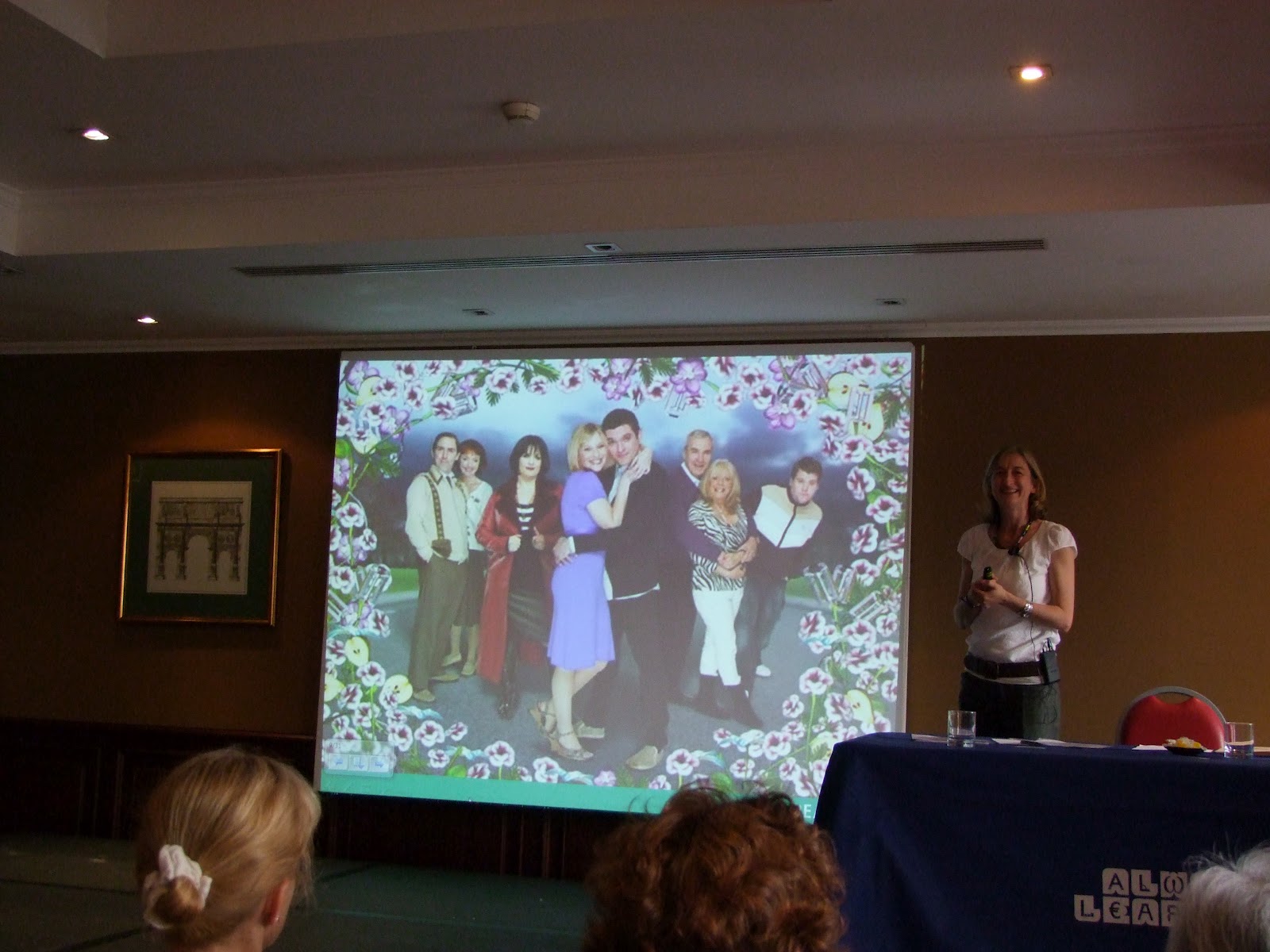
One of the most well-received sections of Antonia’s presentation was the video from the award-winning BBC TV series, “Gavin and Stacey” (where Gavin’s first day at work is unintentionally sabotaged by a succession of well-meaning calls and visits by relatives and friends). The Pearson-BBC tie-up is obviously a huge coup in terms of bringing this type of genuinely entertaining and engaging material into the classroom in such a way that Intellectual Property (IP) rights are respected. The crossover between mainstream media and language teaching is something that Pearson in particular has exploited by means of the media giant’s existing holdings, such as the Financial Times (which provides the content backbone in the widely-used Market Leader series), as well as its Economist-branded Intelligent Business textbooks for language learning.

Technology to empower but not replace the teacher (MyEnglishLabs)
Chris Morris
Chris Morris, a Pearson international teacher trainer on new digital initiatives showcased MyEnglishLabs with the theme of “Informed teaching and personalised learning”. Chris flagged up further the divide between “digital natives” and “digital immigrants” that was something of a leitmotif throughout this event. Despite the “brave new world” of digital technology and all the benefits it has to bring to the classroom some teachers are suspicious – if not downright terrified – of the impact it could have. Chris pointed out that technology will “empower not replace” the teacher: in fact, it can be liberating, by doing away with routine tasks such as endless marking and correcting of textbooks. In his presentation of MyEnglishLabs Chris showed how the platform can allow the teacher to assign online homework which students can complete at their own pace – and even on their mobile phone, if they download the app. Exercises can be selected for an individual student giving the teacher "fine-grained" control over their personal syllabus. MyEnglishLabs contains over twenty activity types, including various types of exercises (gap-fill, word search, etc), tests and comprehension practice linked to the course content. From the teacher’s perspective, perhaps the main benefit of this system is that it gives you an overview of all the material students have completed as well as their progress and scores. The teacher can “zero in” on those areas of a student’s language that require particular attention. This can also help in planning future courses by showing those areas where students in general are having difficulty (a point that also featured in the British Council section of "Digital Transformations" in the context of exams - technology is reducing the random element in ELT materials and activities, which can only be a good thing).

MyEnglishLab live and direct during Chris's presentation

MyEnglishLabs is an impressive platform that certainly reduces the drudgery of routine activities such as assigning and marking homework, testing and providing additional practice – and it’s always a joy to see someone demonstrate technology which they are genuinely enthusiastic and even passionate about. However, I personally have always been slightly underwhelmed by these systems when I have actually tried to base a complete course around them. MyEnglishLabs seems quite similar to English360 – the newly-independent course management system that features ELT material from Cambridge English (in particular). I suppose that both these systems and other similar products are of most use to large institutions where administration and the ability to monitor the performance of large numbers of students is critical (i.e. schools, colleges and universities). These “large customers” (who will inevitably produce the bulk of the revenues for providers of learning management systems, such as MyEnglishLab and others) work on a more industrial scale – and the automation at the heart of these management systems can produce not only savings in terms of teacher time, energy and even costs (especially as regards photocopying and printing), but also produce benefits for the students – not least by allowing a high level of individual customisation. With smaller schools, specialist training companies and freelancers, there is less need for this kind of “enterprise” technology.

The other key factor is that while these systems are often described as “intuitive” by developers and vendors, they can actually impose quite a large burden on the teacher who must add “system administrator” to their ever-lengthening list of roles. I haven’t really explored MyEnglishLabs in depth yet – but while the presentations were impressive, especially in terms of content – I would like to know more about the training and support that goes with the system. I often find that a “social” approach works best in these situations: an active online community is usually the best source of knowledge and support when you get stuck or are seeking inspiration.

Teachers can see progress through course material and grades at a glance on MyEnglishLabs

Going online: how the exam process is going digital (British Council)
Margaret Fowler talks about digital technology and the British Council
Margaret Fowler of the British Council spoke about the impact of computer technology on the exams that the BC administers and manages in Italy and worldwide. With many exams now available in either paper- or computer-based versions, students can choose which form to take. (Currently, only ESOL exams e.g., PET, BEC, FCE, CAE and KET are available in computer-based format. There is no computer-based version of IELTS yet.)

There are some slight differences. In the computer-based exam (and others), students use headphones for the listening section, for example. (Interestingly, while this can increase confidence when compared to listening to audio output from loudspeakers, it doesn’t actually affect grades.) The test takes less time as there is no need to transfer answers to another sheet for marking. Basic word-processing functions such as copy and paste and word count are also available for the writing section, although some candidates may find it uncomfortable to scroll through the reading passages.

Exam security has gone high-tech too. All candidates are photographed on the day of the test and the images are stored in a central database in the UK: these can be used to verify someone’s identity in the case of doubt about a "dodgy" certificate or someone's claim to be the awardee. Digital technology is also crucial to the development of exams run by the British Council: for example, the Cambridge Learner Corpus, a database of exam scripts (completed papers) that incorporates a treasure-trove of student errors, can be plundered to help exam writers understand which areas of the language students need to focus on. And any so-called “jagged profiles” or anomalies between language skills (e.g. an unusually low mark in a reading or listening paper for an otherwise strong candidate) will be immediately picked up by the analytical software used to crunch all the exam results.

The British Council’s exams service is increasingly in demand. There has been a 20% rise in the number of people taking CambridgeProficiency (CPE) - currently celebrating its 100th anniversary - this year. Margaret’s presentation included some striking images of the (truly) industrial process that underlies this success: warehouses stacked full of completed test papers and high-security printing, for example. With the increasing use of computer-based exams, however, these could eventually become a legacy of the “dead tree” age of information (and it would help the environment a bit, too).

The secret to a successful conference on digital technology: expert hosting 
Russell Lewis thanks Antonia Clare
The whole event was kept moving along at a brisk pace by the very capable Andy Barbiero and Russell Lewis of Pearson, who wove the various sections together with both wit and veuve. (I’d like to see more of these guys presenting Pearson’s materials: they’re obviously both great at winning professional audiences over with their enthusiasm, knowledge of the products and sensitivity to what classroom teachers need.) Both Pearson and the British Council had stalls well-stocked with books, brochures and leaflets covering a range of issues of interest to English teachers. Helpful and informative representatives from the two organisations were also on hand to field queries and provide details of new products and services. The event was a welcome opportunity for some useful networking in addition to the excellent presentations. (And, by the way, it was all free. Not bad!)

Andy Barbiero of Pearson in the hot seat during a simulation of a classroom activity 
So, following this brief introduction to how digital technology is transforming the English teaching world, it was back into the cauldron of the Milan heat (happily weighed down somewhat by a free copy of MyGrammarLab, which all the delegates received). But as I left the air-conditioned oasis of the Melià I certainly felt that I had gained a good insight into how Pearson and the British Council – among many other companies, organisations and individuals working in this field – are helping language teachers and students to benefit from the many advantages that technology can bring to our profession.

Pushing the right button(s): Longman Pearson's "MyGrammarLab" 


Sunday, 27 May 2012

Teaching English in Italy: Advice and FAQs from TJ Taylor


TJ Taylor, a language training and consultancy company based in Milan, have produced a very useful guide to Teaching English in Italy: Advice and FAQs for anyone considering becoming an EFL teacher in Italy – or, indeed, for teachers who are already working but would like to know exactly what their options are:

'Teaching English in Italy can be a tremendously rewarding experience, especially as Italian adults are generally very rewarding students. However, there are some practices and situations to be aware of that will help you avoid the most common traps and frustrations of being a ESL teacher in the 'bel paese'.'

The guide includes 'some FAQs that we hope will help make your time in Italy as professionally and personally rewarding as possible.’

You can find some really good advice here and even if you are an experienced teacher or you run a school / consultancy, I think you will benefit from reading TJ Taylor’s answers to these FAQs. They are especially good on the thorny question of Italian employment contracts and tax – seemingly impenetrable topics that can flummox even the most rational and intelligent person!

I would add one point to TJT’s FAQs: if you are considering teaching in Italy – or if you already teach and want to become a freelancer or develop your career – it’s absolutely imperative that you speak to a commercialista. For anyone who doesn’t know what / who this is, a commercialista is a kind of “super accountant” / tax lawyer / Gandalf figure who will help you navigate the perils of Italy’s fiscal system. (‘Bureaucracy in Italy is designed to make life difficult.’ – TJ Taylor.)

There is a spectrum of schools and different language companies with “excellent and 100% trustworthy” at one end and “don’t touch them with a barge-pole” at the other. The overall message is: find out as much as you can before you accept a job with a school / employer; ask around – most EFL teachers will be very happy to tell you whether or not a particular school is OK or if you should steer clear of it; and make sure that you have all the correct paperwork – especially a contract.

I would also add that in the age of social media, you should join as many groups and networks as you can (such as the Milan Business English Network) and contact people who are already teaching in Italy. I am always very happy to advise people who want to come and teach here – especially in Milan.

Well done, TJ Taylor – especially Alex Taylor – for providing such a useful resource for teachers!

Read the Advice and FAQs here.