Showing posts with label theatre. Show all posts

Sunday, 28 January 2024

Fritters, Blinis and Bristin: an Evening of Comedy - Review


J Productions, the brainchild of theatre impresario Julia Holden, returned to Milan’s Teatro Filodrammatici on Wednesday 24th January, serving up a highly unusual and memorably tasty comic concoction. Directed by Justin Butcher and featuring an excellent ensemble cast (Stephen Guy Daltry, Rupert Mason, Jennie Eggleton and Butcher himself) Fritters, Blinis and Bristin: an Evening of Comedy offered food for thought and laughs galore.

You’ve definitely heard of fritters. You've probably heard of blinis (even if you've never eaten one). But Bristin?? Unless you’re a hard-core fan of Dario Fo (winner of the 1997 Nobel Prize in Literature), I doubt that word will ring a bell. Fear not, however - all will be revealed soon.

So, hopefully you've worked up a healthy appetitie: let’s tuck in. 

The programme was in two parts beginning with the fritters and blinis (the latter being East European pancakes buttered and served with smoked salmon or caviar. Anton Chekhov couldn’t get enough of them when he visited Siberia – and even wrote a story about a blini to die for). Before the interval, we were treated to three Chekhov one-act plays, vaudeville farces in fact. Farce may not be something you associate with the angsty samovar-centred drawing-room-and-veranda-based tragedies of Russia’s best-known dramatist. But apparently he churned them out when he was getting started (although his English Wikipedia page barely mentions them). 

Russian blinis with red caviar, sour cream and dill. Image: Cooking the World

Accompanied by Stephen Guy Daltry on the accordion, the show kicked off with a selection of Russian songs, which were also interspersed throughout the fritter- and blini-based segment as palate cleansers of sorts. (The company’s Kalinka got the audience clapping in time to the music: a slightly odd sensation, given the ongoing war between Ukraine and Russia. It should be noted, however, that the J Productions presentation of Under Milk Wood starring Guy Masterson-Mastroianni, staged in the same theatre in 2022, was in aid of Ukrainian refugees. Justin Butcher himself is an outspoken champion of human rights.)

Audience at the Teatro Filodrammatici

The first course in this Russian section took the form of a monologue entitled The Evils of Tobacco. A twitchy, snuff-taking gentleman, the henpecked husband of a penny-pinching harridan who rules her academy for young ladies (and hubby) with a rod of iron, is supposed to be delivering a scientific lecture warning his audience of the dangers of the “noxious weed” but he is constantly sidetracked from his main aim, griping and sniping at the woman who has made his life a misery. Rupert Mason’s delivery was flawless: the taut, nervous husband gradually takes the audience deeper into his confidence, finally uttering howls of long-suppressed despair before finally realising he has gone too far and withdrawing back into the straitjacket of his quiet desperation. In fact, as with all three fritters and blinis on offer here, the laughter has a bitter aftertaste of the kind we associate with the best 1970s British sitcoms: Steptoe & Son, Rising Damp, etc. People trapped in situations that would be tragic if they weren’t funny. (Mr Blini, anyone?)

Rupert Mason as the ageing vaudevillian and Stephen Guy Daltry as the prompter in Swansong

Next up was Swansong. An ageing actor (Mason again) finds himself alone in the theatre after the audience has left and the lights have gone out. He is startled by what he takes for an apparition: a ghostly figure combining Scrooge in a long white nightshirt and cap holding a candle with at least one of the Christmas ghosts: it turns out to be the theatre's old prompter (played by Daltry) who reveals that he sleeps in the theatre at night. Initially wallowing in self-pity, the old vaudevillian eventually rouses himself and relives his on-stage triumphs, belting out his greatest hits, including Hamlet and King Lear with the prompter feeding him his lines. As the has-been harangues the storm in the heath scene from Lear, the prompter drums up some thunder on a tambourine. They make an odd couple that recalls Ronald Harwood’s The Dresser, memorably brought to life on screen by Albert Finney as Sir, gradually sinking into dementia with his very own Fool at his side, the eponymous dresser, Norman (played by Tom Courtenay). 

Jennie Eggleton, Stephen Guy Daltry & Justin Butcher in The Bear

The final dish of the first half was The Bear. A peremptory creditor (played with enormous energy by great-coated and booted Justin Butcher) blusters his way into the drawing room of an impoverished widow (Jennie Eggleton) who owes him money. Shoving aside the ineffectual butler (Daltry), the ursine landowner works himself up into a rage, demanding a huge sum of cash to pay the interest on his mortgage. Ignoring the increasingly desperate pleading of the widow, the Bear installs himself in the drawing room, calling for drinks and making himself at home. Eventually, the outraged lady of the house challenges him to a duel and has her late husband’s duelling pistols brought down to the drawing room. Standing back to back, Widow and Bear prepare to face off and settle it once and for all. (I won’t say what happens next, in case you catch the show at a later date – but it’s a neat comic sleight of hand by the author of the better-known tragedies The Seagull, Uncle Vanya and The Cherry Orchard.)

Justin Butcher & Jennie Eggleton in Chekhov's The Bear

More Russian tunes and even some dancing – and thus ends the first section of this highly original evening with the audience licking its fingers and dabbing them at the fritter and blini crumbs left on the plate / stage.

Stephen Guy Daltry, Ruper Mason, Justin Butcher & Jennie Eggleton in One was Nude...

All of which brings us to the main course and dessert combined: Dario Fo’s One was Nude & One wore Tails. It’s basically a shaggy dog story played out on stage. Starting with two Italian streetsweepers having a lopsided philosophical debate – taking in the meaning of life, the universe and everything, the conversation between the smarter of the two and his more synaptically-challenged mate leaves the latter flummoxed but somehow convinced that he is actually a manifestation of God. This wide-ranging banter probably works better in Italian or even in the salad of dialects that Fo lovingly assembled and dressed with wordplay, folk wisdom and all the other ingredients of his (re)creation of the language of the medieval giuillare (or wandering jester) and the fabulatore, the figure of the working-class storyteller that he came to revere and sought to model. While the evening’s fritters and blinis are decidedly Russian, “Bristin” is actually another culinary reference with a deeply personal significance for Dario Fo. It means “pepper seed” and was the nickname of his grandfather, a yarn-spinning itinerant merchant whom the young Dario accompanied on his rounds, sitting beside him on his wagon, soaking up the old man’s tall tales and learning his storytelling technique by osmosis.

Stephen Guy Daltry & Justin Butcher in Dario Fo's One was Nude...

The ‘Nude’ in One was Nude & One wore Tails refers to an ambassador (Daltry) who finds himself in a compromising situation following a swift exit from an amorous encounter. Still wearing his top hat – and nothing else – he takes refuge in the street sweeper’s bin. The one in 'Tails' is a man in a tux who cycles round town and goes into posh restaurants to sell flowers. There is also a lady of the night (Eggleton in shiny red mac and fishnets) who’s concerned about the Vice Squad. Authority comes in the form of the policeman (actually a Carabiniere played by Mason) who has a key role in re-establishing the bourgeois order that the anarchic action threatens to overturn.

Rupert Mason, Stephen Guy Daltry & Justin Butcher in One was Nude...

It is a truth universally acknowledged that a nude ambassador in a bin must be in want of black tie so he can go home without alerting the suspicions of his wife. However, the proletarians he encounters during his naked odyssey end up bearing the brunt and taking the punishment for his misdeeds. (Here endeth Fo's riotous socialist lesson, which was the sort of thing that got him arrested and hounded by the authorities for most of his career, right up to the point when he won the Nobel and became pretty much untouchable. It's difficult to find a comparable figure in the English-speaking world: Dario Fo's career is intertwined with the rollercoaster politics of Italy in the 20th century.)

Rupert Mason & Jennie Eggleton in One was Nude & One wore Tails

The plot of One was Nude is convoluted and – as you might guess – farcical. At one point, the copper chases the ambassador (his modesty protected by a shopping bag worn like lederhosen) to the strains of The Benny Hill Show theme. (A thumbs up here for the excellent sound production, which also included comic-style sound effects when the rozzer administers some “hands on” policing to the street sweeper (and / or the flower seller – it’s a bit hazy now, your Honour).

Stephen Guy Daltry & Justin Butcher in One was Nude & One wore Tails

Reprising his role as accompanist, Daltry takes up his squeeze box again and the audience is invited to sing along to a rousing chorus of Bella Ciao, the Italian partisan anthem better known to younger audiences as the song that The Professor teaches to his city-named accomplices in the Spanish Netflix series Casa de Papel (unimaginatively rendered as Money Heist in the English version).


Stephen Guy Daltry, 
Justin Butcher, Jennie Eggleton & Rupert Mason in One was Nude...

Following a number of well-deserved curtain calls, Butcher came out onto the stage (now in civvies) and thanked Julia Holden, the theatre and the audience for the opportunity to bring Dario Fo in English back to to the stage in the city that he is most closely associated with. For Justin Butcher, this is obviously something of a mission and he has acknowledged Fo as his greatest theatrical influence

Poster with members of the cast: (anti-clockwise) Jennie Eggleton,
Justin Butcher, Rupert Mason & Stephen Guy Daltry

Overall, this was a deliciously satisfying evening of outstanding theatre featuring bravura performances by a group of highly talented actors, great music, brilliant costumes (especially the streetsweepers’ bowler hats – although I might be biased), a beautiful venue and “a lorra lorra laffs” (as the late, great Cilla Black might have put it).

As always, I await the next J Productions presentation with baited breath!

Your humble scribe (left) with the Welsh Cultural Attaché to Milan, Mr W. McHoya

Robert Dennis
January 28th 2024
Milan


About the Author
Robert Dennis is a Business English teacher based in Milan. He has been teaching for over 30 years both in the UK and in Italy. A long-time collaborator with John Peter Sloan, Robert published “Business English” (Gribaudo) in 2020. The book was launched with “Il Sole 24 Ore” and sold in newsstands throughout Italy. Robert has a website for people who want to learn Business English: payasyoulearn.com. The site features keywords and phrases, audio and exercises to help professionals improve their language skills. A graduate in English from Oxford University, Robert is also a translator and regular contributor to EasyMilano.com, the online magazine for expats.


Wednesday, 6 April 2022

Under Milk Wood comes to Milan with a stunning performance to help Ukraine


Guy Masterson-Mastroianni in Dylan Thomas's Under Milk Wood, J Productions

Tonight was a rare opportunity: the chance to see the incredible Guy Masterson-Mastroianni performing all 69 roles of Dylan Thomas’s Under Milk Wood in a special charity performance for Ukraine at the Filodrammatici Theatre in Milan, thanks to Julia Holden and J Productions

Guy Masterson-Mastroianni was absolutely incredible, transforming himself physically and vocally into all the characters of the 20th century classic set in the fictional Welsh town of Llareggub (or "Bugger All" in reverse). With minimal staging – literally, just a chair – and a few props (sunglasses, pint glass), Guy brings the story to life, switching between the various personalities that inhabit Thomas’s dreamscape – from the blind Captain Cat, reliving his seafaring times, to the baker Dai Bread with his two wives, the Mrs Dai Breads, and from Organ Morgan, obsessed with the music of Johann Sebastian Bach to Polly Garter, pining for her dead lover. Masterson-Mastroianni’s performance veers from a portrayal of skipping and chanting children in the playground to surly, hawking fishermen on the quayside, and from the poetic Reverend Eli Jenkins’s sermons to Sinbad the lovestruck publican at The Sailors’ Arms, who yearns for schoolteacher Gossamer Beynon.

The lighting and audio were matched flawlessly, with the almost cinematic precision of sound effects and atmospheric music by Matt Clifford, combining to create a rich, lyrical texture complementing the performance (in English).

Guy Masterson, who is actually the great nephew of Sir Richard Burton, was inspired to become an actor by his great uncle’s rendition of Under Milk Wood, which was commissioned by the BBC in 1954 as a radio drama by Dylan Thomas and later adapted for the stage. Guy has performed the piece over 2,000 times and, as he told us after the show, it is actually a “symphony” which carries him along with its intricate rhythms. Running at 100 minutes, his performance is not only a dramatic tour-de-force but also an impressive feat of memory in its own right.

All proceeds from the show, which was supported by law firm Trevisan & Cuonzo, will go to helping Ukrainian refugees.

Robert Dennis
https://robertdennis.it/


Guy Masterson-Mastroianni, Julia Holden and the J Productions team

Guy Masterson-Mastroianni with Robert Dennis

Tuesday, 2 June 2015

An Empowering experience at the Piccolo: VIP event to launch the new integrated Cambridge English course


On Monday 25th May 2015, Cambridge English held a VIP presentation of their new Empower course. The event was a great opportunity to see the books and get some hands-on practice with the online materials and testing package, integrated with the publisher’s own learning management system. The afternoon also provided a nice networking opportunity and a chance to meet other English language professionals in the suitably dramatic setting of the Piccolo theatre (near Piazza Cordusio in central Milan. The theatre is a satellite of the larger Piccolo in the city's Lanza district). 

Cambridge English Empower is a new general adult course that combines content from Cambridge University Press with validated assessment from Cambridge English Language Assessment. As Chris Jory, Publishing Manager of ELT adult courses at CUP pointed out, this makes the course unique and marks a new chapter in the closer integration of course materials and testing from one of the main ELT publishers and testing organisations.


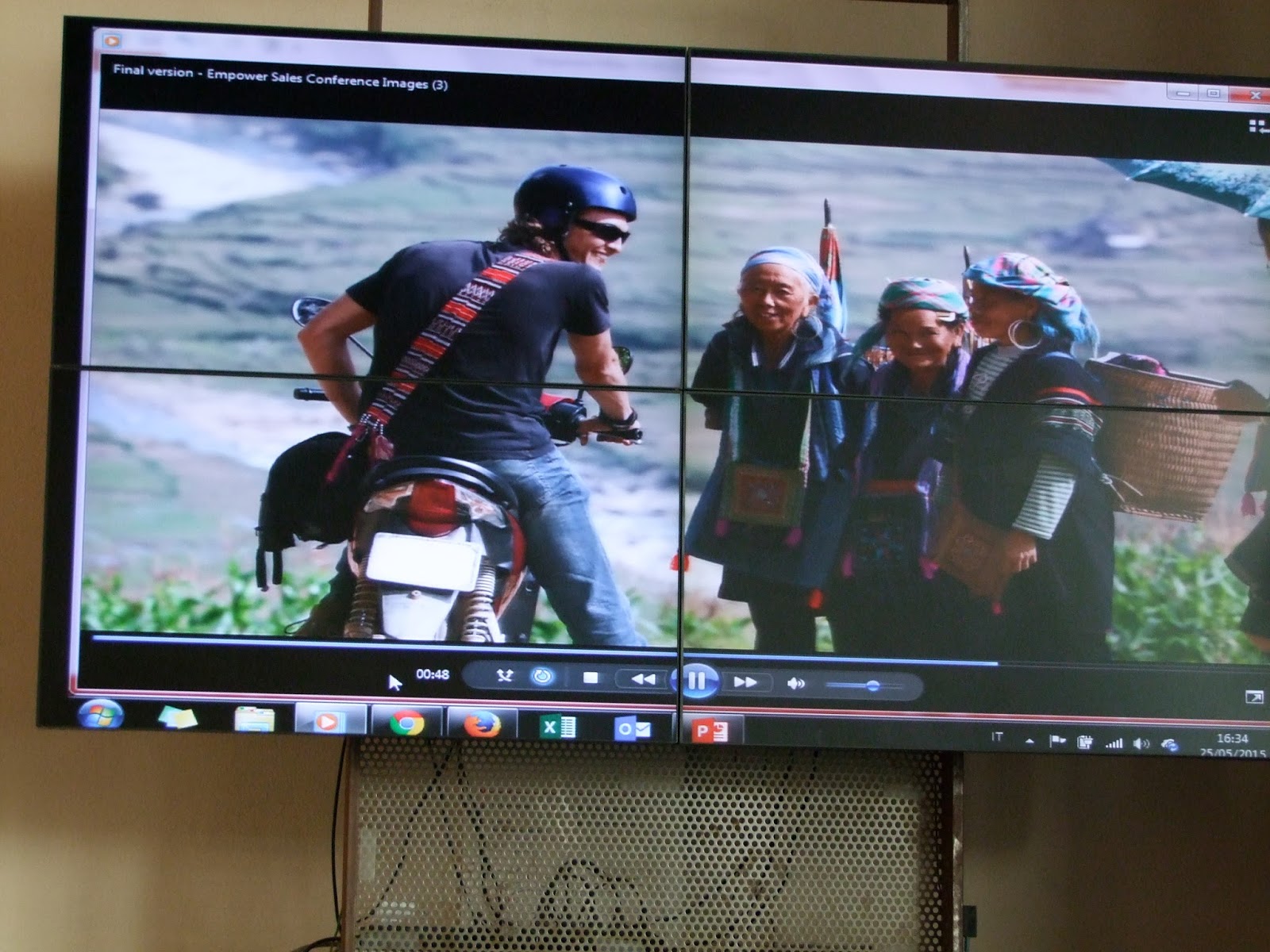
The first thing that you notice about Empower is the fresh and exciting graphic treatment Cambridge have lavished on the course. In particular, gone are the rather tired standard images used to accompany the text in traditional class-based course books. Instead, Cambridge have commissioned and gathered a wealth of really exciting and unusual visuals, including photos that have a strong narrative content and that can be used to stimulate class discussions. Chris’s presentation featured a montage of images including a backpacking biker’s tour of South America, a busker dressed as a chicken playing the double bass and a beach house perched precariously on a raised platform. All of these images immediately invite the wh- questions that trigger active discussions between students and in whole class discussions. (Who are these people? What are they doing – and why? etc.)

Indeed, the emphasis of Empower is very much on eliciting personal experiences and encouraging students to talk about their own lives and to discover the life stories of fellow students. As language teachers, we know that this is always the most enjoyable and rewarding aspect of classroom teaching – and the visually-rich materials of Empower will certainly help teachers and students to have these discussions.


The structure of the course is actually fairly conventional. Chris was at pains to point out that although the course features innovation in terms of its visual design, integration with technology and the testing package, in pedagogical terms it doesn’t try to reinvent the wheel. In fact, it allows time-poor teachers to teach “off the page” with minimal preparation and follows a tried and trusted communicative pedagogical approach.

The course also features naturalistic and engaging video content, which can be used in both in class and for students to watch in their own time on a range of devices.


Clare McCallum, Head of ELT Marketing Europe and UK Sales at Cambridge University Press, spoke about how Empower dovetails with Cambridge’s other academic activities: language assessment and testing. This is undoubtedly the main innovation of the series for teachers as well as teaching institutions: a course book from a heavyweight publisher that is designed to plug straight in the Common European Framework of Reference (CEFR). Cambridge has also drawn on its insights from English Profile, its collaboration with the Council of Europe, that provides  a ‘profile’ or set of Reference Level Descriptions for English. For example, each chapter of Empower features the “Can do” objectives for the appropriate level on the “Getting Started” page.


Since the blended learning approach is now becoming standard in all course books, teachers have come to expect online resources that are both effective and easy to use – and here as well, Cambridge has delivered with a suite of digital materials that allow a high degree of personalisation. Indeed, making everything as personal and relevant for the individual student is now the main challenge in a publishing industry that has recently been likened by Nick Robinson of ELT Jam to a supertanker changing  direction. The shift towards individualised learning and adaptive technology is clearly in evidence in Cambridge’s design of the assessment component of its course. Empower allows learners to take up to 25 different paths through its testing software and features a range of intelligent technologies, including voice recognition and software that can assess fluency based on a speaker’s propensity to hesitate, for example.


Technology and big data also feature in Empower’s use of the Cambridge English Corpus, a multi-billion word collection of written, spoken and learner texts drawn from a huge range of sources: newspapers, the web, books, magazines, radio, exams, schools, universities, the workplace and everyday conversation. The CLC also includes the Cambridge Learner Corpus - a unique 50 million word collection of exam scripts written by students taking Cambridge exams all over the world.


Marcus Tubby, an ELT Consultant at Cambridge University Press based in Italy, demonstrated the assessment package in action and walked participants at the event through the Cambridge Learning Management System. Using PCs provided by Cambridge, we were given the chance to try out the live demo of the course and the platform, which includes a range of useful tools such as individual and class enrolment, as well as a Grade Book with exhaustive analyses of student and group performance. While some teachers might find all the number crunching and endless graphics of pie-charts a bit bewildering, obviously, this is the way the industry / professions is moving – and for schools, especially those providing training to corporate clients, having this kind of instant feedback on individual students is a huge boon.


Along with the other major ELT publishers, Cambridge has been at pains to make their course and the integrated technology as user-friendly as possible. However, at the digital chalk face most teachers will need increasing support as well as training to really capitalise on the benefits of this innovation.


The event concluded with a delicious buffet and a chance to chat and mingle with the VIP participants and the speakers. Russell Lewis, Marketing Manager at CUP, Italy was also on hand with members of his team to answer questions and demonstrate the live version of Empower. The particpants received an information pack which, in addition to sample chapters from the course, included a "fold-out" USB key containing a link to the Cambridge Empower site.

Robert Dennis
Director, Riverstone Language & Communications

You can see all the photos from this event in a special album I have created on Flickr. (Please note that if you would like to use these images, you can contact me and I will be happy to share them with you - but some "link love" or an attribution is always appreciated!)


Tuesday, 10 November 2009

London South Central: Bermondsey Street and the South Bank

This is an article I wrote a few years ago for World Language Consultants Ltd, a language school in Bermondsey Street in South London. Some of the facts have changed (e.g. the Eurostar train terminal that connects Britain to the Continent is now at St Pancras), but most of the places referred to are the same. If you plan to visit the capital it might be a good idea to check some of the tourist websites (such as visitlondon.com) that contain current information on visiting times and prices, etc.

Exploring London South Central
Whether you live in London or are just visiting, you'll find there's plenty to see and do in London South Central. Explore the area's rich history and culture, hunt for bargains in its arcades and markets, and chill out at some of the trendiest cafés and bars in the capital.

London South What ?
London South Central is the new name for one of London's oldest districts. It includes Vauxhall, Waterloo, London Bridge, Bankside and Elephant & Castle. Traditionally, the area has always been seen as charming but dodgy. (In Shakespeare's day the South Bank was as famous for its brothels as its theatres). And in more recent times, taxi drivers have refused to go "south of the river" at night.

But all that is about to change. South London has been smartening up its act, and is attracting a new generation of artisans and professionals who have transformed some of its most run-down areas into thriving local economies. While the attractions of the South Bank are a must for visitors to the capital, there's also plenty to discover in some of the smaller streets tucked away behind the waterfront.

How to get there
The Eurostar terminal at Waterloo [now at St Pancras - and featuring the longest champagne bar in Europe] has brought the area within easy reach of the Continent, and there is also a good rail service to London Bridge and Waterloo stations if just you're coming in to town for the day. If you're already in London, hop on the tube (Jubilee and Northern Line trains stop at London Bridge, while Waterloo connects with the Jubilee, Northern and Bakerloo Line as well.) There are also plenty of buses, and there's even a river bus service, if you really want to arrive in style.

What to see
Go for a spin on the London Eye for a breathtaking bird's-eye view of the capital, and marvel at Sir Norman Foster's London Assembly building near Tower Bridge. Check out Tate Modern art gallery (formerly Bankside power station), Shakespeare's Globe and the Millennium Bridge. Relax in the precincts of Southwark Cathedral, then stroll down to Hay's Galleria and Gabriel's Wharf where you can shop and take in the view from one of the many waterside cafés or bars.

Step back in time
The Thames has always been London's gateway to the wider world, and you don't need to look far to discover Britain's maritime history. Visit Sir Francis Drake's reconstructed ship, The Golden Hinde, at St Mary Overie Dock, or explore HMS Belfast, which played a leading part in the Normandy Landings.

Shakespeare's Globe, a faithful reconstruction of the original theatre, stages open-air plays (take an umbrella just in case) and has a fascinating permanent exhibition about the building in Elizabethan times. To see the darker side of London's history, descend into the South Bank's medieval Clink prison (which is where the expression comes from). And if that's not grisly enough, the London Dungeons in Tooley Street will bring you face to face with the Black Death and Jack the Ripper. (Stick close to the guide, and don't wander off on your own, if you want to make it to the gift shop!)

Make a scene
Playing host to both the Royal National Theatre and the Globe, the South Bank is rightly regarded as the home of drama in London, with the West End having long ago given up any claims to that title. Plays are staged throughout the summer in The Scoop, a modern amphitheatre next to the London Assembly. Head for the Old Vic, where you can currently catch Kevin Spacey's production of Cloaca (until 11 December).

Make it new
If you're looking for Old Masters, you won't find them on the South Bank. (Try the National Gallery, or catch the regular boat service that takes gallery-goers from Tate Modern to Tate Britain). Tate Modern hosts installations and exhibits outsize sculpture in the massive Turbine Hall. It also has cafés, a superb restaurant and a well-stocked bookshop. Further down the South Bank, you'll find the Saatchi Gallery, which boasts Damien Hirst's shark and Tracey Emin's infamous unmade bed. The Hayward Gallery, behind the Royal National Theatre, has a fascinating exhibition, Eyes, Lies & Illusions (until 3 January 2005) which features optical illusions, magic lanterns and all sorts of visual trickery. And if that's not enough, why not pop into the Salvador Dali exhibition in County Hall. Or just enjoy the surrealist statues outside, including Space Elephant (an elephant with spider legs carrying an obelisk on its back.)

Handbags and Glad-rags
While most of London South Central's tourist hot-spots are along the river, there are also some great places to discover away from the South Bank. But Bermondsey Street must surely be the hottest spot of all. Once a desolate wasteland of derelict factories and disused warehouses, it's now home to design studios (including Kurt Geiger), loft apartments and some great restaurants.

Dominating Bermondsey Street is Zandra Rhodes's Fashion and Textile Museum. This striking building, a former warehouse painted bright orange, is also the home of the shocking-pink-haired designer, who lives in the penthouse (complete with palm trees).

Bermondsey Street's latest addition is World Language Consultants Ltd, one of London's longest-established business language schools, which specialises in teaching English and foreign languages to professionals. WLC is located directly opposite the Fashion and Textile Museum, adding a complementary splash of colour to the other side of the street with its distinctive blue door.

Food for thought
London South Central has more than its fair share of great restaurants and cafés.Bermondsey street boasts several superior eateries, including the Delfina Studio Café, the Bermondsey Kitchen and The Garrison, a gastropub with its own cinema in the basement. Other places to check out are Terence Conran's Blue Print restaurant and the Oxo Tower, which has stunning panoramic views. Vinopolis, the museum and temple to the god of wine rolled into one, has an excellent restaurant (with, needless to say, an outstanding wine-list). And fans of Bridget Jones will recognise Borough Market, even if they have yet to sample the unbelievably fresh produce from its specialist gourmet stalls, selling everything from game to white truffle oil.

What makes London South Central exciting and distinctive is its mix of the historical with the ultra-modern: you can find them side by side in its architecture its culture, and its diverse communities of long-established residents and those who have discovered more recently the charms of this unique area.

© Robert Dennis 2004